What to do with those holiday plants?
Someone gave you a plant for the holidays -- now what?
Many plants have become associated with the holiday season, brightening our homes during these gloomy December days. If you think of most of these plants as nice, long-lasting flower arrangements that you will discard after they finish blooming, you won't be disappointed. Some, however, can be grown on for years with special care, and others can simply be planted in the garden. Parents of young children and pet-owners should be aware that some are poisonous.
The Poinsettia (Euphorbia pulcherrima) is remarkable in that in just 75 years it has become THE Christmas plant.
This roadside weed from Mexico has been bred (largely by the Ecke family in Southern California) to the point that nearly 100 million of them are sold worldwide every Christmas. This in spite of the fact that more than 60% of the public incorrectly believes them to be poisonous! The showy part of the plant is a bract, which is a leaf, and the flowers are the small yellow parts in the middle.
Care during the holidays:
Make your house like Mexico! The Ecke Ranch website (http://www.ecke.com) states "if you are comfortable, so is your poinsettia." Poinsettias definitely don't like to be below 50F, and don't like drafts or cold winds. The brightest room in your house is best. Water just when they go dry, and tepid or warm water is better than cold tap water.
After the holidays:
Poinsettias will begin to drop leaves in February, and then will go dormant. You can reduce watering at that time, and as soon as frost is unlikely (late February) you can move the pot outdoors. Cut them back 50%, repot into a larger pot, and start watering. Start feeding with Miracle-Gro or a similar fertilizer as new growth begins.
Getting them to bloom again is tricky. From late September Poinsettias need 14 hours of complete darkness (not even exposure to a simple incandescent light bulb!) for several weeks to trigger blooming. ANY disruption of that photoperiod requirement will prevent blooming!
Kind of a hassle. -- What did you pay for this plant?
Just buy a new one next year!
Poisonous?
NO!
Not at all!
Don't get me going.
Poinsettias are NOT POISONOUS!
No part of the plant is poisonous! Nursery people have even eaten leaves on TV to prove it!
No amount of leaves stuffed into lab animals was able to cause a toxic reaction, nor was any amount of application of the sap.
They're NOT POISONOUS!
From snopes.com:
"Thom David, marketing manager of the Paul Ecke Ranch in Encinitas, California, has a way of convincing people ... . He's been known to grab a few bracts off the nearest poinsettia plant and eat them in front of persistent disbelievers. Seems to work, too - they don't doubt him after that.
Speaking from "bitter" experience, he says it's unlikely a kid or an animal will eat more than one bite. He describes the taste as far worse than the most bitter radicchio. Frankly, he says, the flavor is indescribably awful."
Holly (Ilex species, especially Ilex aquifolium 'Variegata') is enjoyed for the long-lasting, clean shiny foliage which is great in wreaths and arrangements, and the bright red berries.
Holly is an excellent garden plant that prefers protection from the hottest sun. Male and female plants of English holly are needed to get berries (and nurseries don't sell them by sex!), but some varieties of other species set berries reliably without cross-pollination. Often described as preferring acid soils, I find that hollies do well here without special attention if the soil is amended when they are planted and if they aren't drought-stressed. Avoid the hottest afternoon sun.
Poisonous?
The berries are described as causing "minor toxicity" in the Regional Poison Control Center guide, and the botanical name of our native holly, Ilex vomitoria, gives an indication of the symptoms.
Ivy (Hedera helix) is being used more and more for winter greenery and as filler in winter arrangements.
The smaller-leaved varieties such as 'Needlepoint' or 'Hahn's' are preferred. Ivy can be grown into rings, wreaths, "poodles," cones, or other shapes. Ivy makes a great indoor plant if it is washed off periodically to prevent spider mites, and can be kept outside in morning sun or the shade of a tree. It is completely hardy in our climate, so it can live outside year-round. Ivies can become invasive if planted in the garden, so keep them in pots.
Poisonous?
Yes -- leaves and berries cause major toxicity, and the symptoms are very unpleasant.
Amaryllis bulbs (Hippeastrum hybrids) are among the easiest plants to grow and bloom during the holidays, and have stupendous large flowers in shades of red, pink, and white.
Amaryllis naturally bloom in the early summer. These bulbs are produced in Holland and South Africa. Those from Holland have been forced into dormancy and will bloom 2 – 3 months after planting. Those from South Africa think they are in the summer, being from the Southern hemisphere, and will bloom right away.
Give Amaryllis water every few days until the bloom is done. Cut off the spent bloom spikes and allow the foliage to grow indoors until frost danger is past. I've had my best results simply planting these in the ground in partial shade or full morning sun, in average soil. They will bloom in future years in the early summer. Watch for snails! It is possible to get them to bloom for future Christmases by forcing them into dormancy in the late summer (withhold water), but it doesn't always work.
Poisonous?
One reference: "The principal irritant is present in small amounts so large quantities of the bulb must be eaten to cause symptoms (diarrhea, nausea, vomiting)."
Pure white Paperwhite narcissus (Narcissus spp.) and their related varieties ('Soleil d'Or' is gold; 'Chinese Sacred Lily' is white with a light yellow center) are also very easy to bloom indoors for the holidays.
The fragrance is powerfully sweet!
This bulb multiplies very freely outdoors in the ground here. Keep watering the pot they are in, or the bowl, or whatever, until they finish blooming. The brighter the situation, the less floppy the leaves will be. After the holidays, stick them in the ground. They'll multiply freely in sun or light shade, and will increase for years. I'm still enjoying flowers from bulbs that old-time Davis resident and botanical illustrator Dr. Addicott brought me 20 years ago.
Poisonous?
The bulbs can cause "major toxicity."
Kalanchoe blossfeldiana is an unpronounceable recent addition to the holidays (try Kall-ann-koe-uh).
Growers have developed varieties of this succulent with blooms in neon colors -- shades of orange, pink, cerise, and red -- which hold for many weeks. Too tender to be outside in the winter here, they can live in a pot with little care for months or years and need very little water. They won't bloom again as densely or compactly as the original plant did, but can put out sprigs of bright blossoms in the spring and summer. Keep these in the brightest part of your house while they are in bloom, and water only when dry. Transplant into a larger pot after it finishes blooming, and put in out in morning sun or the shade of a high tree after frost.
Poisonous?
No!
Azaleas (Rhododendron species) sold during the holidays are new varieties with a prolific, long bloom.
A little tender in our climate, so they might be damaged in freezing weather (unlike their hardier garden cousins). Typically they are grown in soil with a high amount of peat moss, which makes it tricky to water them correctly, and they are usually incredibly root-bound. If water just puddles on the surface, or runs down the side of the pot, the peat moss has dehydrated and the pot needs to be set in a bowl of water to rehydrate.
If you're going to plant these in the garden, amend the soil heavily with a soil mix that's special for acid-loving plants., and plan on fertilizing regularly with an "acid-type" fertilizer. Tear the roots apart as you plant them to reduce the root-bound condition. Water very carefully as we get into hot weather, making sure to water the root ball thoroughly about twice each week.
Poisonous?
"Major toxicity," and the foliage may cause dermatitis (skin rash).
Mistletoe is an oddity.
This semi-parasitic plant grows entirely on other plants but also photosynthesizes to create food for itself. The mistletoe of Christmas is probably in the genus Phoradendron, as are several of our native mistletoes. A quick review of Munz' definitive California Flora describes it as a "large genus of the Americas," with the species Phoradendron tomentosum ssp macrophyllum on sycamores, poplars, willows, ash trees, walnuts, and persimmons [and birches] in the Sacramento valley and other areas." This is the one on older trees all over Central and East Davis, and certainly not the species the druids prized on their oak trees. Birds enjoy the berries and then spread them from tree to tree in their droppings.
Poisonous?
My reference books were ambiguous, so an operator at the Poison Control Center (1-800-342-9293) commented that ingestion of a couple berries or leaves would lead to severe vomiting and diarrhea. She also referred us to an excellent web site -- http://www.calpoison.org -- for more information about poisonous plants.
Enjoy your holiday plants -- carefully!
Published in the Davis Enterprise, 28 December 2000
Thursday, December 10, 2009

Saturday, December 5, 2009
Freeze alert for the Sacramento Valley
Freeze Alert!
December 5, 2009
Temperatures Monday night and Tuesday morning are likely to drop into the mid-20's! Expect frost damage on subtropical plants. And watch the weather: lows in the upper teens and low 20's can cause serious damage to citrus trees and other subtropicals.
National Weather Service link for Sacramento.
Plant protection tips--
Cover plants: lightweight spun plastic fabrics usually sold as "floating row covers," or frost blankets can simply be draped over the plant, as they are light enough that there won't be damage from contacting the foliage. If you use any material that isn't clear, you need to remove it during daylight hours. Plants can't live without light! Wrapping the trunk with burlap can help prevent major damage in a severe freeze; probably not necessary this time.
Move plants: pull potted plants up against a south or east wall, under an overhang. Reflected or retained heat from warm walls or cement walks will provide additional protection. Protect from cold wind. Fences or walls will prevent additional stress from cold winter winds. If practical, pull the container into your garage for the next few days.
Water: make sure all plants, especially those in containers, are well watered. If dry soil freezes, it will pull moisture from the roots, causing them damage. If the soil is moist it can freeze without harming plant roots.
Spray with an antitranspirant? Though research results are mixed, products such as Cloud Cover or Wilt-Pruf applied just prior to cold weather may give the foliage 3 - 4 degrees protection against the cold as well as desiccating winds.
Provide a heat source: Christmas lights hung in citrus trees have proved very successful, even with temperatures in the teens. Landscape lighting and portable shop lights will work as well. Make sure the light source is plugged into a grounded extension cord approved for outdoor use.
Harvest fruit? Your call. This is a short-duration freeze, unlikely to do significant damage to the fruit of most varieties. Thin-skinned varieties of citrus could be damaged, especially those on the outer part of the tree (unprotected by foliage).
You may wish to harvest lemons (especially Meyer), and limes, as they are ripe now and will deteriorate quickly if damaged. Freeze the juice for later use. Mandarins that are outside the foliage might be damaged. Thicker-skinned types such as navel oranges will probably be adequately protected by covering the trees, but they are also ripe and could be harvested. Avoid harvesting Valencia oranges, grapefruits, and tangelos, as they don't ripen until later in the spring. Citrus fruit does not ripen further off the tree.
Cold as it is, this will not likely break the record for temperatures set in 1990, when we had 13 consecutive mornings below freezing, with low temperatures on Dec. 22 and 23 of 18 and 17 degrees. The freeze of January 2007 equaled the number of days, but not the absolute low temperatures, of the 1990 freeze.
Here are the temperature data for the 1990 and 1998 freezes.
For more articles about frost and freeze: The 2007 freeze
general frost protection guidelines,
Frost vs. Freeze,
and Winter Care of Citrus.
Some plants that may be severely damaged or killed:
Australian tree ferns
Begonias
Bougainvillea (older plants likely to recover)
Hibiscus (tropical)
Mandevilla (evergreen types)
Serious damage, but likely to resprout:
Avocadoes
Brugmansia (Angel's trumpet)
Bananas (mostly killed to the stem)
Citrus trees (limes and young trees are most vulnerable)
Hardenbergia (Lilac vine—expect damage to the flower buds; maybe no lovely purple flowers this winter!)
Jasmine (true jasmine; Star jasmine is fine).
Lantana
Palms -- some, particularly Queen palm (outer fronds will dry up and look dead, but the growing point is protected inside the center of the tree).
Pandorea (Bower vine, considerable top damage)
Passifloras (cut 'em to the ground in late spring; they'll be back)
Potato vines (the purple ones look worse than white, but mine recovered in 1990)
Red trumpet vines (severely damaged, unlikely to flower this summer)
Any decision about replacing plants should wait until we've had several weeks of warm weather. Subtropicals can be surprisingly resilient, and may resprout as late as May. So don't be in a rush to pull them out.
December 5, 2009
Temperatures Monday night and Tuesday morning are likely to drop into the mid-20's! Expect frost damage on subtropical plants. And watch the weather: lows in the upper teens and low 20's can cause serious damage to citrus trees and other subtropicals.
National Weather Service link for Sacramento.
Plant protection tips--
Cover plants: lightweight spun plastic fabrics usually sold as "floating row covers," or frost blankets can simply be draped over the plant, as they are light enough that there won't be damage from contacting the foliage. If you use any material that isn't clear, you need to remove it during daylight hours. Plants can't live without light! Wrapping the trunk with burlap can help prevent major damage in a severe freeze; probably not necessary this time.
Move plants: pull potted plants up against a south or east wall, under an overhang. Reflected or retained heat from warm walls or cement walks will provide additional protection. Protect from cold wind. Fences or walls will prevent additional stress from cold winter winds. If practical, pull the container into your garage for the next few days.
Water: make sure all plants, especially those in containers, are well watered. If dry soil freezes, it will pull moisture from the roots, causing them damage. If the soil is moist it can freeze without harming plant roots.
Spray with an antitranspirant? Though research results are mixed, products such as Cloud Cover or Wilt-Pruf applied just prior to cold weather may give the foliage 3 - 4 degrees protection against the cold as well as desiccating winds.
Provide a heat source: Christmas lights hung in citrus trees have proved very successful, even with temperatures in the teens. Landscape lighting and portable shop lights will work as well. Make sure the light source is plugged into a grounded extension cord approved for outdoor use.
Harvest fruit? Your call. This is a short-duration freeze, unlikely to do significant damage to the fruit of most varieties. Thin-skinned varieties of citrus could be damaged, especially those on the outer part of the tree (unprotected by foliage).
You may wish to harvest lemons (especially Meyer), and limes, as they are ripe now and will deteriorate quickly if damaged. Freeze the juice for later use. Mandarins that are outside the foliage might be damaged. Thicker-skinned types such as navel oranges will probably be adequately protected by covering the trees, but they are also ripe and could be harvested. Avoid harvesting Valencia oranges, grapefruits, and tangelos, as they don't ripen until later in the spring. Citrus fruit does not ripen further off the tree.
Cold as it is, this will not likely break the record for temperatures set in 1990, when we had 13 consecutive mornings below freezing, with low temperatures on Dec. 22 and 23 of 18 and 17 degrees. The freeze of January 2007 equaled the number of days, but not the absolute low temperatures, of the 1990 freeze.
Here are the temperature data for the 1990 and 1998 freezes.
For more articles about frost and freeze: The 2007 freeze
general frost protection guidelines,
Frost vs. Freeze,
and Winter Care of Citrus.
Some plants that may be severely damaged or killed:
Australian tree ferns
Begonias
Bougainvillea (older plants likely to recover)
Hibiscus (tropical)
Mandevilla (evergreen types)
Serious damage, but likely to resprout:
Avocadoes
Brugmansia (Angel's trumpet)
Bananas (mostly killed to the stem)
Citrus trees (limes and young trees are most vulnerable)
Hardenbergia (Lilac vine—expect damage to the flower buds; maybe no lovely purple flowers this winter!)
Jasmine (true jasmine; Star jasmine is fine).
Lantana
Palms -- some, particularly Queen palm (outer fronds will dry up and look dead, but the growing point is protected inside the center of the tree).
Pandorea (Bower vine, considerable top damage)
Passifloras (cut 'em to the ground in late spring; they'll be back)
Potato vines (the purple ones look worse than white, but mine recovered in 1990)
Red trumpet vines (severely damaged, unlikely to flower this summer)
Any decision about replacing plants should wait until we've had several weeks of warm weather. Subtropicals can be surprisingly resilient, and may resprout as late as May. So don't be in a rush to pull them out.
Friday, December 4, 2009
Those UC Davis Arboretum All-Stars!
About the Arboretum All-Stars
If you're looking for ideas in the "off" gardening seasons - the heat of summer or the waning days of fall - a walk in the arboretum can be helpful. On a sparkling November day I parked near Mrak Hall and wandered east toward the redwood grove, making note of what had seasonal color or interest. Before you even enter the arboretum you can see a plant unique to Davis. Toyon (Heteromeles arbutifolia) is a native shrub whose abundant berries are turning bright red now.Their winter color leads to a second common name: California Christmasberry. A number of years ago a yellow-fruited variant occurred, and a nice specimen is growing just at the corner of Old Davis Road where you turn in towards Mrak Hall. This variety is now called 'Davis Gold'. While you might think a yellow berry would be less interesting than the seasonal red of the traditional species, I noted that the lighter-colored fruit stands out better against the dark green foliage.
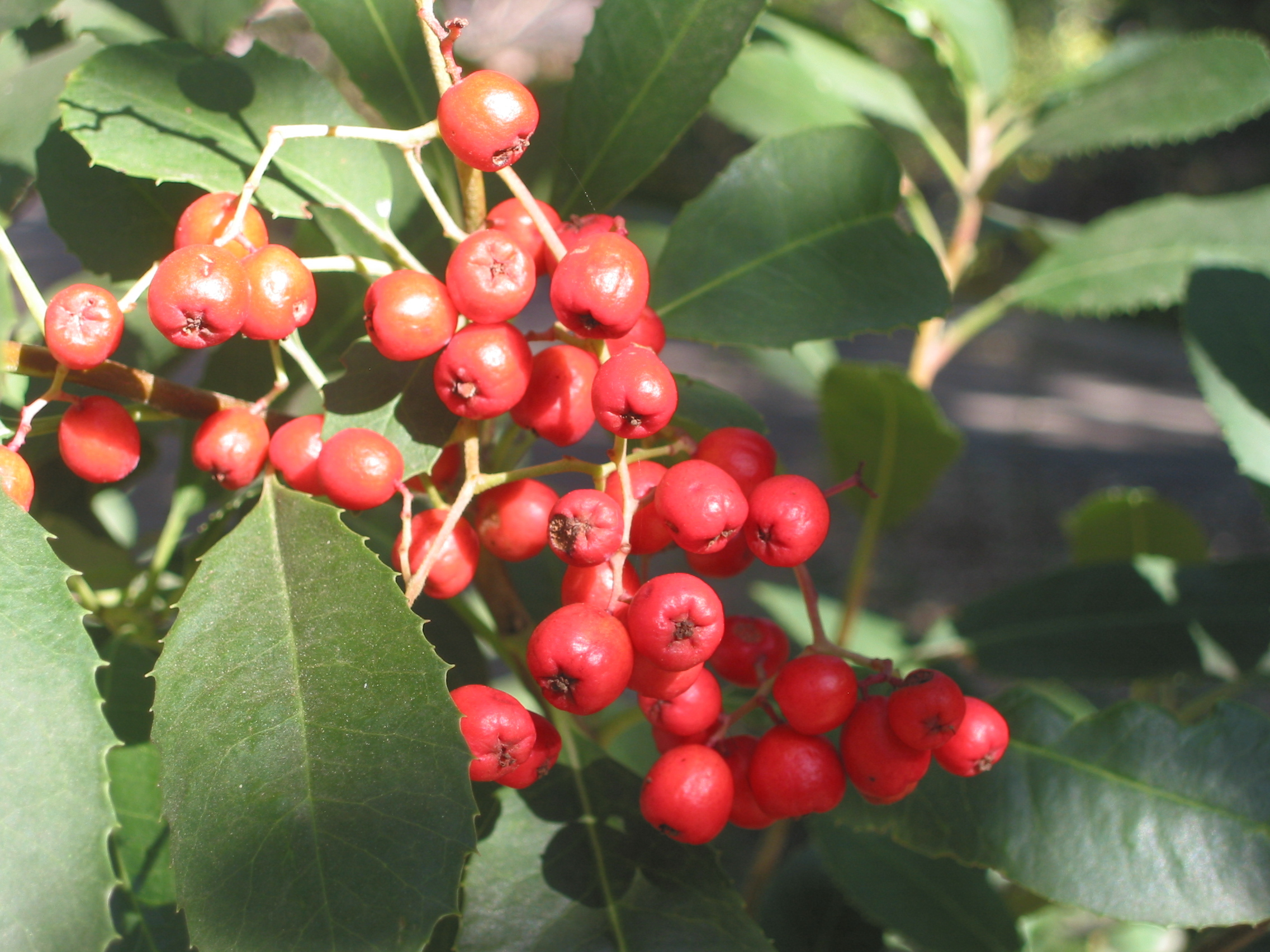
Toyon (Heteromeles arbutifolia) is sometimes called California Christmasberry
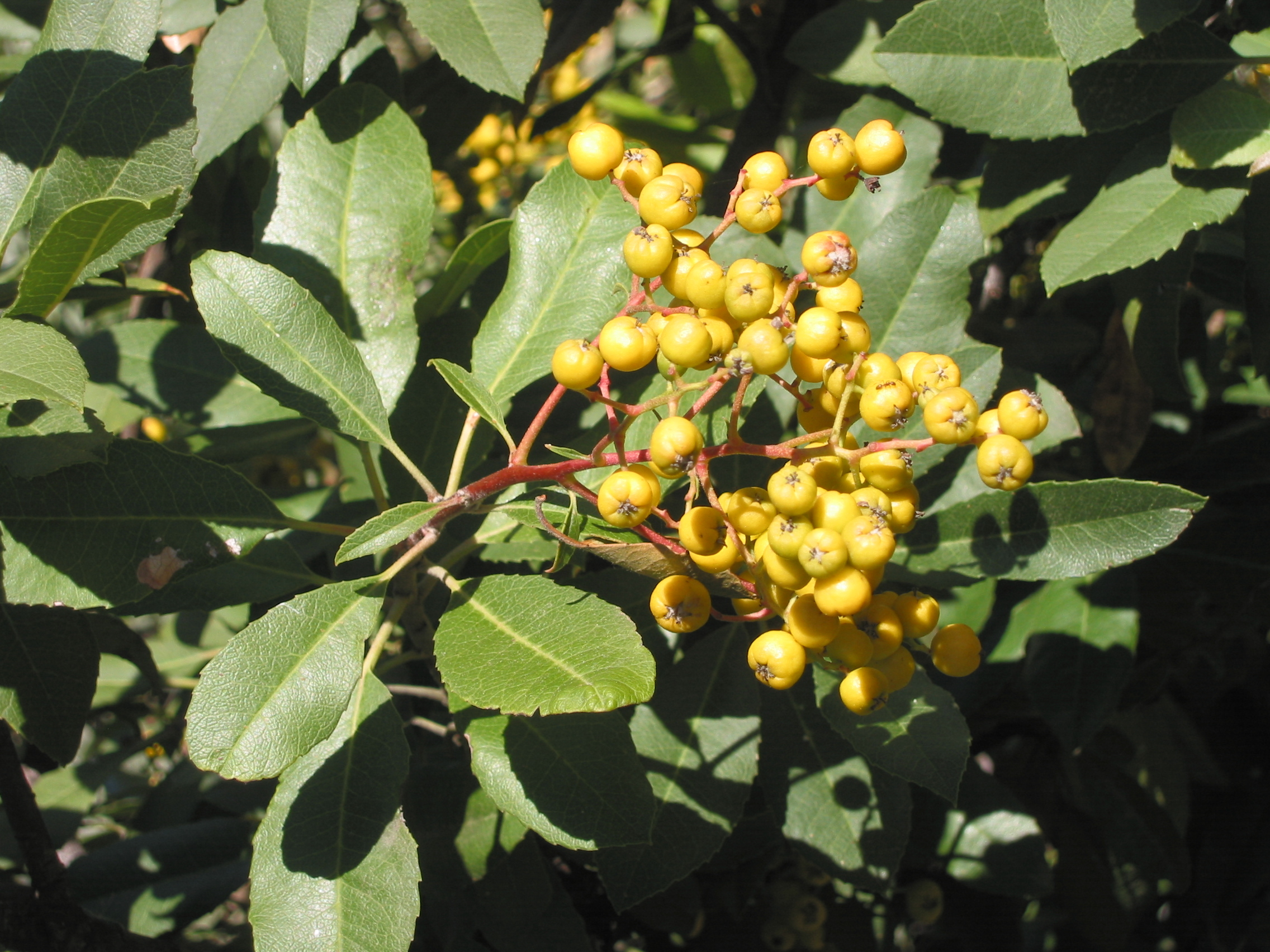
This popular native shrub grows slowly to 10' or more, with flowers that attract beneficial insects and winter berries that attract songbirds. The species, shown at top, typically has red berries, but this golden-fruited variety called 'Davis Gold' originated right here at the UC Davis Arboretum. Check their sales for availability, as it is uncommon in the trade.
A flash of color around on the west side of Putah Creek drew my eye. Rosa chinensis 'Mutabilis' is a very robust old China rose that has a unique quality: the blossoms open light apricot-yellow, then (contrary to most flowers) darken as they age through pink to red (hence the name "mutabilis"). The blossoms are a single row of papery petals, usually twisted and splayed. With upright petals in all colors, all on the plant at the same time, it has sometimes been called the Butterfly rose because it looks as though dozens of butterflies have alighted on the bush.
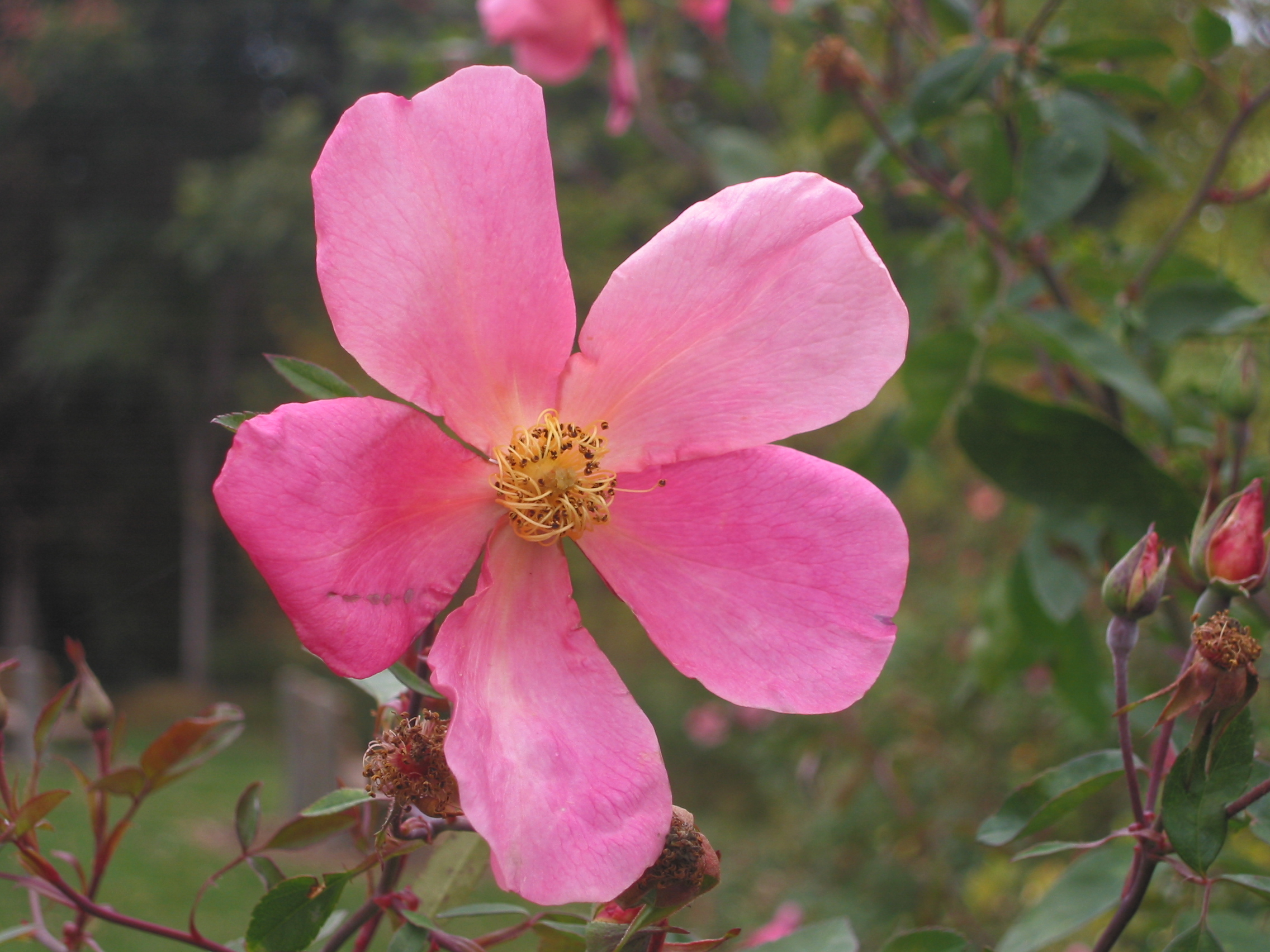
The Butterfly rose is usually listed in references as Rosa chinensis 'Mutabilis', but the Arboretum All-Star list now has it under the name R. x odorata 'Mutabilis'. The delicate-looking flowers consist of a single row of petals which open yellow, then darken through pink to red. Dozens of blooms are open on the plant at a time, from April through November.
This is a large shrub! It can reach a height of 7 - 8' tall with equal spread.
(I notice that Rosa x odorata 'Mutabilis' is the currently accepted name of the Butterfly rose used on the All-Star list, but nearly every other reference is likely to have it by the older name I used above. Someday I will write a column about why taxonomists change plant names.)
A few years ago the staff at the arboretum began compiling a list of plants that do well in the Sacramento Valley. The stated basis for selection as an All-Star: "100 tough, reliable plants that have been tested in the Arboretum, are easy to grow, don't need a lot of water, have few problems with pests or diseases, and have outstanding qualities in the garden. Many of them are California native plants and support native birds and insects. ... The vast majority of All-Star plants can also be successfully planted and grown throughout California."
I love this list, but frankly it is beginning to drive retailers and landscapers a little crazy. Not because of the list itself or the plants on it, but because of public misconceptions about it. It is not intended as a definitive list for the region, and availability can be a problem.
If I were making any criticisms, it would be that some of the plants are easy to kill: winter daphne, and natives such as ceanothus, manzanita, and western redbud are all notoriously easy to over-water. Some plants tolerate drought while others require it; many California natives are vulnerable to crown rot fungus caused by summer watering. The list is light on trees, and those selected are mostly unavailable in the nursery trade (perhaps their inclusion here will interest some wholesale growers in propagating them). But those are minor concerns, and I have been told that another 50 or so recommendations are on their way.
What it is:
An excellent list of many plants that do well in our area.A great starting point as you select plants for your landscape design. With two ferns, seven grasses, 35 perennials, 42 shrubs, 8 trees, 6 vines, you can find ideas for a new landscape or a renovation project. One-third of them are California natives. Many are unusual, perhaps helping you think outside of the traditional options.
What it is not:
Read more
Wednesday, November 25, 2009
The Edible Plants of Thanksgiving!
My New England grandmother put on a classic Norman Rockwell Thanksgiving dinner each year. Many of you could probably recite the menu, and it never varied. Oh, at one point she added mashed turnips to the fare, because my father's mother had told her that my father loved them. This was patently untrue, and neither did anyone else, but there were some things you just didn't tell Grandma. So year after year the dish of lovingly mashed and buttered turnips sat untouched. But now I have a son who loves braised turnips with the holiday meal.
The modern menu has become a mix of foods from around the world. But it is still heavy on the fruit, roots, and grains of our American natives—albeit eastern natives and plants originally domesticated from central and South America. Cranberry sauce, succotash, the starchy side dishes and pies all have American origins. Some of the plants can be grown here; others have special requirements that would make it difficult.
I have a vivid memory of a rather tense discussion between my father and grandfather about the origins of that hard, candied fruit that sticks in your teeth when you eat fruitcake. One said it was a citrus, the other said it was a melon. These were two proud men, each sure of his position. The oldest child was eventually dispatched upstairs to look it up in the encyclopedia. The answer is at the end.
So to help your family resolve these factual disputes, here is some basic information about the Thanksgiving comestibles!
Vegetables and snacks:
The colonists didn't have any of these!
Vegetable sticks:
* Carrot -- Daucus carota sativa, and
* Celery -- Apium graveolens dulce.
These are cool season annuals; celery is from Europe and Asia, and carrots are probably from Afghanistan. Planted in early fall for winter and spring crops. Celery is surprisingly easy to grow, but a little tricky to blanch for the pale stalks you see in the store. So garden celery is green and has strong flavor.Carrots require loose soil or the roots will be misshapen, and the seed takes a long time to germinate. So it is often planted together with'
* Radishes -- Raphanus sativus
From the Mediterranean. Family: Brassicaceae (Mustard). Radish seeds germinate in days, and are ready to harvest in 3 – 6 weeks. Planted in fall or early spring in loose soil. The carrot seeds will just be sprouting as you pull the radishes.
* Olives -- Olea europea
Small tree, grown in full sun. Easy, ornamental, drought tolerant. Common allergy plant.
From:
Mediterranean. Family: Oleaceae
Soaked in water, brine or lye to remove the bitter glucosides. Usually cured from green olives in California, then some are processed by bubbling air through the solution to make them turn black. Black (ripe) fruit are used for Italian and Greek-style olives.
Read more....
The modern menu has become a mix of foods from around the world. But it is still heavy on the fruit, roots, and grains of our American natives—albeit eastern natives and plants originally domesticated from central and South America. Cranberry sauce, succotash, the starchy side dishes and pies all have American origins. Some of the plants can be grown here; others have special requirements that would make it difficult.
I have a vivid memory of a rather tense discussion between my father and grandfather about the origins of that hard, candied fruit that sticks in your teeth when you eat fruitcake. One said it was a citrus, the other said it was a melon. These were two proud men, each sure of his position. The oldest child was eventually dispatched upstairs to look it up in the encyclopedia. The answer is at the end.
So to help your family resolve these factual disputes, here is some basic information about the Thanksgiving comestibles!
Vegetables and snacks:
The colonists didn't have any of these!
Vegetable sticks:
* Carrot -- Daucus carota sativa, and
* Celery -- Apium graveolens dulce.
These are cool season annuals; celery is from Europe and Asia, and carrots are probably from Afghanistan. Planted in early fall for winter and spring crops. Celery is surprisingly easy to grow, but a little tricky to blanch for the pale stalks you see in the store. So garden celery is green and has strong flavor.Carrots require loose soil or the roots will be misshapen, and the seed takes a long time to germinate. So it is often planted together with'
* Radishes -- Raphanus sativus
From the Mediterranean. Family: Brassicaceae (Mustard). Radish seeds germinate in days, and are ready to harvest in 3 – 6 weeks. Planted in fall or early spring in loose soil. The carrot seeds will just be sprouting as you pull the radishes.
* Olives -- Olea europea
Small tree, grown in full sun. Easy, ornamental, drought tolerant. Common allergy plant.
From:
Mediterranean. Family: Oleaceae
Soaked in water, brine or lye to remove the bitter glucosides. Usually cured from green olives in California, then some are processed by bubbling air through the solution to make them turn black. Black (ripe) fruit are used for Italian and Greek-style olives.
Read more....
Written for the Davis Enterprise, November 24, 2005
Tuesday, November 17, 2009
Noshing in November!
November is all about food.
"You should make a harvest calendar," someone said to me recently: a list of what we can harvest, month by month, from our garden and landscape. I like a challenge. It's easy to have bounty from your back yard, in, say, July. One peach tree can produce hundreds of fruit. With stone fruit varieties available to ripen as early as May and as late as October, a well-planned and rigorously pruned family orchard can readily yield from late spring into early fall. Citrus varieties ripen winter and spring, with some outliers into the summer and beyond (kumquats and Meyer lemons can have ripe fruit all year).
By now most gardeners have pulled their tomatoes, perhaps planted a few winter vegetables. The fruit trees are dropping their leaves. Perhaps grandmother made jams and preserves from the summer garden to enjoy during winter, but "putting food by" is a less common practice nowadays. What could be in your harvest basket in November and December?

A November harvest basket!
Clockwise from the upper rose: 'Owari Satsuma' mandarin, Feijoa; turnips, sweet peppers, rose hips; walnuts; hot peppers; Arbutus (small white blossoms). All surrounded by Ginkgo leaves.
This year we built a new vegetable planter primarily for root vegetables. I was curious if we could get winter vegetables going early enough to harvest for the Thanksgiving meal. Root vegetables like loose soil, and I decided that the easiest way to accomplish that was with a raised bed. So 2 x 12's were hammered into a 4 x 8 rectangle. The soil was amended with 2 parts compost to 1 part native soil, dug thoroughly to a depth of about 18 inches. A mini-sprinkler water line was attached and run nearly daily. Seeds were planted in early September: radishes, carrots, turnips, and beets. I could have planted parsnips, but my suspicion is that nobody would eat them; maybe next year.
Voila! Radishes were ready in October. Turnips will be on the Thanksgiving table, parboiled and then braised in butter and pepper. Beets are just bulging, so they will be later holiday fare. And the carrots look to be at least a month or so away. Brussels sprouts planted nearby have just begun to form their odd little side sprouts; six plants may produce enough for a small side dish now, with lots more to come as they mature up the stem. Lettuce and other salad greens can be harvested within a few weeks of planting; likewise Pak choi and Swiss chard. And all of these will continue to yield through the winter and spring, until hot weather returns.
Continue reading....
"You should make a harvest calendar," someone said to me recently: a list of what we can harvest, month by month, from our garden and landscape. I like a challenge. It's easy to have bounty from your back yard, in, say, July. One peach tree can produce hundreds of fruit. With stone fruit varieties available to ripen as early as May and as late as October, a well-planned and rigorously pruned family orchard can readily yield from late spring into early fall. Citrus varieties ripen winter and spring, with some outliers into the summer and beyond (kumquats and Meyer lemons can have ripe fruit all year).
By now most gardeners have pulled their tomatoes, perhaps planted a few winter vegetables. The fruit trees are dropping their leaves. Perhaps grandmother made jams and preserves from the summer garden to enjoy during winter, but "putting food by" is a less common practice nowadays. What could be in your harvest basket in November and December?
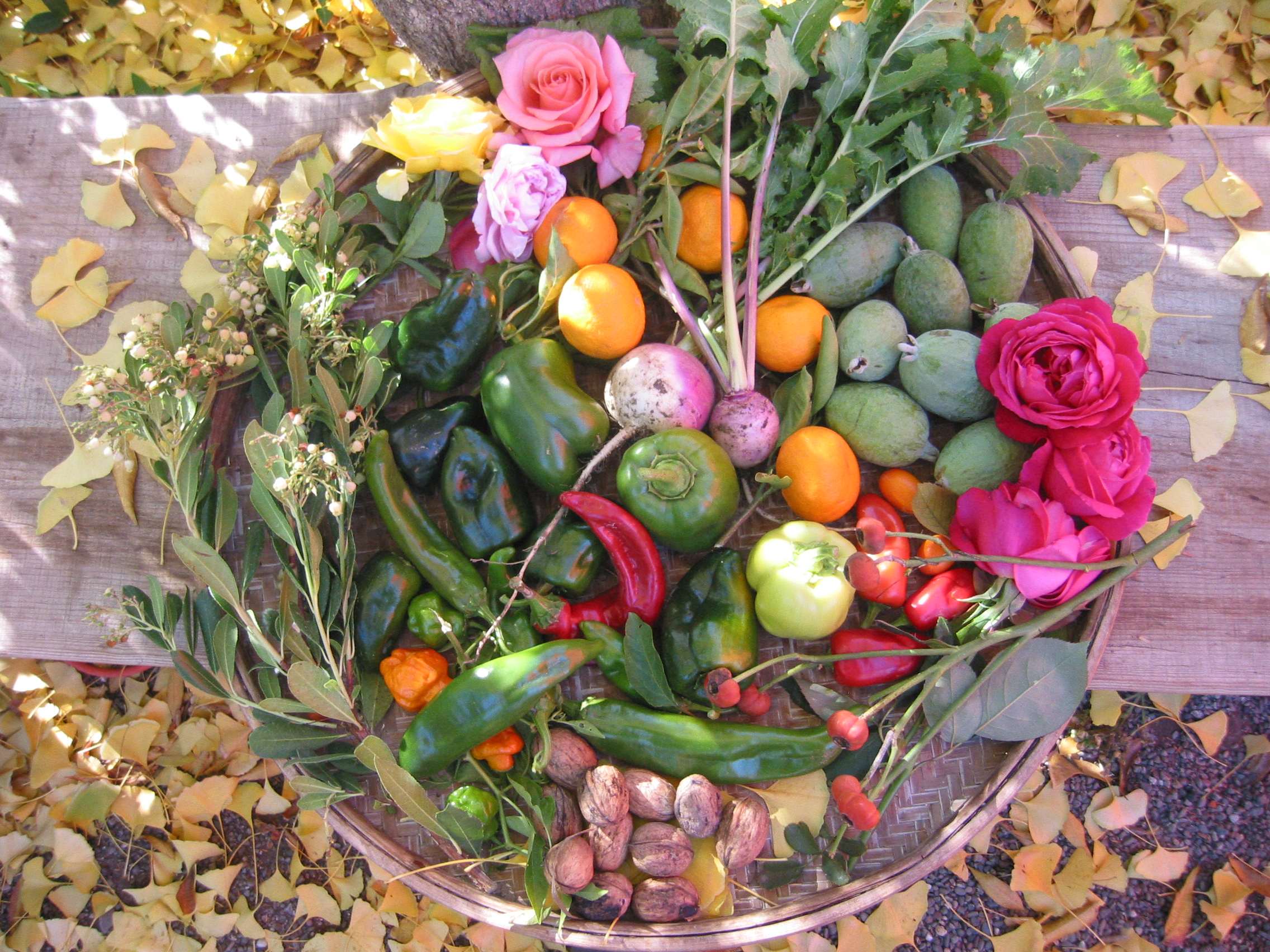
A November harvest basket!
Clockwise from the upper rose: 'Owari Satsuma' mandarin, Feijoa; turnips, sweet peppers, rose hips; walnuts; hot peppers; Arbutus (small white blossoms). All surrounded by Ginkgo leaves.
The vegetable garden.
We almost always have sunny, dry weather here in the fall. While I have pulled most of my tomatoes, I was still harvesting fruit into November. Nights in the 40's and a couple of rainstorms put an end to that. But don't pull your pepper plants, if you have room: the green fruit that have set in late summer will continue to ripen nearly until frost.This year we built a new vegetable planter primarily for root vegetables. I was curious if we could get winter vegetables going early enough to harvest for the Thanksgiving meal. Root vegetables like loose soil, and I decided that the easiest way to accomplish that was with a raised bed. So 2 x 12's were hammered into a 4 x 8 rectangle. The soil was amended with 2 parts compost to 1 part native soil, dug thoroughly to a depth of about 18 inches. A mini-sprinkler water line was attached and run nearly daily. Seeds were planted in early September: radishes, carrots, turnips, and beets. I could have planted parsnips, but my suspicion is that nobody would eat them; maybe next year.
Voila! Radishes were ready in October. Turnips will be on the Thanksgiving table, parboiled and then braised in butter and pepper. Beets are just bulging, so they will be later holiday fare. And the carrots look to be at least a month or so away. Brussels sprouts planted nearby have just begun to form their odd little side sprouts; six plants may produce enough for a small side dish now, with lots more to come as they mature up the stem. Lettuce and other salad greens can be harvested within a few weeks of planting; likewise Pak choi and Swiss chard. And all of these will continue to yield through the winter and spring, until hot weather returns.
Continue reading....
Saturday, November 7, 2009
De-puckering persimmons?
Puckery persimmons?
From the Davis Enterprise, December 27, 2007
We get questions....
I've heard there is a way to pick persimmons and ripen them so they aren't astringent.
Of the dozens of Oriental persimmon varieties, two are commonly grown in California. Fuyu persimmons are flattened on the bottom and are non-astringent. They can be eaten as soon as they turn orange (November), having a mild, sweet flavor and a texture firm enough to munch like an apple or add to fruit salad. They also dry nicely, sliced thin and layered in a fruit dehydrator for a few hours. Dip the slices in melted chocolate for an elegant touch.
Hachiya persimmons are elongated and have a point on the bottom of the fruit. They turn color in November but aren't edible until December. Hachiya and other astringent persimmon varieties, including the native American species, are famous for their astringency when under-ripe, and for their gelatinous texture when ripe. Many people are put off by the gooshy ripe fruit, but Hachiya has a richer flavor and is more prized for cooking.
Astringency in persimmons is caused by tannins, the same chemicals that make tea, red wine, and unripe bananas and peaches cause your mouth to pucker. Tannins cause the surface of your tongue and mouth to constrict and stop salivating: 'it will drawe a mans mouth awrie with much torment,' said Captain John Smith upon tasting the American 'putchamin' in Virginia. Mmmm. Yet fully ripe, with the flesh nearly liquid, they are described as luscious and honey-like.
The USDA tried over a number of years to introduce persimmons to growers and consumers, and sought to overcome the astringency and mushiness of the fruit in order to broaden its appeal. Observing the process of ripening employed in Japan and China, they saw the hard, unripe fruit:
--immersed in a mix of water and lime for several days.
--sealed in a covered earthenware jar with a burning stick of incense for a day or two.
--buried in mud for several days.
--packed in sake casks just after the sake was drawn off, immediately sealed air tight.
Each of these techniques left the fruit firm, ripe, and non-astringent.
Sunday, November 1, 2009
Plants with colorful winter fruit!
Pyracantha berries are turning color, citrus have their first ripening blush.
Here's a list of plants to provide color in the landscape in the winter.
Here's a list of plants to provide color in the landscape in the winter.
Subscribe to:
Posts (Atom)