Saturday, May 4, 2013

Don’s pick -- tomatoes!


                             Don’s pick     

I was asked, “if you could plant just five tomatoes, which would they be?”
What is this, purgatory?!? Well, that’s a tough choice, but here are five I wouldn’t be without. Ok, with a couple of alternates.

Early Girl -- reliable yield early and late in the season, great flavor, good disease resistance.

Champion or Better Boy -- high yield, large fruit, great flavor, good disease resistance.

Costoluto Genovese (shown at right) – beautiful fluted fruit, very meaty, wonderful rich flavor, great for cooking.

Juliet or SunGold – very high-yielding small-fruited types. Juliet is my preference, but Sungold is the most popular cherry tomato of all time.

Pineapple – golden yellow fruit with red striations, very sweet, very large fruit. Makes a beautiful salsa.

Can I please plant some more types?

How about….

Abraham Lincoln
Ace
Better Boy
Giant Belgium
Lemon Boy
Mortgage Lifter
San Marzano
Sweet 100
Whopper
Oh, I’m sure I could come up with another dozen….

In sum: plant some reliable hybrids, some heirlooms that are known to do well in our area, and try something new every year. You may discover a new family favorite! Now is the time to plant tomatoes, peppers, eggplant, and all your favorite summer vegetables.


Thursday, April 4, 2013

You Can Grow That: If I Were Planting A Vegetable Garden...


If I Were Planting A Vegetable Garden.

A rerun from March 2003

"Spring, the sweet spring, is the year's pleasant king;


Then blooms each thing, then maids dance in a ring,

Cold doth not sting, the pretty birds do sing,

"Cuckoo, jug-jug, pu-we, to-witta-woo!"

Thomas Nashe (1567-1601)


The sun is out, green shoots are everywhere, and spring is here! While the nights are still too cool for summer vegetables to be happy in the ground, there is planning and soil preparation we can do and seeds to buy and start. Once the night temperatures are above 55F, the seedlings can go in.

If I were planting a summer vegetable garden for the very first time, I'd....


  • Find a sunny spot, a hose, and a couple of shovels and kids.


  • Take some samples of the plants that are growing there to find out the best way to get rid of them.Mow them off or chop them down, if appropriate, maybe even cover them with plastic for a little while.


  • Dig the edges and make a layout, then water the area with a sprinkler for a little while and plan to come back to it in a few days.


  • Measure it and plot it on paper.


  • Go and ask about what grows well here and when to plant it.


  • Decide what I wanted to grow, writing down everything. Don't forget flowers and herbs!

  • Then....


  • Go through and turn the soil once to bury the chopped weeds, and water again lightly. Let it sit for a couple of days.


  • Turn it again with shovels, spading forks, or a rototiller, mixing in bags of soil amendment that you buy (or have delivered bulk; add some fertilizer to this). Turn, mix, and rake this until the dirt is mixed with the compost and the soil feels kind of fluffy. Rake it all smooth and make your rows.


  • Roll out a simple drip watering system, or a soaker hose. Hold this in place with "anchor pins" or bent pieces of wire. Make sure you'll be able to control the water to your tomatoes separately from all the other plants, as they'll need a lot less frequent watering as the season goes along.


  • Plant! Put in your young transplants, watering each one as you go. Plant seeds carefully, covering them with loose soil and pressing it in gently, then water the whole bed. You'll want an attachment for the hose that makes a gentle spray of water for the seedlings. Don't forget to label each row.


  • Put down something to prevent weeds. Landscape fabric covered with mulch, multiple layers of old newspapers (omit the colored sections), a thick layer of bark�.weeds grow faster than baby vegetables!
  • Then....

    Check the seeds and young plants each day for watering. You can water with your hose for the first few weeks while the plants are getting going; then you'll use the soaker hose for deeper waterings.

    Go buy a good book on vegetarian cooking! Deborah Madison's is the best I own.

    If I were limited for space, and wanted a little bit of everything, I'd plant:


  • At least 3 - 4 tomatoes. One reliable hybrid, one small-fruited type, one or two sauce types for cooking, and at least one heirloom type for fun.
  •  

  • A couple of bell peppers, including one that is a different color; one productive hybrid such as 'Gypsy', and one medium-hot pepper for salsa such as Jalapeo or Anaheim.


  • A cucumber that isn't likely to get bitter, such as Lemon or a burpless type, or an Armenian one to train up on a fence.


  • I'd do several plantings of bush beans a few weeks apart, crowding them in around other plants 'cuz you pull them out after you harvest them. Or make a narrow teepee and grow some pole beans, but be sure to keep them picked or they'll stop producing!


  • Some seeds of carrots, beets, and radishes.


  • I'd probably plant an eggplant. I always do, for some reason.


  • At least a couple of plants of basil. Although I find the pot I plant near the front door is the one that gets used the most. And some other fresh herbs: Italian parsley, chives, oregano, and a couple of plants of English thyme--all scattered around the edges of the garden, or at the entrance, mixed with some lavender for fragrance and beauty.


  • Some green onion seedlings for seasoning.


  • Some strawberries--but don't expect any fruit to make it all the way to the house.


  • One squash plant. Period. And we LIKE squash.


  • At least a couple of potato plants, because they're fun to harvest and taste very sweet fresh from the garden.


  • A couple of okra plants, because they're easy to grow, don't take much space, and it's worth a try cooking them.


  • A few large sunflowers for seeds, even if it's just for the birds.

  • If I had unlimited space, and lots of shovels and kids and time, I'd have


  • Every kind of sunflower, and lots of cosmos for the butterflies and hummingbirds.


  • Borage for the bees, and flowers for the good bugs.


  • Enough Ambrosia melons to have one every day.


  • Gigantic watermelons, and some that fit in the icebox.


  • Wax beans and green beans--and purple beans and Italian beans, and interesting beans for drying for soups.


  • Sweet peppers of every possible color, green and ripe. Hot peppers to use, and some to admire from afar.


  • Tomatoes to share, cook, and can.


  • Okra and eggplant of every kind, just to give away.


  • Three or four kinds of potatoes, so you could dig up a mix of new baby ones right from the garden to boil for your dinner that evening.


  • Sweet white corn from July through September.


  • Three different types of summer squash, so some could grow into huge misshapen monsters.


  • Winter squashes for baking on rainy days. Pumpkins for pie and fun. Weird gourds.


  • A long row of pickling cucumbers so you could pick a few each day to make pickles or relish every week.


  • Some beds planted in cover crops to be ready for the fall garden.


  • Alpine strawberries and mint to sample while you sit in the nearby shade--watching the kids and shovels at work.

  • Maybe that really is Where The Sidewalk Ends.
      © 2013 Don Shor, Redwood Barn Nursery, Inc., 1607 Fifth Street, Davis, Ca  95616
      Feel free to copy and distribute this article with attribution to this author.


    Monday, February 4, 2013

    Lilacs and Redbuds for Spring!


    Lilacs and Redbuds for the Sacramento Valley

    Watch out for sentences that begin with “in my day.” It's a sign that some old guy is about to tell you a story about the way things used to be.


    Syringa 'Sensation' -- lilac

    Well, in my day, people planted fruit trees in the winter, bulbs in the fall, tomatoes in April or May. And some flowering shrubs (including roses) and shade trees were also planted in the winter, when they're dormant. But as each new cohort of beginning gardeners comes along, I realize that these seasonal gardening cycles haven't been passed down from the previous generations. Nowadays lots of people look for daffodils in spring, fruit trees in summer. Industry terms like “bare-root” are no longer common knowledge.

    Most deciduous fruit trees, most roses, many shade trees, and a lot of flowering trees, shrubs, and vines are grown in fields like agricultural crops. They're planted very close together, pruned and trained minimally, and then dug up by machines in December. That's when the whole supply for the season becomes available. All the soil is washed off the roots, and they are stacked and bundled and shipped off to nurseries all over the world.

    The roots are bare, so they are called bare-root. They're dormant, and stay that way for several weeks. So garden centers can stick them in shavings or sand, keep them moist, and (hopefully) sell them to you before they leaf out. Or they can pot them up when they have time. If sales are strong, selection tends to dwindle by late spring. This applies to certain popular flowering shrubs. I want to highlight two of these that have best availability in the winter and spring.

    Lilacs

    “I didn't know we could grow those here!” is the most common thing I hear about this old favorite garden plant. This is reinforced by many online resources which inexplicably list lilacs for “zones 3 through 7.” We're in USDA zone 9. They don't bloom reliably in Southern California or coastal climates due to a lack of winter chilling. But we get sufficient chilling here, and they sure do bloom.

    Those online references are usually from the East coast or Midwest, and California is different. The zones they are referring to are USDA zones. West-coast gardeners do better to use the Sunset Western Garden Book. We're Sunset Zone 14, and Sunset lists the Common lilac (Syringa vulgaris) for zones 1 - 11 and 14.

    When we bought our rural property it came with lilacs that had been planted decades prior by the original owner. They've always grown and bloomed well for us with very little care; in fact, the original shrubs have reseeded. And I've planted more. Lilacs tolerate nearly any soil type, prefer alkalinity (something that likes Davis water!), and accept drought. Full sun is best. They will grow in some shade, but mildew on the leaves can be a problem. You can prune them, or not, as you prefer. Just wait to do it until after they bloom. The only caveat as to location is that they should not be in a cold-sheltered location. Lilacs want winter chill, so don't plant them against your house. Out in the open is best.

    Cercis 'Don Egolf' -- Chinese redbud
    There are hundreds of varieties; dozens of species, with many hybrids within and between those species. Best-known and loved are the varieties of Common lilac (Syringa vulgaris), as they have the largest flowers and most fragrance. They bloom at the end of the branch in the spring, and the bushes have an upright habit. Others bloom all along the branches, with clusters of smaller flowers, often also very fragrant. A good example is the Arboretum AllStar, the laceleaf Persian lilac (Syringa x persica laciniata). These tend to have a more informal, arching growth habit.

    Climate change indicators?

    My lilacs bloom from early to late April, varying slightly by year and by variety. Lilacs have long been noted as plants that mark the season: their leaf emergence and bloom is a sure sign of spring. In fact, they hold a special place in the study of phenology, which is the science that connects seasonal biological phenomena to variations in climate. Gardeners and botanical gardens have been recording the dates of flowering of lilacs for generations.

    Phenology is just a fancy term for what old gardeners have done for years. “Plant corn when oak leaves are the size of a squirrel's ear,” is an example. Handy if you have an oak tree and a squirrel nearby. Or this: “Plant bean, cucumber, and squash seeds when lilac is in full bloom.”

    In the 1950's a more systematic approach to using phenology was developed. In order to provide consistency, and avoid planting an invasive species, a naturally sterile variety of Syringa chinensis called Red Rothomagensis was distributed to hundreds of sites around the country, and a reporting network was created. The results? “Regional differences were detected, as well as an average 5-6 day advance toward earlier springs, over a 35-year period from 1959-1993… spring warming is strongest regionally in the northwest and northeast…” So when grampa says, “sure seems like the lilacs are bloomin' earlier than they used to,” he is right.

    Want to participate? Check out the USA National Phenology Network at www.usapn.org.

    Red Rothomagensis is sometimes available in garden centers.

    Redbuds

    Every March when the redbuds in the Arboretum come into bloom, we get lots of inquiries. Compared to lilacs, these get a little dicier. Do they grow here? The answer is more complicated.

    Western redbud (Cercis occidentalis) is our native species, represented locally in the Warren G. Roberts Redbud Collection in the UC Davis Arboretum. It grows fine here so long as you don't water it very often after it is established (usually by the second summer). Western redbud is very prone to crown rot if it gets watered too frequently. It is a multi-stemmed shrub, rarely grown as a tree.

    Eastern redbud (Cercis canadensis), very common in nurseries, doesn't like our dry heat. During hot spells the leaves get badly spotted and burnt. That goes for the regular species as well as the red-leaved variety called Forest Pansy. You can try planting them in the shade of a taller tree, but expect unsightly foliage by mid-summer. This species is not at all drought tolerant.

    Just to confuse things, a variant or hybrid of the Eastern redbud called the Oklahoma redbud is quite heat tolerant. Usually classed as Cercis canadensis texensis, it has a thicker, glossier leaf that resists sun scorch. A smaller tree than the Eastern redbud, but larger than our Western redbud, it can tolerate some drought, and also can take regular watering, so it is one of our best choices for the garden.

    Yet another good garden variety is a variety of Chinese redbud (Cercis chinensis) called Don Egolf. This seedling was discovered in the U.S. Arboretum in Washington. Very slow-growing, it also happens to be naturally sterile. If the seed pods of the other types bother you, this one is cleaner. The flowers are a more intense dark magenta purple than the other varieties. Tolerant of watering as well as some drought, it has an upright form but only appears to get to about ten feet tall.

    Redbuds can tolerate nearly any soil type, and don't mind alkaline water. No pruning needed.

    Lilacs and redbuds both fit in a low-water landscape. They have spectacular blooms, and are carefree.

    Tuesday, December 4, 2012

    December musings: edibles--You Can Grow That!


    The off-season edibles.

    Sitting in my kitchen the day after Thanksgiving, cracking pecans I had picked up that morning and roasted, drinking pomegranate juice somebody had squeezed from a mere fraction of our crop, and eating a last ripe, red sweet pepper from the vegetable garden, I thought about heading out to see if the Satsuma mandarins were getting sweet enough. Some of the Robert Livermore walnuts were mixed in with the pecans.
    Earlier I'd told the workers at the nut processing plant next door, who like to take a walk for their break each afternoon and who often enjoy our garden, to go ahead and help themselves to some of the Fuyu persimmons. I don't really have a use for 300+ fruit this year, and that is a light
    crop. Their husbands like to harvest the prickly pear cactus fruit: I've watched as they stand along the county road, carefully digging the thorns out with their pocketknives before they eat the fruit on the spot. Sometimes the tender new growth disappears for nopales.

    Looking out the window at my meadow of fine fescue, I thought to myself, this Sacramento Valley of Northern California is sure a nice place to garden. We get enough chilling for the deciduous ftuit and nut trees, but we aren't so cold that (most) citrus are harmed. And the number of plants on my property that just take care of themselves and produce food for casual picking and eating always amazes visitors. I'm not talking about the vegetable garden, or the actual orchard. Just things I've planted in various places that I put almost no effort into.

    Ripe kumquats
    are on my tree year-around, and the tree is right along the rose garden path for easy picking.

    Pineapple guavas
    in abundance every October.

    Quince
    . Hmm. They smell great in the fall, and I have friends who use them.

    Walnuts
    and pecans in fall, sitting on our kitchen counter through the winter.

    Persimmons
    : Fuyu from November, Hachiya from December, until the birds finish them off.

    Pomegranates
    in November and December. Finally found a way to juice them this year!

    Satsuma mandarins
    are anticipated by extended family and friends for the holidays, and through January.

    Navel oranges
    ripen from February to April.

    Strawberries
    in early spring, Boysenberries and their cousins in late spring. I really should get the caneberries under control, but they do make great bird habitat.

    Midsummer we enjoy the Persian mulberries
    until the birds take over the harvest.

    Almonds
    in late summer.

    Family, friends, and strangers expect to harvest from the fig
    trees that have been on our property for decades.

    What's interesting is that these zero-input food plants mostly provide food in the 'off' months. Mid-summer my regular orchard trees – peaches, plums and pluots, and all the other prune-me water-me crowd – are abundant. And the vegetable garden is overflowing. But just as all that is winding down, as I've enjoyed that last worm-free apples (a tiny percentage of the crop, sad to say) and the sauces and salsas are made, it's those fall nuts, winter citrus, and spring berries that fill the gap.

    What care do these all get? I water them. Some as little as once a month. Fertilizer? Nope. I could prune them for size control, but mostly I don't bother. Birds enjoy the surplus that's out of reach. I'm fortunate to have unlimited space, but most of these could
    be kept small in a regular back yard. Pecans and walnuts are very large trees, perhaps not suitable for your situation. Persimmons will get plenty big if you let them (my Fuyu is at least thirty feet tall), but can be kept lower. Consider fruit litter when you plant them. If you don't eat it, the fruit may end up on the ground.

    There's a lot I could add, and probably will. Meyer lemon, Chilean guava? I'm sure I'll find places for those, too. If it's edible and there's a path, there's probably a place for it. I have an Arbutus unedo
    (Strawberry tree) that people like to sample now and then. Jujube fruit mostly falls to the ground; I really need a dehydrator! If I gave my asparagus bed, now over two decades old, more attention it might yield more. As it is I get a sampling of shoots in early spring, and enjoy the beautiful ferny foliage in summer. Maybe some day I'll even harvest some of my bamboo shoots.


    Kumquats


    Quince


    Pecans

    Mandarins

    More pictures at our website here: http://redwoodbarn.com/Decmusingsedibles.html

    Tuesday, November 27, 2012

    I've linked a number of my articles about water conservation on one page here: http://redwoodbarn.com/waterconservation.html

    Sunday, November 4, 2012

    Great Natives for Valley Gardens


      Low Water Plants continued:

      Great Natives for Valley
      Gardens


      written for the Davis Enterprise, November 01 2012
      This is part of a continuing series of articles on plants that can grow and look good with low water. The focus here is on low to medium shrubs for very limited irrigation, especially natives. Low-water taller shrubs were discussed in our November 2011 article.

      Note that some California native plants require drought, as compared to tolerating drought. They'll die if you water them too often. In garden references you'll sometimes see the notation "needs good drainage" or "short-lived." Those are code for "susceptible to crown rot," meaning that if they get watered too frequently in warm weather they may get attacked by Phytophthora, a fungus-like organism that invades the plant at the crown and kills it swiftly. Many, but not all, of our native plants are vulnerable.
      Watering deeply and infrequently, and avoiding mulch around the stem, are the best practices for avoiding crown rot.

      Low and ground-cover shrubs

      Botanical name: Arctostaphylos species
      Common name: Manzanita
      As a group I am leery of manzanitas because they are so easy to kill, being very sensitive to overwatering. But a couple of garden cultivars are less vulnerable. Howard McMinn grows to about three feet tall, four feet wide or more. It has a dense growth habit, with shiny green leaves that contrast nicely against the red stems.
      Baccharis pilularis Twin Peaks
      Dwarf coyote brush.
      Very tough, drought-tolerant native. Great for attracting beneficial insects. Otherwise a dull, somewhat scruffy looking plant. Unbelievably resilient, so it earns its place on my list on that account. Nobody's going to say, "ooh, look at your coyote brush!" But you don't ever have to prune or even water it.
      Ribes viburnifolium
      Catalina perfume
      Will grow in considerable shade, spreads steadily to make an attractive ground cover. Fragrant evergeen foliage. Light pink flowers in late winter attract hummingbirds; small red berries attract songbirds.

      Salvias: sages.


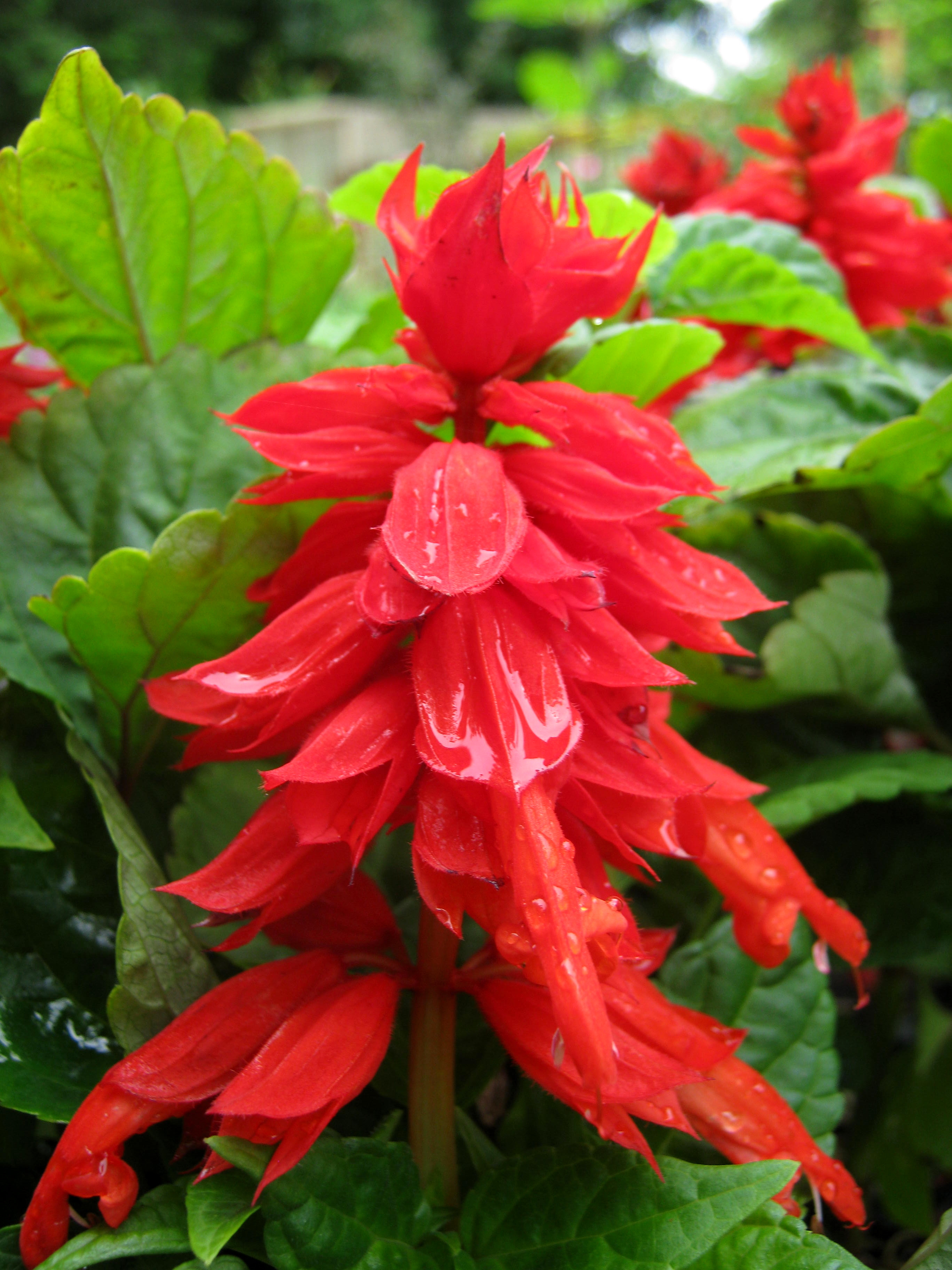
      Salvia splendens
      Red Hot Sally
      For many years, the annual Scarlet sage was the best-known member of Salvia. These showy flowers are planted in spring, bloom through fall, and then die with frost. But the blooms are non-stop and they attract hummingbirds as readily as their perennial and shrubby cousins.
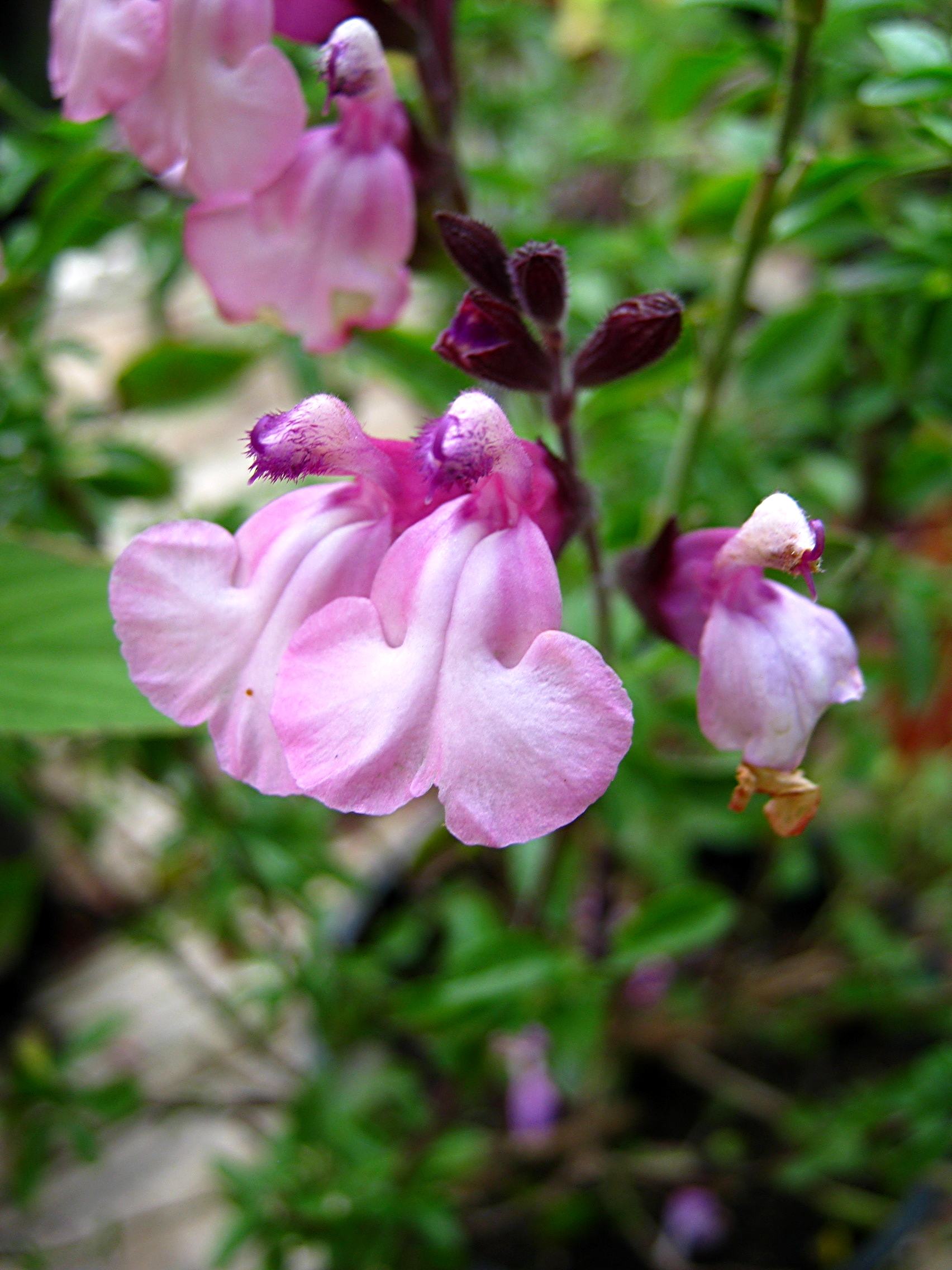
      Salvia Pink Frills
      Patrick Worley, the breeder at Suncrest Nurseries who introduced this describes it as a "greggii type" to about 2 feet tall and wide. These lighter colors stand out nicely against the dark green foliage. A plant will have 30- 50 flowers at a time during autumn.
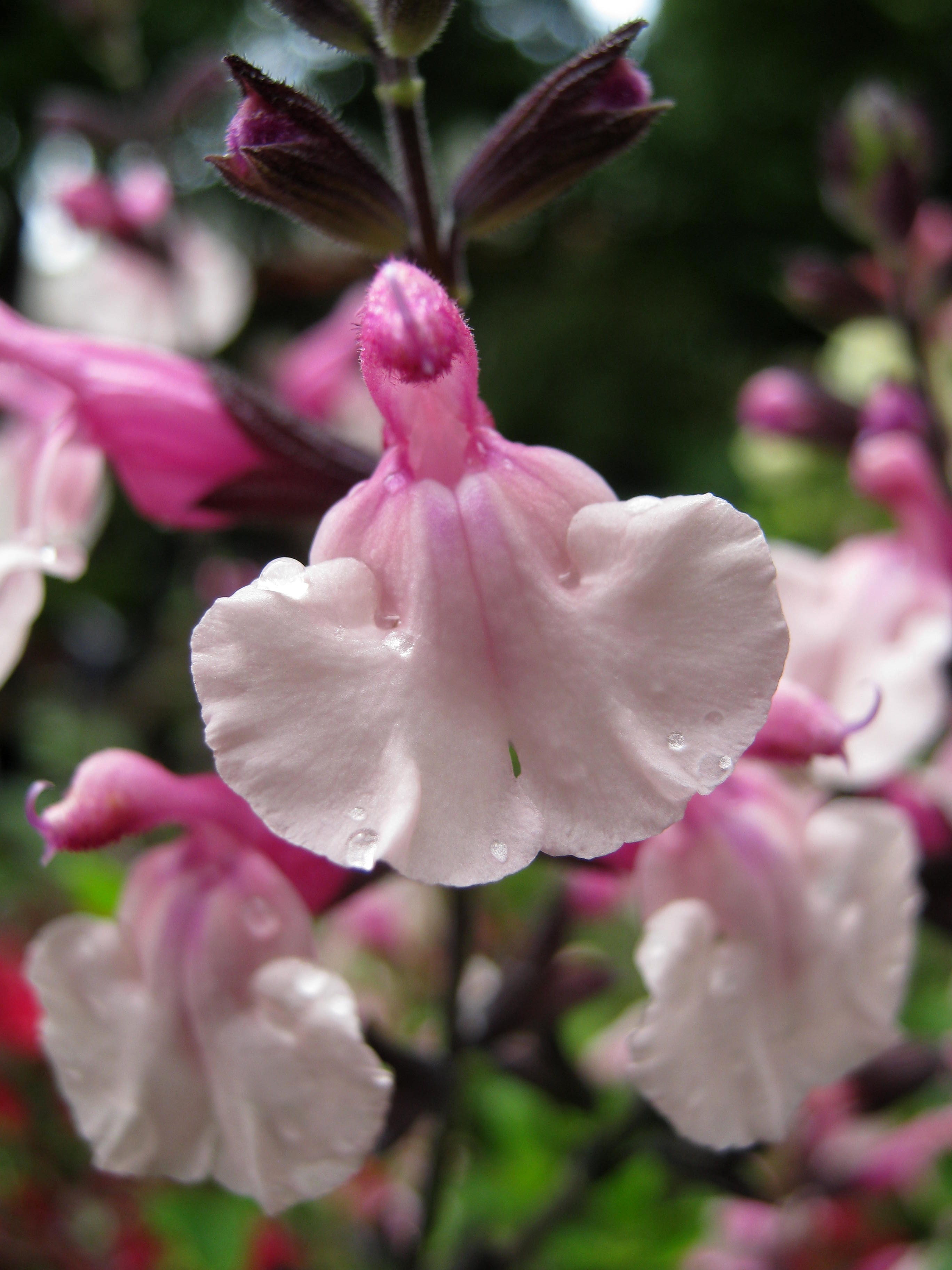
      Salvia Dancing Shadows
      The breeder describes these as "painted icy pink and white flowers" on red-violet stems. Another profuse bloomer in the sun-loving, drought-tolerant Salvia greggii group.
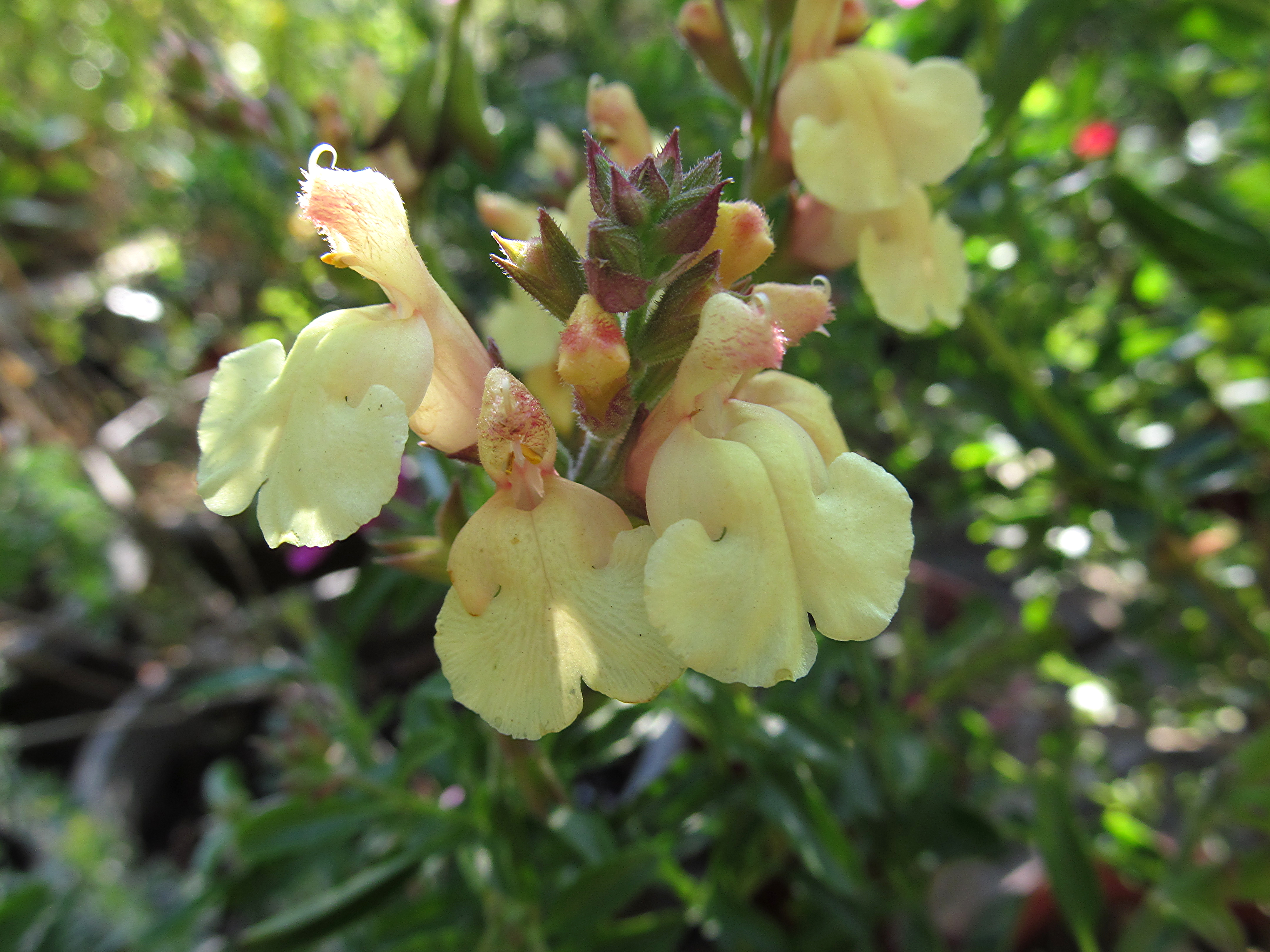
      Salvia Golden Girl
      Yellow is the holy grail of Salvia breeders, and this is the closest yet. Suncrest Nurseries describes it as "very compact" to 18 inches, which makes it a low-grower in this group.
      fine fescueCarpenteria californica
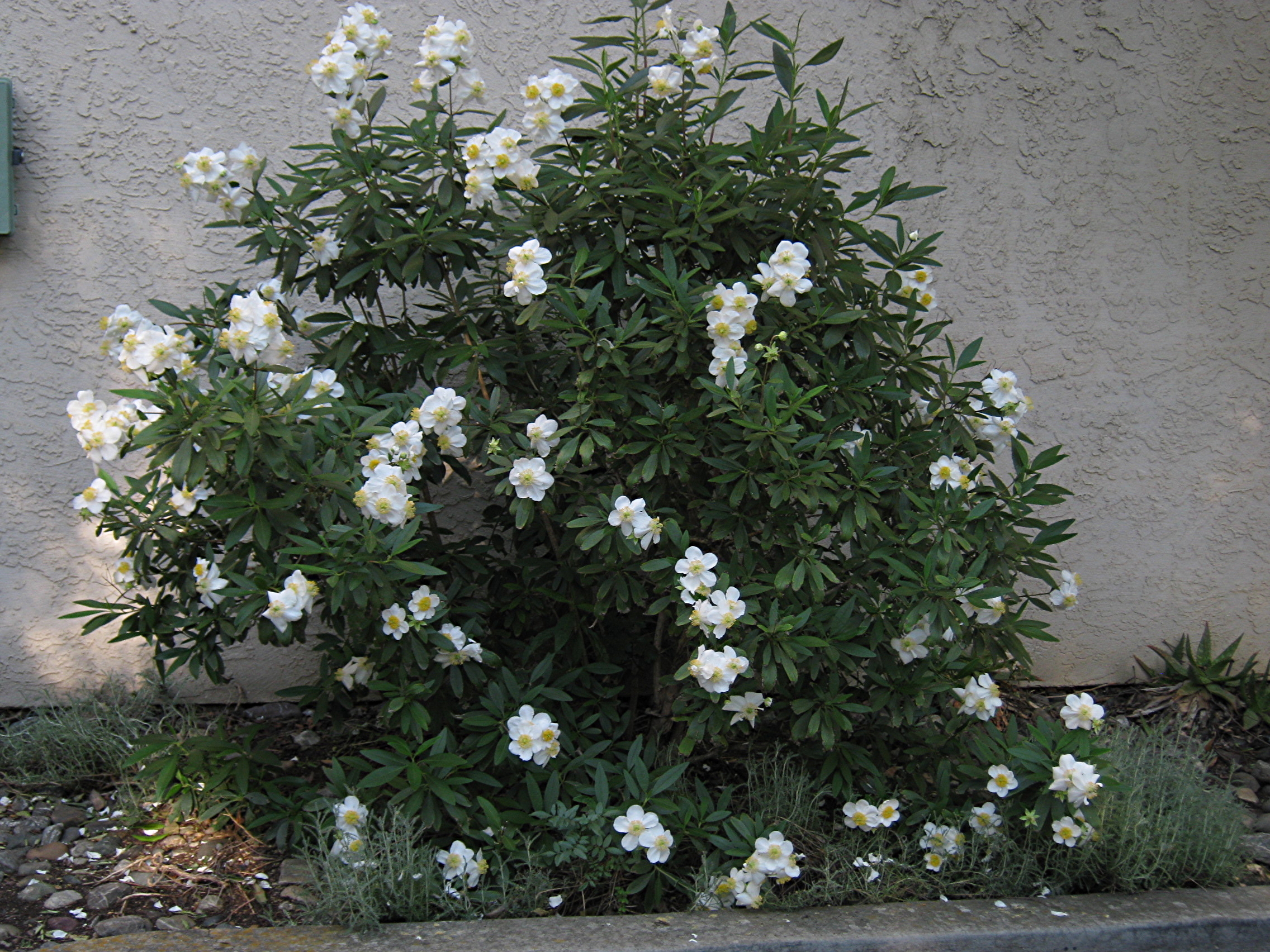
      Shown here in May, the native Bush anemone gives several weeks of bloom in late spring. It is actually a rare species, growing only in a few sites in Fresno and Madera counties. But growers of native plants have popularized it for California gardens. Unlike many natives, it is not fussy about soil and can tolerate regular watering, but is also tolerant of drought.
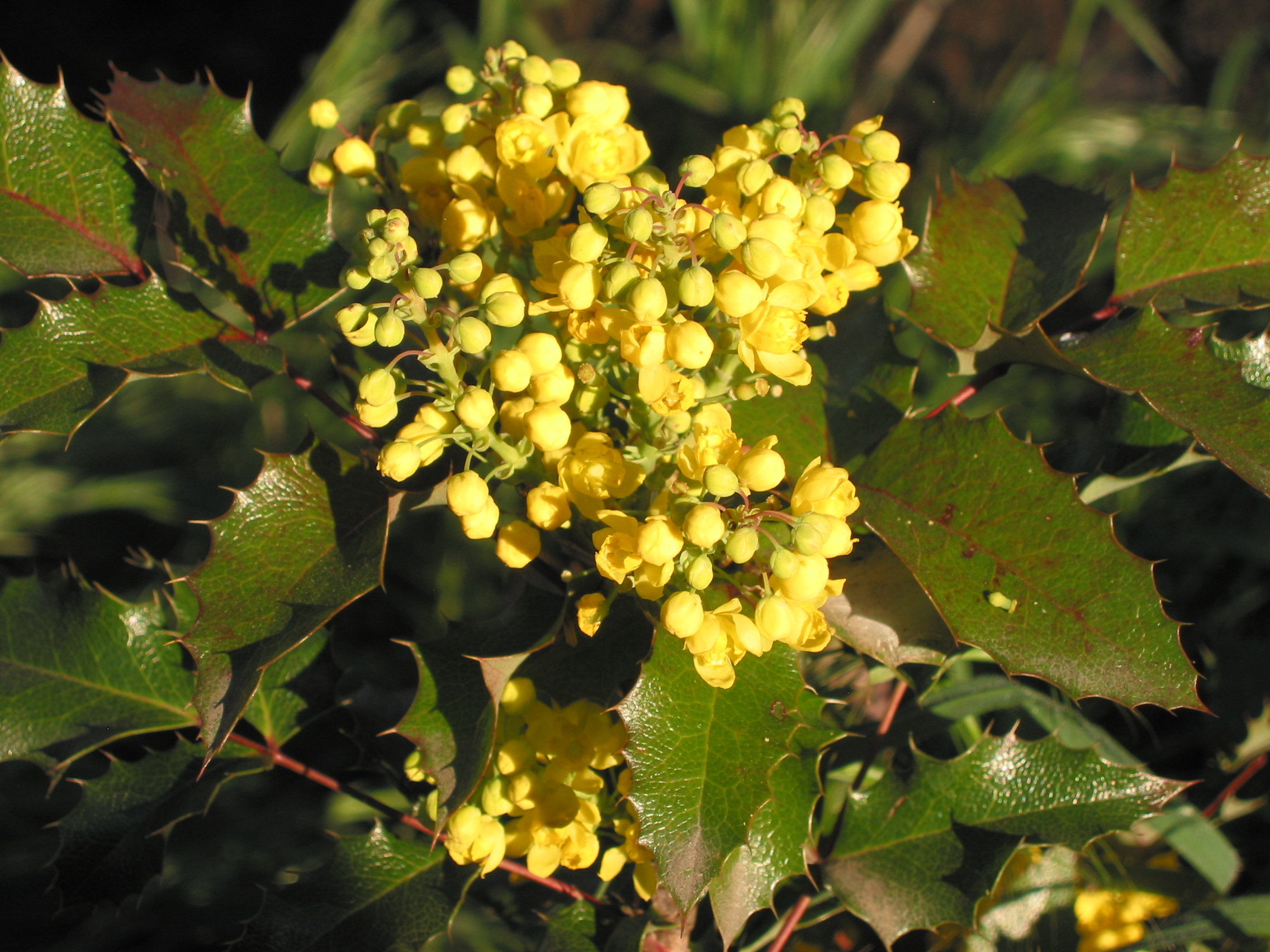
      Mahonia aquifolium
      Oregon grape
      Ok, it's not native here, but it is native over on the northwest coast. Mahonia has bright yellow flowers in winter, edible fruit that attracts songbirds, and tolerates drought or watering, sun or shade. Prickly leaves resemble holly. This original species is tall and rangy, but new forms have more compact growth habit, shinier leaves, coppery new growth, and more abundant bloom.
      Botanists recognize hundreds of species in the genus Salvia, possibly up to a thousand. While most gardeners knowSalvia officinalis (garden sage, from Europe) used in cooking, more than half of the species are from South and Central America, with a few species from California and the Southwest. Some types are frost tender and prefer regular watering. A few like some shade. But our native species and their hybrids are generally very tolerant of drought and hot sun.
      The flowers of Salvias are fascinating up close. They are "bilabiate" which means "having two lips." There are often glandular hairs on the flowers and leaves. The stamens are fused into a lever, which bends down and deposits the pollen on the back of the visiting bee or bird as it probes the long flower tube. The female flower stigma develops next and is bent down to receive the pollen. The flower is adapted to many pollinators, rather than any specialized one. Salvias are always active with wildlife. Hummingbirds, butterflies, carpenter bees, and bumblebees are attracted to the flowers. Beneficial insects harbor on the foliage. Songbirds like the small seeds. A mixed planting of salvias, lavenders, rosemary, and daisies will give year-around color, help prevent garden pests, enhance pollination, and require very little water once established.
      Southwestern native sages
      Salvia greggii, S. microphylla, and more. These are the stars of the autumn garden, at their peak of bloom right now.
      For gardeners, this is one plant group where there has been a sea change in availability of species, hybrids, and cultivars in the last couple of decades. My 1970 edition of the Sunset Western Garden Book lists ten species on about half a page, with only three cultivars. Native plant specialists carried a couple of species. In the herb section of your local garden center you could find common garden sage for use in your holiday turkey stuffing. Annual Scarlet sage was a popular summer bedding plant. That was about the extent of the Salvia trade.
      Then in the early 1990's Salvia greggii, now called Autumn sage, started to show up. No named varieties, but it caught on quickly for the bright pink late summer and fall blooms. Now Salvias cover six pages in the new 2012 edition of Sunset. One grower has 30 to 40 varieties available.
      What makes these important for Valley gardeners is that many of them come from hot, low-rainfall regions. Salvia greggii is native to the high deserts of southwest Texas and Mexico. Salvia microphylla, Graham's sage, comes from Southeastern Arizona and Mexico (it is recognizable by the much more fragrant foliage, which occurs in some of its progeny). When you bring these two together in a garden, they hybridize very readily and reseed happily. So now there are dozens of natural and intentional hybrids, in an ever-increasing range of colors.
      For taxonomy buffs: the naturally occurring, original hybrids between S. greggii and S. microphylla and other species were given the name Salvia x jamensis. The 'x' indicates an inter-specific hybrid of known parentage. But that was a while ago. The exact parentage of many of the new cultivars is simply unknown at this point, so they often just have a cultivar name; e.g., Salvia 'Dark Dancer'. The genus name (Salvia) is properly italicized; the cultivar name should be in single quote marks. Neither is standard editorial practice in the news industry, but it is how you will usually see the name in journals and reference books.
      Hybrids and cultivars in this complex group are generally 2 to 4 feet tall and wide. Most branch heavily from the base. S. greggii types tend to get woodier and taller, eventually a little rangy. You can cut these back in spring to keep them shorter and more compact. The bloom is light and steady in spring and summer, and absolutely profuse in fall.
      The color range started in reds and pinks, then broadened to lavenders and purples. A light yellow form appeared; now there are some stronger yellow ones.
      Every time I think I have a favorite, another variety comes along. In addition to those shown here, I have created a pinterest board of my Salvia pictures: http://pinterest.com/redwoodbarn/salvias/
      California native sages.
      Mostly spring-blooming, these have denser growth habits than the previous species and tend to get larger.
      Salvia apiana 
      Silvery-white leaves give this the common name of White sage. Three feet tall and wide; white flowers, intensely fragrant foliage. Hardy to 20 degrees F or lower. This is the one used for burning in purification rituals. Hard to propagate and thus not common in the trade. It is easy to kill by overwatering.
      Salvia clevelandii 
      Cleveland sage is a Southern California native that grows to about three feet tall and a little wider. It has attractive grey-green foliage, and tall whorls of blue flowers in late spring. A very useful shrub in low-water landscapes, it combines well with non-native low-water plants such as Cistus (rockrose), lavenders, and rosemary, as well as natives such as Ceanothus (wild lilac) and manzanita. A few cultivars: Allen Chickering has lavender-blue flowers; Winnifred Gilman's are darker blue.
      I have found this plant often harboring ladybugs in the adult and larva forms in winter and early spring.

      A few other native shrubs


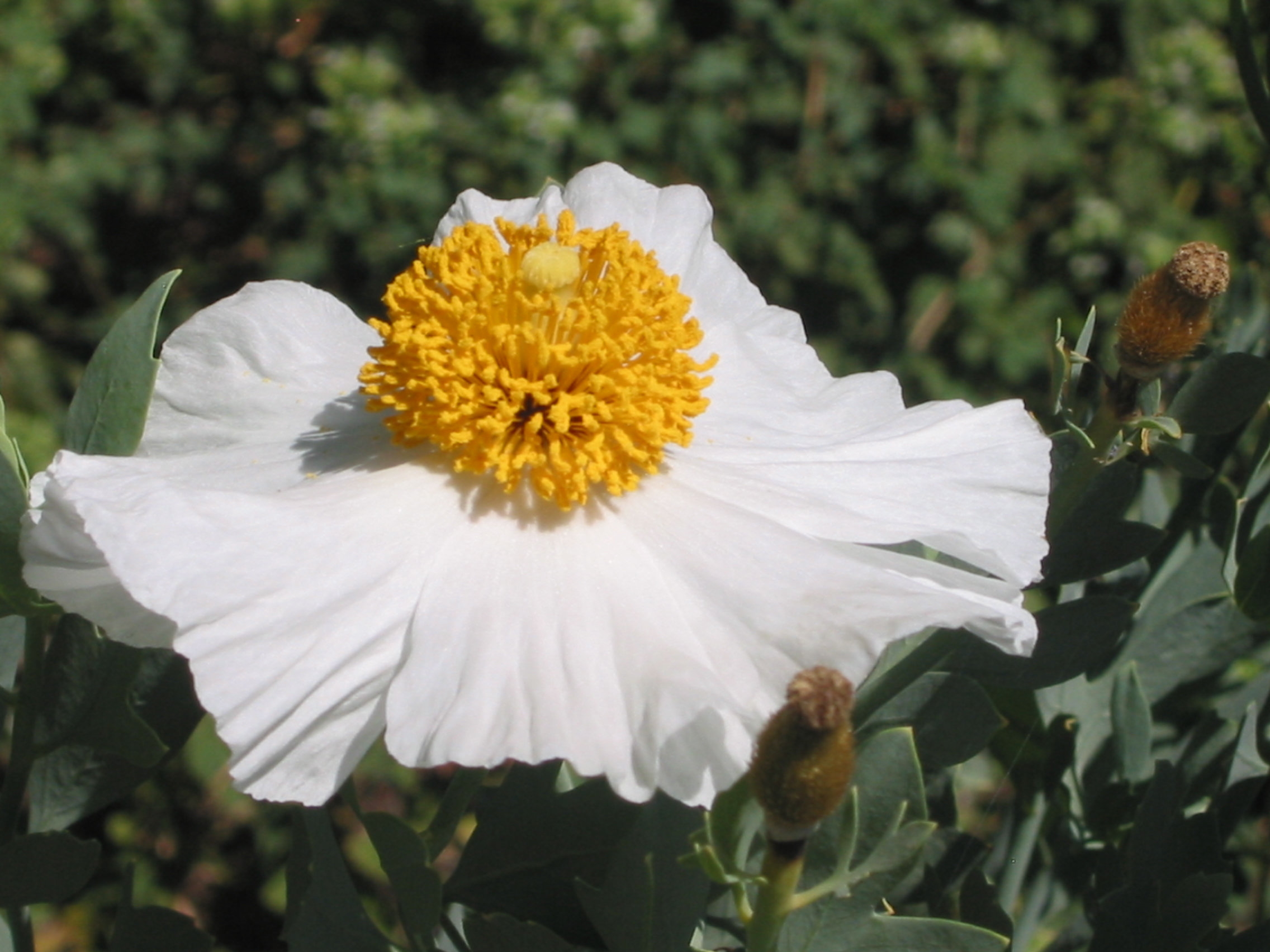
      Romneya coulteri
      Can you see why it's called Fried-egg flower? Matilija poppy is the other common name of this Southern California native. A big (up to 8 feet tall!), spreading, somewhat coarse-looking plant with flowers that bob above the foliage in summer. Easy, tough, moderately invasive, tolerant of watering or drought.
      Carpenteria californica
      Bush anemone
      This slow-growing, tidy shrub to four to five feet, from our coastal mountain range, has shiny leaves and a compact growth habit. White showy flowers in late spring resemble anemones. Tolerant of sun or light shade.
      Ceanothus species and varieties
      Wild lilac
      Attractive shiny leaves and fragrant blue flowers in spring. Water deeply and very infrequently in summer; they are notorious for dying abruptly in warm weather when they get watered too often. There are low spreading types. Centennial stays under a foot tall and spreads several feet. Yankee Point grows to two to three feet tall and spread six to eight feet or more.
      The UC Davis Arboretum touts Valley Violet, a well-mannered low shrub with small leaves and unusual lavender-pink flowers.
      Several varieties grow to six feet or so, some spreading wider. Julia Phelps has dark, small leaves and vivid cobalt-blue flowers; one of the showiest in bloom.
      Ray Hartman, mentioned in the Nov. 11 article, is big, fast, and upright, tall enough to train as a screen or small tree to fifteen to twenty feet.
      Mahonia aquifolium
      Oregon grape
      Native to the coast side of the coastal mountain range. Shiny leaves, bright yellow flowers in winter, blue berries that attract songbirds. Tolerant of sun but better-looking in some shade and tolerant of deep shade. Compacta is a denser, shorter variety. John Muir and Ken Hartman (a hybrid) are selections with denser foliage, spinier leaves.
      As you change over your landscape for lower water use, consider some of these plants native to California and the southwest for their durability and beauty!
      Previous columns about low-water plant choices in the Davis Enterprise columns here.
      Look for the October and November 2011, January 2012 and June 2012 columns.

      More pictures of Salvias here
      and on Pinterest here.c 2012 Redwood Barn Nursery
      www.redwoodbarn.com