
The history of the spread and use of the plants of the genus Capsicum is a curious one. These plants, native to the Americas, are now grown throughout the world, and appear in recipes that come back to America in ethnic restaurants. The genus is represented in American cuisine by all of the varieties of green peppers, chili peppers, Oriental hot peppers, pimentos, and paprika. The amazing part of this is the speed with which the plants spread and were adopted into local cultures along the routes of the Spanish and Portuguese explorers of the 15th and 16th centuries.
Here's the history of how they spread in an article written by my father.
Tuesday, September 29, 2009

Monday, September 21, 2009
September means planning for winter fragrance!
September isn't really fall, is it?
Not here in the valley! It can be hot and dusty, which makes it hard for gardeners to look forward to the next season. But just as we plan in spring for our summer gardens, NOW is the time to plan and plant for your winter garden!
Good gardeners are always looking ahead to the next two seasons.
You're picking peppers and thinking about peas! The powerful scent of a summer gardenia reminds you that it's time to think about winter fragrance. For generations of gardeners, winter fragrance has meant sweet peas (Lathyrus) and stock (Matthiola). If you're frugal and like to plant from seed, September is when you plant both of these. (You can also do a planting of sweet peas in February and hope that we don't get hot earlier than usual).
When I was a young teen, working around the neighborhood, I worked for one afternoon for a plant breeder who also happened to be an excellent and rather particular gardener. He hired me to dig a trench a foot deep, setting aside the soil; then I dug compost and manure into the next foot of soil, and planted sweet pea seeds in the bottom of the trench. I blended compost and manure with the first soil and set it aside, as he planned to layer it in over the plants as the vines grew. Sure seemed like a lot of work (which, of course, is why he was paying me to do it!).
Years later this technique became popular with organic gardeners in areas of poor soils and was called double digging. I call it aerobic gardening. I thought I must have done it right, because years later he complimented me on the quality of the sweet peas that year. But I now know that a lot of it was luck-- mild weather when the vines are flowering--and some of it was knowing which varieties to plant. Not to mention knowing how to tell a 14-year-old boy how to do a task correctly! I'm still working on this last concept....
Sweet peas like a mild climate, and especially dislike hot weather.
We plant them here so they're established enough to get through the winter and bloom before hot weather hits. Our winters are rarely cold enough to damage the plants, although they were killed or severely damaged in the severe freezes of 1990 and 1998. Sweet peas need full sun in the winter--watch the sun pattern as it shifts to the south to make sure they won't be in the shade in February and March. They prefer soil that has been amended (see above!) so it drains well in the winter. There are even dwarf varieties that can be grown in pots.
The names of the different types of sweet peas can be a little confusing.
Older varieties are usually called "heirlooms." Modern varieties are called Spring-flowering and Summer-flowering, but none of them really flower in the summer here. These types start blooming when daylength is increasing in mid-spring, and flower from mid-April through May until temperatures reach the mid-90's. Early-flowering varieties will bloom earlier in the winter if you plant them early enough (i.e., NOW!), but are less heat-tolerant.
The older varieties are remarkable for their fragrance and have become available again from specialty seed suppliers. Several seed companies now offer the older varieties.
I said that none of the regular sweet peas bloom in the summer here, but folks driving through Gold Country and other parts of Northern California have probably noticed the two-toned perennial sweet pea (Lathyrus latifolius) that has naturalized in those areas. This one is different: it blooms in the summer and tolerates aridity, but isn't especially fragrant.
Stock is like deer: the name is singular and plural at the same time. This is one of our best winter annuals.
I have no idea what the common name comes from, and a quick search of reference books and on the internet didn't elucidate. The Sunset Western Garden Book describes some as being "branching" (multiple shoots from the base) and others as being "unbranched." Our experience is that early planting (i.e., NOW!) will give you plants that branch from the base, and late planting will give a single spike of flowers. The flowers have a great sweet/spicy fragrance. Like sweet peas, you don't just stick these in the ground in heavy soil areas: turn compost into the whole area before you plant.
I have an old memory of stock...another good gardener in that same neighborhood where I grew up: a wonderful woman who let me plant whatever I wanted in her yard, as long as she could cut or smell the flowers. She planted intensely fragrant stock just under the window where the breeze came in. Years later I smelled the stock we sell as bedding plants and got a hint of that sweet and spicy fragrance, but I realized that she had planted a different species (M. longipetala bicornis) known as the Evening-scented stock. Unfortunately, this stock is not common in the trade.
Nevertheless, the stock that you plant from seed or six-packs will have some of that same special scent. Plant it in full winter sun. The more dwarf varieties aren't as fragrant, but can be crowded into small pots for winter color. Although we sell it as a winter annual, many gardeners report stock living through the summer and reblooming, and it occasionally naturalizes by reseeding, gradually reverting to taller, single-flowered types.
There are other seeds to plant in September.
Snapdragons, calendulas, pansies and violas are popular winter and spring-blooming annuals that can be grown from seed or transplanted from seedling packs.
Wildflower seeds are planted now for late winter and spring bloom--California poppies are the best known, but Lupines, Tidytips, and many others grow and naturalize well here. You can't just fling these seeds onto hard, dry soil: loosen it first by tilling or scratching the surface. Cover the seed with a fine layer of compost, and water daily for a few weeks until winter rains begin.
Many perennials can be grown from seed or transplants now for blooms next year. And vegetable growers are already planning their winter gardens, planting broccoli, cauliflower, cabbage, peas, carrots, beets, and more.
Save money and spice up your winter garden by planting now from seed!
(originally written for the Davis Enterprise, August 23, 2001)
Not here in the valley! It can be hot and dusty, which makes it hard for gardeners to look forward to the next season. But just as we plan in spring for our summer gardens, NOW is the time to plan and plant for your winter garden!
Good gardeners are always looking ahead to the next two seasons.
You're picking peppers and thinking about peas! The powerful scent of a summer gardenia reminds you that it's time to think about winter fragrance. For generations of gardeners, winter fragrance has meant sweet peas (Lathyrus) and stock (Matthiola). If you're frugal and like to plant from seed, September is when you plant both of these. (You can also do a planting of sweet peas in February and hope that we don't get hot earlier than usual).
When I was a young teen, working around the neighborhood, I worked for one afternoon for a plant breeder who also happened to be an excellent and rather particular gardener. He hired me to dig a trench a foot deep, setting aside the soil; then I dug compost and manure into the next foot of soil, and planted sweet pea seeds in the bottom of the trench. I blended compost and manure with the first soil and set it aside, as he planned to layer it in over the plants as the vines grew. Sure seemed like a lot of work (which, of course, is why he was paying me to do it!).
Years later this technique became popular with organic gardeners in areas of poor soils and was called double digging. I call it aerobic gardening. I thought I must have done it right, because years later he complimented me on the quality of the sweet peas that year. But I now know that a lot of it was luck-- mild weather when the vines are flowering--and some of it was knowing which varieties to plant. Not to mention knowing how to tell a 14-year-old boy how to do a task correctly! I'm still working on this last concept....
Sweet peas like a mild climate, and especially dislike hot weather.
We plant them here so they're established enough to get through the winter and bloom before hot weather hits. Our winters are rarely cold enough to damage the plants, although they were killed or severely damaged in the severe freezes of 1990 and 1998. Sweet peas need full sun in the winter--watch the sun pattern as it shifts to the south to make sure they won't be in the shade in February and March. They prefer soil that has been amended (see above!) so it drains well in the winter. There are even dwarf varieties that can be grown in pots.
The names of the different types of sweet peas can be a little confusing.
Older varieties are usually called "heirlooms." Modern varieties are called Spring-flowering and Summer-flowering, but none of them really flower in the summer here. These types start blooming when daylength is increasing in mid-spring, and flower from mid-April through May until temperatures reach the mid-90's. Early-flowering varieties will bloom earlier in the winter if you plant them early enough (i.e., NOW!), but are less heat-tolerant.
The older varieties are remarkable for their fragrance and have become available again from specialty seed suppliers. Several seed companies now offer the older varieties.
I said that none of the regular sweet peas bloom in the summer here, but folks driving through Gold Country and other parts of Northern California have probably noticed the two-toned perennial sweet pea (Lathyrus latifolius) that has naturalized in those areas. This one is different: it blooms in the summer and tolerates aridity, but isn't especially fragrant.
Stock is like deer: the name is singular and plural at the same time. This is one of our best winter annuals.
I have no idea what the common name comes from, and a quick search of reference books and on the internet didn't elucidate. The Sunset Western Garden Book describes some as being "branching" (multiple shoots from the base) and others as being "unbranched." Our experience is that early planting (i.e., NOW!) will give you plants that branch from the base, and late planting will give a single spike of flowers. The flowers have a great sweet/spicy fragrance. Like sweet peas, you don't just stick these in the ground in heavy soil areas: turn compost into the whole area before you plant.
I have an old memory of stock...another good gardener in that same neighborhood where I grew up: a wonderful woman who let me plant whatever I wanted in her yard, as long as she could cut or smell the flowers. She planted intensely fragrant stock just under the window where the breeze came in. Years later I smelled the stock we sell as bedding plants and got a hint of that sweet and spicy fragrance, but I realized that she had planted a different species (M. longipetala bicornis) known as the Evening-scented stock. Unfortunately, this stock is not common in the trade.
Nevertheless, the stock that you plant from seed or six-packs will have some of that same special scent. Plant it in full winter sun. The more dwarf varieties aren't as fragrant, but can be crowded into small pots for winter color. Although we sell it as a winter annual, many gardeners report stock living through the summer and reblooming, and it occasionally naturalizes by reseeding, gradually reverting to taller, single-flowered types.
There are other seeds to plant in September.
Snapdragons, calendulas, pansies and violas are popular winter and spring-blooming annuals that can be grown from seed or transplanted from seedling packs.
Wildflower seeds are planted now for late winter and spring bloom--California poppies are the best known, but Lupines, Tidytips, and many others grow and naturalize well here. You can't just fling these seeds onto hard, dry soil: loosen it first by tilling or scratching the surface. Cover the seed with a fine layer of compost, and water daily for a few weeks until winter rains begin.
Many perennials can be grown from seed or transplants now for blooms next year. And vegetable growers are already planning their winter gardens, planting broccoli, cauliflower, cabbage, peas, carrots, beets, and more.
Save money and spice up your winter garden by planting now from seed!
(originally written for the Davis Enterprise, August 23, 2001)
Sunday, September 13, 2009
September in your garden!
September in your garden!
Lawn: Fertilize lawn with a regular lawn fertilizer. Apply pre-emergent to prevent winter weeds, or renovate if heat breaks— de-thatch, aerate, overseed.
Roses: Fertilize mid September to early October to get a great fall bloom.
Trees: Fertilize deciduous trees.
Shrubs: Prune evergreen shrubs when heat breaks. Plant landscape shrubs, trees, and ground covers. Move existing landscape plants.
Annuals: Start seeds or buy plants of pansies, violas, snapdragons, Calendula, stock, sweet alyssum, and more. Broadcast wildflower seeds.
Perennials: Lots of perennials can be started from seed this month: foxgloves, candytuft, columbine, coral bells, Dianthus, and many more. Preemergents or mulches will help prevent annual winter weeds. Cut back herbaceous (soft) perennials hard; lightly trim woody ones. Best time for a major cleanup in the perennial border. Plant bulbs when soil has cooled.
Vegetables: Plant broccoli, cauliflower, carrots, lettuce, greens, peas, beets, onions, and more.
Weather notes: Hot, dusty, windy. Wash plant foliage early in the day to remove dust and insects. Move indoor/outdoor plants back in by Hallowe'en. First cold rain usually mid-late October, but don't count on it....
Watering systems: Set timer for fall schedule late this month.
Pests and diseases: Whiteflies, leafhoppers, spider mites.
Shop now for: Perennials in small packs and pots; spring-blooming flower bulbs; landscape plants.
Lawn: Fertilize lawn with a regular lawn fertilizer. Apply pre-emergent to prevent winter weeds, or renovate if heat breaks— de-thatch, aerate, overseed.
Roses: Fertilize mid September to early October to get a great fall bloom.
Trees: Fertilize deciduous trees.
Shrubs: Prune evergreen shrubs when heat breaks. Plant landscape shrubs, trees, and ground covers. Move existing landscape plants.
Annuals: Start seeds or buy plants of pansies, violas, snapdragons, Calendula, stock, sweet alyssum, and more. Broadcast wildflower seeds.
Perennials: Lots of perennials can be started from seed this month: foxgloves, candytuft, columbine, coral bells, Dianthus, and many more. Preemergents or mulches will help prevent annual winter weeds. Cut back herbaceous (soft) perennials hard; lightly trim woody ones. Best time for a major cleanup in the perennial border. Plant bulbs when soil has cooled.
Vegetables: Plant broccoli, cauliflower, carrots, lettuce, greens, peas, beets, onions, and more.
Weather notes: Hot, dusty, windy. Wash plant foliage early in the day to remove dust and insects. Move indoor/outdoor plants back in by Hallowe'en. First cold rain usually mid-late October, but don't count on it....
Watering systems: Set timer for fall schedule late this month.
Pests and diseases: Whiteflies, leafhoppers, spider mites.
Shop now for: Perennials in small packs and pots; spring-blooming flower bulbs; landscape plants.
Thursday, August 27, 2009
We get questions....
Dear Don,
I need suggestions for a difficult shady planting area off our parking lot. We planted Mondo grass in this area years ago and it is doing well, but it is very slow and not very interesting. It is the north side of a commercial building, and is also shaded by Sapium trees and very large Xylosma shrubs (which we keep pruned up for safety reasons). Watering is with an old sprinkler system with regular lawn-type heads.
It would be nice to get some flowers, but that might be asking a bit much. We’re ok with keeping the mondo grass, just want something more interesting with it. -- Bob
-------
First, review the sprinklers for coverage and make sure the entire planting area is getting watered.
Lift several clumps of mondo grass and plant most of them in the shadiest areas. Set some in reserve to plant around new plants.
Plant groups of 3 – 5 each of one-gallon perennials in 5 - 6 places. Choose for tolerance of shade, some seasonal bloom if possible, and ability to withstand existing water schedule and raking of leaves in fall.
Examples:
Turf lily
Liriope muscari
Purple flowers in summer, grassy leaves. Long-lived, very shade-tolerant.
Lenten rose
Helleborus orientalis
Flowers in pink, purple, or white resemble single rose blossoms. Bloom in winter. Very shade-tolerant, tough, long-lived.
Heartleaf bergenia
Bergenia cordifolia
Big leaves look lush year-around. Pink flowers on the common form are a nice bonus in late winter. New white-flowered form (‘Bressingham White’) is even showier, and the two colors mix nicely.
Columbine
Aquilegia hybrids
Showy flowers in spring. Each plant lives 3 – 4 years, but tend to reseed nicely. Attract hummingbirds.
Coral bells and ornamental Heucheras
Heuchera sanguinea and hybrids
Delicate-looking wands of pink-red flowers in spring; hybrids are grown for colorful foliage.
You may want to add some low shrubs along corners or up against the building.
Plants selected should be no more than 3’ tall, or readily pruned to that height. Examples: dwarf Heavenly bamboo (Nandina domestica ‘Firepower’) could be planted on 2 – 3’ centers (a total of 10 – 12 plants). Other options include Sweet Victorian box (Sarcococca ruscifolia) or a dwarf variety of Oregon grape (Mahonia aquifolium).
Sunday, August 23, 2009
Early Autumn Flowers
Early autumn flowers!
Sure feels like fall today, with high temperatures in the mid-80's. There will be hot weather again before summer ends, but gardeners can look ahead now to one of our best gardening seasons....
Warm days, cool nights, and dry weather characterize the early fall here. Great gardening weather, a perfect time to re-seed your lawn, plant landscape shrubs and trees, divide perennials. But don't forget flowers at this time of year.
Annuals
- Nurseries and garden centers are already carrying the winter annuals, many of them in full bloom: pansies and violas, snapdragons, stock, and calendulas in six-packs and four-inch pots. These will give quick color, but may go out of bloom if there is another spell of hot weather. Don't be discouraged. Trim off the spent blossoms and seed heads, and new flower buds will emerge almost immediately. All of the afore-mentioned flowers will bloom all winter and well into next spring. One of my favorites is Chrysanthemum paludosum. This relative of the more familiar Mums has an annual white flower that resembles a miniature Shasta daisy, blooming from October through May.
Perennials
- Perennials bloom year after year. Many summer bloomers produce another crop of blossoms in fall; others are autumn specialists.
Achillea
Yarrow. Many new colors, mostly warm pinks, reds, yellow. All yarrows draw beneficial insects and spread steadily but not rampantly. Will take light shade. These have been blooming all summer, but usually put on a late summer surge of flowers which age gracefully and which also dry nicely.
Achillea
Asters resemble Chrysanthemums, but bloom earlier: mid-summer to early fall. They are bright little daisies, available in lavender, purple, pink, red, and white. All attract butterflies. New varieties have compact growth habit. One of my favorite garden plants in recent years is the old-fashioned fence aster, a big sprawling lavender-flowered daisy which sprawls out over nearby shrubs and trees in September and October.
Chrysanthemums
This is the fall perennial that everyone knows. The big-flowered types that you see in stores are not great garden plants. They require careful staking, pinching, and trimming to get large flowers, and the plants flop all over the place. But there are many miniature, smaller-flowered varieties whose compact growth habits make them excellent garden plants. King's Mums in Clements is the authority on Mum varieties and cultivation: www.kingsmums.com.
Sedum spectabile
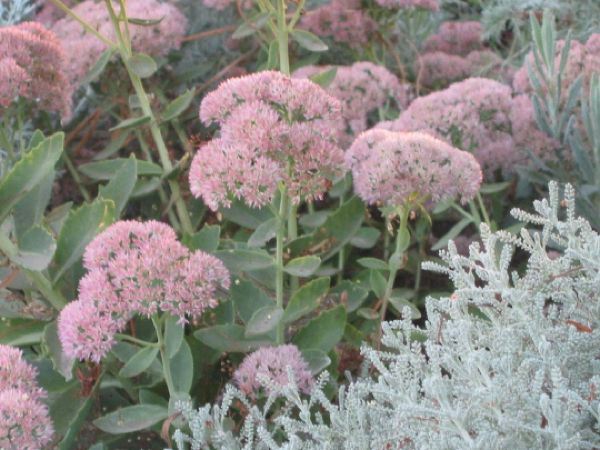
Sedums are succulent plants, usually grown for the foliage. But S. spectabile has spectacular early fall flower clusters in shades of pink and red, which age to a unique brownish-red color. This is a tough plant for full sun or light shade.
Roses
Fall in the Sacramento Valley is a wonderful season for our roses. On your traditional types such as Hybrid Teas (long-stem cutting roses), trim off the hips (seed pods) that may have formed this summer. Shape the bushes a bit with light pruning. Remove any suckers that have sprouted – they are obvious shoots, much more vigorous and vine-like than the main plant. Wash the summer dust and spider mites off the foliage with a strong blast of water. Give each plant some fertilizer and a good soaking. You can expect a nice crop of flowers by Hallowe'en, with blossoms continuing into November.
More informal roses such as the shrub and landscape types may have set a large crop of hips, and these color nicely as the nights get cooler. Rose hips can be used for tea (simply remove the seeds, then simmer 4 – 6 hips in 2 cups of water for about 30 minutes, strain and serve) or for winter wreaths and decorations.
Salvia: the sages are the royalty of the autumn border.
With over a hundred species and varieties of Salvia available from growers, we have types that bloom nearly any time of year. But summer and fall are when Salvias really fill the border. Vivid purples, reds, pinks, some startlingly bright. Salvia flowers attract hummingbirds. Here is just a sampling of some notable species and hybrids.
Annual salvias
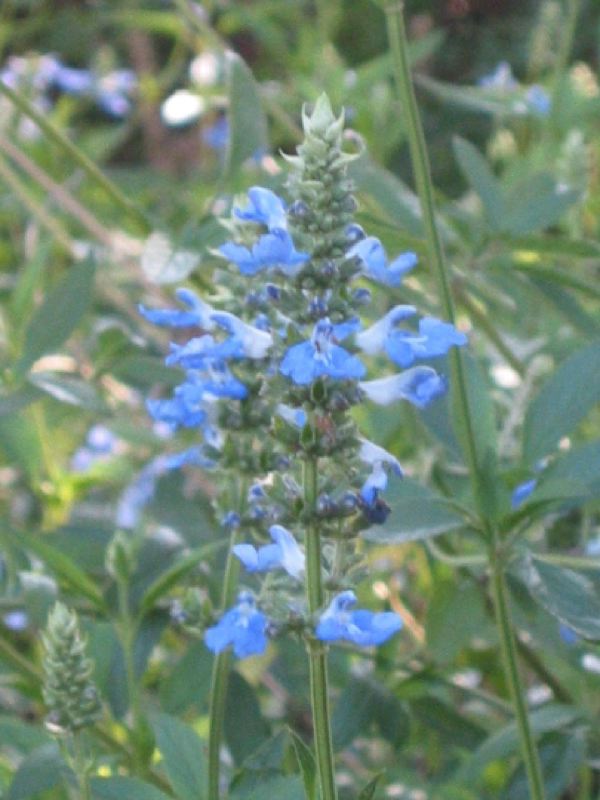
The short, annual red-flowered S. splendens blooms until frost. S. farinacea, the Texas violet, has lovely light blue flower spikes. It doesn't usually overwinter here, so we treat it as an annual. Though both are considered 'summer annuals', their fall bloom is outstanding.
Perennial salvias
Herbaceous (soft) forms that are especially showy include
- S. elegans
Pineapple sage, named for the scent of the foliage. Blooms into winter. Expect some cold damage, but it usually resprouts in spring.
- S. guaranitica
Anise-scented sage. Big sprawly thing with spectacular flowers. Spreads. Hack it to the ground each winter.
- S. 'Indigo Spires'
Another sprawly plant with vivid violet-blue flower spikes which are long enough to cut for flower arrangements.
- S. nemorosa
One of the showiest garden Salvias, with a low growth habit and copious blooms. 'East Friesland' is one of the best varieties: non-stop spikes of purple flowers from May through October.
- S. uliginosa
Bog sage. One of my favorites for the sky-blue flowers. As the name implies, this will grow in soggy soil. In the 'normal' border it makes a great indicator plant: droops when the border needs water, then perks back up instantly. Be forewarned: spreads aggressively. Prune with a machete.
Shrubby salvias
Forms that have showy summer and fall flowers include:
- S. greggii
with numerous varieties and hybrids.Called Autumn sage, although they will bloom nearly any month of the year here. Steady, reliable, long-lived shrubs with flowers that are small but abundant and available in nearly every shade of red, purple, pink, and even white. S. microphyllais basically the same, and S. x jamensisis the name given to hybrids between the two species.
- S. leucantha
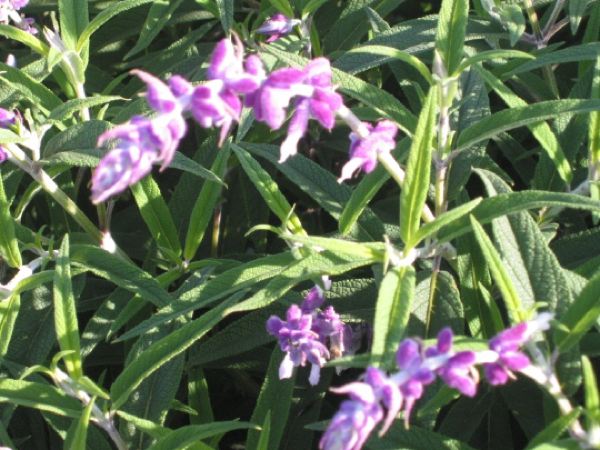
Mexican sage. Big, upright to about 4' here, this may fall over as it blooms. So plant it behind other, stouter Salvias or lower shrubs. Spectacular velvety royal purple flowers continue until frost. One of my favorites.
There are several attractive native and culinary Salvias as well.
These California natives are great garden plants, especially in low-water landscapes. But most bloom in spring or early summer, finishing their cycle before our summer heat and drought puts them into a semi-dormant state. Attractive foliage and growth habit makes them suitable background plants for the fall-blooming species.
- S. apiana
White sage, used for burning rituals. Intensely scented foliage is silvery-gray, almost white. Great in a moonlight garden.
- S. clevelandii
California blue sage. A chaparral shrub from Southern California. There are some named hybrids with uniformly compact growth habit, showier flowers than the species.
- S. spathacea
Pitcher sage. The giant arrow-shaped leaves are attractive enough in their own right. The 3' flower spikes are stunning and, as Sunset says, 'a magnet for hummingbirds.' This spring bloomer may give a repeat fall bloom.
- Salvia officinalis
Garden sage. This is the sage we use in cooking, but it is also an attractive shrub in the landscape or border. The standard form has purplish-grey leaves, but there are forms with golden and pink variegation as well. Tolerant of heat, drought, light shade, it grows to about 3' x 3' or more. Combine with lavender and rosemary as the year-'round backbone of your herb garden.
Brightening the autumn flower garden can seem like a challenge, as we continue to swing back and forth between cool weather and hot spells. Don't worry about short intervals of hot weather. Water new plants thoroughly when you install them, then check every other day. As the days shorten and nights cool, new transplants probably need water every 3 – 4 days.
From the Davis Enterprise, September 27, 2007
Tuesday, August 18, 2009
Cool gardens on a hot day
Cool gardens on a hot day: visiting the UC Davis Arboretum Terrace Garden and Carolee Shields Garden.
Sunday, August 16, 2009
August in your garden and landscape
Here are some ideas for August garden activities. Check out the printable monthly calendar and list of 'what's blooming in August'.
Subscribe to:
Posts (Atom)
