
Too chilly to plant tomatoes, peppers, and eggplant?
When do we plant summer vegetables?
The soil needs to be warm!
Night temperature can be a guide to how warm the soil is.
Night temperature and soil temperature guidelines:
Tomatoes
Night temp: 50 – 55F Soil temp: 60F
Peppers, eggplant
Night temp: 55 – 60F Soil temp: 70F
For night temperature: use a maximum-minimum thermometer, or check the local weather listings.
For soil temperature: use a soil thermometer, or visit the UC Davis weather info site.
Going by the calendar: usually mid to late April for tomatoes, early May for peppers.
Why do nurseries and hardware stores have them now?
Some gardeners like to buy small plants to shift them into larger pots for a few weeks before setting them out.
Everyone else is selling them, and we get tired of saying "it's too early!"
What happens if we plant too early?
Tomatoes will sit, discolor a bit, and then begin to grow as it warms.
Peppers and eggplant will sulk and be stunted all season. Peppers planted later out-perform peppers planted early.
To increase soil temperature:
turn in organic material and mound up the soil.
build a raised planter bed
cover the area with seedling blanket
Or, just wait! We'll have plenty in stock through June!
Sunday, March 14, 2010

Friday, February 26, 2010
A new pest in fruit trees!
Spotted Wing Drosophila
A new pest in fruit trees; homeowner information for monitoring and control of Spotted Wing Drosophila (aka Cherry Vinegar Fly).
Serious infestations in the ripening fruit of cherries were reported in several counties of Northern California, including Yolo County, in spring 2009. Fruit were full of squirming larvae. Most scientists, nursery professionals, and master gardeners encountering the pest simply assumed it was a regular fruit fly infesting overripe fruit. Home gardeners protested that the fruit was ruined right on the tree, just at the peak of harvest. Locally our first reports came from South Davis. Damage to cherries in Santa Clara County was so severe, especially on early varieties, that growers had to stop harvest.
 Photo by Ed Show, courtesy of UC Cooperative Extension, Santa Cruz County
State entomologists had to search to identify this new pest, eventually finding a description from Japan from the early 1930's. The spots on the wings of the male flies clearly marked it as Drosophila suzukii. You know Drosophila as "fruit flies," the annoying little flies that hover over rotting fruit. Some in that group are called "vinegar flies." The new pest was initially called the Cherry Vinegar Fly (CVF), but cherry growers weren't thrilled about that name. So it is now called the Spotted Wing Drosophila (SWD).
The homeowners were right: unlike most fruit flies, which infest overripe and rotting fruit, the SWD adult lays its eggs in fruit that is just ripening, and the larva hatch very quickly in warm weather. Damage can be first seen as a small depression on the underside of the fruit, where the adult female has oviposited (laid her eggs). Larvae hatch and begin to damage within as little as two days.

Photo by Larry Strand, courtesy of UC Statewide IPM Program.
Since then, infestations have been found in California in blueberries, blackberries, olallieberries and raspberries, plums, nectarines, and strawberries. Wine and table grapes have been found infested in Oregon, but not yet in California. The original paper describing infestation in Japan in 1939 listed apples, peaches, and persimmons. You can expect possible infestations in nearly any type of soft fruit that ripens in warm weather. Cherries, strawberries, and blackberries have been the main concern so far.
There isn't going to be any quarantine or regulatory action taken, because the fly is already well established and distributed widely in California, as well as in several other states. Fruit flies disperse very readily, helped along by humans.
The lifecycle of this pest
They apparently overwinter as adult flies. While many will die at freezing temperatures, the whole population won't be killed and enough survive to repopulate. The female lays 2 - 3 eggs per fruit, about 350 in her lifetime, and they can have as many as 10 generations per year (perhaps 3 generations in the course of a cherry crop).
They are most active at 68 degrees F, and activity is reduced at higher temperatures; in fact, the males become sterile at 86 degrees F. So the greatest threat is to fruit that ripens in spring and early summer. Vinegar flies in general are very sensitive to desiccation, and will die within 24 hours in the absence of water. Irrigation management may be part of an overall pest reduction strategy: keep the orchard floor clean, and avoid moisture on the ground and nearby weeds while the fruit is ripening.
What are we going to do about this?
When a new pest arrives, plant professionals have a problem. We can't recommend a pesticide if it isn't labeled for a particular pest and crop. Working with cooperative extension personnel, commercial growers can get emergency permission to use products based on efficacy data from other states, if necessary. Similar recommendations may be forthcoming for homeowners. But at the moment nothing is labeled for you to use on this pest in California.
If you didn't have a problem last year, you can monitor to see if the fly is present in your garden. This is easy, because fruit flies are attracted to vinegar, rotting fruit, sugar, and yeast. Mason jars or fly traps filled with homemade bait solutions can be hung in trees. According to one reference, "yeast and sugar mixed with water proved the most effective bait (one package of Baker's yeast, four teaspoons of sugar and 12 ounces of water)." You will surely catch all kinds of interesting insects, including many species of Drosophila!
Traps can be made readily from materials at home; it's pretty easy to attract and catch fruit flies! Mason jars or Rescue Fly Traps can be filled with any number of vinegar or sugar solutions. Options include a mix of yeast and sugar, or yeast with banana slices, or just an inch or so of apple cider vinegar. In field tests, the yeast/sugar mix caught the most flies. Trapping can be part of an overall management strategy.
Mary Louise Flint, Extension Entomologist with the UC Statewide IPM Program, and author of numerous publications on integrated pest management, questions whether trapping will be worthwhile for home gardeners. Commenting by email, "The problem with trapping flies is that you get so many different flies and potentially hundreds in each trap and they all become a sticky mess. You will likely get hundreds of regular Drosophila (and many other species) in your traps and it will be difficult for home gardeners to separate out the few SWD that may be there." She points out that "by the time you find the flies in your traps, it may be too late to apply" control sprays.
Suffice to say, you would need to check your traps often, learn to recognize this fruit fly. The male is the only species with a spot on the wing, and the female has a huge ovipositor. Spray immediately if you find any. Or just watch for damage on your earliest varieties; look for the dimple-shaped spot on the fruit where the eggs are deposited. Sprays could protect later-ripening varieties.
What control measures are available?
When this pest arrived in Washington State, cherry orchards quickly reached very high levels of infestation. Fruit full of squirmy worms have little market appeal. Tests of conventional pesticides such as malathion gave good results, but full tree coverage was necessary and control required 3 applications at 5-day intervals. In my opinion, spraying your ripening fruit with a commercial pesticide sort of defeats the goal of healthy home-grown produce. And without a commercial sprayer, you won't get good coverage, so results will be spotty.
Spinosad, an organic spray with very low human toxicity, was equally effective when applied the same way. But when it is mixed with a bait to lure the flies to the spray droplets, they got very good results just spraying coarse droplets more or less into the middle part of the tree. That is something homeowners could do with a small hand-held sprayer. Spinosad itself is readily available in garden centers. Monterey Garden Insect Spray and Green Light Lawn & Garden Concentrate are 0.5% spinosad. The key is the bait attractant, which those products lack.
What is spinosad?
It is a byproduct of fermentation of a soil bacterium that was found in an abandoned rum distillery in the Caribbean by a scientist who was on vacation (and my kids used to complain about being dragged to botanical gardens!). It has very low toxicity to mammals.
There is one product called GF-120 NF Naturalyte that mixes spinosad with a bait attractant. Unfortunately, it is only available from farm chemical supply companies, and only in gallon bottles at about $155.00 - not a likely option for someone with a couple of backyard trees! GF-120 is a safe, organically-approved spray, so I was curious what bait attractant they were mixing with the spinosad. The label isn't very informative; chemical companies tend to be a little proprietary about their products. But every chemical has an MSD sheet, which lists all the precautionary statements, the handling instructions, etc., for each ingredient; by law, that must list each active ingredient. Lo and behold, the bait is propylene glycol. When I mentioned this to my son, who works with cars, he arched his eyebrows. "You mean antifreeze?"
Yes, propylene glycol, which you know as auto coolant or antifreeze, is very sweet to the taste (pets get poisoned by antifreeze leaks from vehicles) and attracts fruit flies. Apparently it can be produced in an organically-accepted manner. It is even a food additive. GF-120 is 2.5% propylene glycol, which acts to draw the fruit flies to the spray droplets, where they feed and are killed by the spinosad.
Sweeten the pot?
The principle of adding sweeteners to pesticides is a little unorthodox, but not unprecedented. I was reminded of a similar extension-approved tactic we used years ago. Back when we had a commercial pest-control service, we did spraying for walnut husk fly. A farm adviser at the time recommended adding Karo corn syrup to the spray tank! Current recommendation for husk fly is to "add about 4 - 6 tablespoons of molasses per gallon of water applied," and spinosad is now the spray of choice for that (unrelated) pest.
Perhaps the same idea could be adopted for homeowners seeking a reasonable control for Spotted Wing Drosophila: use spinosad at the label recommendation, with 4 - 6 Tbsp of molasses per gallon added to the sprayer.
Use a coarse spray on the trunk and interior of the tree, to draw the flies away from the fruit. You could even use a small squirt bottle and just spray around the inner canopy of the tree. Do this a few days before the fruit ripens, and again once or twice as it begins to ripen. Molasses is going to be sticky, so wash your sprayer out with detergent after use. Spinosad on the fruit will not hurt you, but it isn't necessary to spray the fruit.
It's important to note that GF-120 is the only pesticide extension personnel are currently suggesting, as Flint commented to me, "but with the caveat that it may not be completely effective and is also difficult to obtain." Spinosad with molasses might work for home gardeners, but "we don't have any data for backyard trees." Extension folks and nursery professionals will be interested in any results from home gardeners. If and when a labeled product is available in a smaller unit, at a reasonable price for homeowners, it would be best to use that. We'll keep you updated.
Another option will be to pick the fruit while it is still firm, bring it inside, and ripen it indoors. Look closely at the fruit for the dimple-like point where the female deposits the eggs. Or just sort through your fruit at harvest. Infested fruit is very recognizable: it turns to a pulpy, wormy mess almost instantly.
For more photos and links, check out the original article at http://redwoodbarn.com/DE_Drosophila.html
Written for the Davis Enterprise, February 25, 2010
A new pest in fruit trees; homeowner information for monitoring and control of Spotted Wing Drosophila (aka Cherry Vinegar Fly).
Serious infestations in the ripening fruit of cherries were reported in several counties of Northern California, including Yolo County, in spring 2009. Fruit were full of squirming larvae. Most scientists, nursery professionals, and master gardeners encountering the pest simply assumed it was a regular fruit fly infesting overripe fruit. Home gardeners protested that the fruit was ruined right on the tree, just at the peak of harvest. Locally our first reports came from South Davis. Damage to cherries in Santa Clara County was so severe, especially on early varieties, that growers had to stop harvest.
 Photo by Ed Show, courtesy of UC Cooperative Extension, Santa Cruz County
State entomologists had to search to identify this new pest, eventually finding a description from Japan from the early 1930's. The spots on the wings of the male flies clearly marked it as Drosophila suzukii. You know Drosophila as "fruit flies," the annoying little flies that hover over rotting fruit. Some in that group are called "vinegar flies." The new pest was initially called the Cherry Vinegar Fly (CVF), but cherry growers weren't thrilled about that name. So it is now called the Spotted Wing Drosophila (SWD).
The homeowners were right: unlike most fruit flies, which infest overripe and rotting fruit, the SWD adult lays its eggs in fruit that is just ripening, and the larva hatch very quickly in warm weather. Damage can be first seen as a small depression on the underside of the fruit, where the adult female has oviposited (laid her eggs). Larvae hatch and begin to damage within as little as two days.

Photo by Larry Strand, courtesy of UC Statewide IPM Program.
Since then, infestations have been found in California in blueberries, blackberries, olallieberries and raspberries, plums, nectarines, and strawberries. Wine and table grapes have been found infested in Oregon, but not yet in California. The original paper describing infestation in Japan in 1939 listed apples, peaches, and persimmons. You can expect possible infestations in nearly any type of soft fruit that ripens in warm weather. Cherries, strawberries, and blackberries have been the main concern so far.
There isn't going to be any quarantine or regulatory action taken, because the fly is already well established and distributed widely in California, as well as in several other states. Fruit flies disperse very readily, helped along by humans.
The lifecycle of this pest
They apparently overwinter as adult flies. While many will die at freezing temperatures, the whole population won't be killed and enough survive to repopulate. The female lays 2 - 3 eggs per fruit, about 350 in her lifetime, and they can have as many as 10 generations per year (perhaps 3 generations in the course of a cherry crop).
They are most active at 68 degrees F, and activity is reduced at higher temperatures; in fact, the males become sterile at 86 degrees F. So the greatest threat is to fruit that ripens in spring and early summer. Vinegar flies in general are very sensitive to desiccation, and will die within 24 hours in the absence of water. Irrigation management may be part of an overall pest reduction strategy: keep the orchard floor clean, and avoid moisture on the ground and nearby weeds while the fruit is ripening.
What are we going to do about this?
When a new pest arrives, plant professionals have a problem. We can't recommend a pesticide if it isn't labeled for a particular pest and crop. Working with cooperative extension personnel, commercial growers can get emergency permission to use products based on efficacy data from other states, if necessary. Similar recommendations may be forthcoming for homeowners. But at the moment nothing is labeled for you to use on this pest in California.
If you didn't have a problem last year, you can monitor to see if the fly is present in your garden. This is easy, because fruit flies are attracted to vinegar, rotting fruit, sugar, and yeast. Mason jars or fly traps filled with homemade bait solutions can be hung in trees. According to one reference, "yeast and sugar mixed with water proved the most effective bait (one package of Baker's yeast, four teaspoons of sugar and 12 ounces of water)." You will surely catch all kinds of interesting insects, including many species of Drosophila!
Traps can be made readily from materials at home; it's pretty easy to attract and catch fruit flies! Mason jars or Rescue Fly Traps can be filled with any number of vinegar or sugar solutions. Options include a mix of yeast and sugar, or yeast with banana slices, or just an inch or so of apple cider vinegar. In field tests, the yeast/sugar mix caught the most flies. Trapping can be part of an overall management strategy.
Mary Louise Flint, Extension Entomologist with the UC Statewide IPM Program, and author of numerous publications on integrated pest management, questions whether trapping will be worthwhile for home gardeners. Commenting by email, "The problem with trapping flies is that you get so many different flies and potentially hundreds in each trap and they all become a sticky mess. You will likely get hundreds of regular Drosophila (and many other species) in your traps and it will be difficult for home gardeners to separate out the few SWD that may be there." She points out that "by the time you find the flies in your traps, it may be too late to apply" control sprays.
Suffice to say, you would need to check your traps often, learn to recognize this fruit fly. The male is the only species with a spot on the wing, and the female has a huge ovipositor. Spray immediately if you find any. Or just watch for damage on your earliest varieties; look for the dimple-shaped spot on the fruit where the eggs are deposited. Sprays could protect later-ripening varieties.
What control measures are available?
When this pest arrived in Washington State, cherry orchards quickly reached very high levels of infestation. Fruit full of squirmy worms have little market appeal. Tests of conventional pesticides such as malathion gave good results, but full tree coverage was necessary and control required 3 applications at 5-day intervals. In my opinion, spraying your ripening fruit with a commercial pesticide sort of defeats the goal of healthy home-grown produce. And without a commercial sprayer, you won't get good coverage, so results will be spotty.
Spinosad, an organic spray with very low human toxicity, was equally effective when applied the same way. But when it is mixed with a bait to lure the flies to the spray droplets, they got very good results just spraying coarse droplets more or less into the middle part of the tree. That is something homeowners could do with a small hand-held sprayer. Spinosad itself is readily available in garden centers. Monterey Garden Insect Spray and Green Light Lawn & Garden Concentrate are 0.5% spinosad. The key is the bait attractant, which those products lack.
What is spinosad?
It is a byproduct of fermentation of a soil bacterium that was found in an abandoned rum distillery in the Caribbean by a scientist who was on vacation (and my kids used to complain about being dragged to botanical gardens!). It has very low toxicity to mammals.
There is one product called GF-120 NF Naturalyte that mixes spinosad with a bait attractant. Unfortunately, it is only available from farm chemical supply companies, and only in gallon bottles at about $155.00 - not a likely option for someone with a couple of backyard trees! GF-120 is a safe, organically-approved spray, so I was curious what bait attractant they were mixing with the spinosad. The label isn't very informative; chemical companies tend to be a little proprietary about their products. But every chemical has an MSD sheet, which lists all the precautionary statements, the handling instructions, etc., for each ingredient; by law, that must list each active ingredient. Lo and behold, the bait is propylene glycol. When I mentioned this to my son, who works with cars, he arched his eyebrows. "You mean antifreeze?"
Yes, propylene glycol, which you know as auto coolant or antifreeze, is very sweet to the taste (pets get poisoned by antifreeze leaks from vehicles) and attracts fruit flies. Apparently it can be produced in an organically-accepted manner. It is even a food additive. GF-120 is 2.5% propylene glycol, which acts to draw the fruit flies to the spray droplets, where they feed and are killed by the spinosad.
Sweeten the pot?
The principle of adding sweeteners to pesticides is a little unorthodox, but not unprecedented. I was reminded of a similar extension-approved tactic we used years ago. Back when we had a commercial pest-control service, we did spraying for walnut husk fly. A farm adviser at the time recommended adding Karo corn syrup to the spray tank! Current recommendation for husk fly is to "add about 4 - 6 tablespoons of molasses per gallon of water applied," and spinosad is now the spray of choice for that (unrelated) pest.
Perhaps the same idea could be adopted for homeowners seeking a reasonable control for Spotted Wing Drosophila: use spinosad at the label recommendation, with 4 - 6 Tbsp of molasses per gallon added to the sprayer.
Use a coarse spray on the trunk and interior of the tree, to draw the flies away from the fruit. You could even use a small squirt bottle and just spray around the inner canopy of the tree. Do this a few days before the fruit ripens, and again once or twice as it begins to ripen. Molasses is going to be sticky, so wash your sprayer out with detergent after use. Spinosad on the fruit will not hurt you, but it isn't necessary to spray the fruit.
It's important to note that GF-120 is the only pesticide extension personnel are currently suggesting, as Flint commented to me, "but with the caveat that it may not be completely effective and is also difficult to obtain." Spinosad with molasses might work for home gardeners, but "we don't have any data for backyard trees." Extension folks and nursery professionals will be interested in any results from home gardeners. If and when a labeled product is available in a smaller unit, at a reasonable price for homeowners, it would be best to use that. We'll keep you updated.
Another option will be to pick the fruit while it is still firm, bring it inside, and ripen it indoors. Look closely at the fruit for the dimple-like point where the female deposits the eggs. Or just sort through your fruit at harvest. Infested fruit is very recognizable: it turns to a pulpy, wormy mess almost instantly.
For more photos and links, check out the original article at http://redwoodbarn.com/DE_Drosophila.html
Written for the Davis Enterprise, February 25, 2010
Monday, February 8, 2010
Blueberries?
Growing acid-loving plants
Written for the Davis Enterprise, December 24, 2008
February 7, 2010: A great article in the Sacramento Bee prompted a flurry of phone calls to our nursery -- can we really grow blueberries here? Here are the issues for gardeners in Davis, Woodland, Dixon, and other communities that rely on groundwater for irrigation. Water from wells is hard and has a high pH.
Oh, those acid-loving plants.
Camellias are the queen of the winter garden - in Sacramento. Azaleas mean spring. Can we grow blueberries? How about true blue hydrangeas? What does "acid-loving plant" mean, anyway?
The issues with Davis water.
What's the problem?
Water in Davis and Woodland is alkaline, meaning it has a high pH, which causes deficiencies of some minerals essential for green leaves and plant growth. When the leaves are yellow between the veins, the plant is deficient in iron. When that yellowing is blotchy, it is lacking magnesium. When the new leaves are smaller than they should be, it is lacking zinc. The water is high in certain salts, which can cause ugly burnt edges on the leaves of some plants.
Note: it isn't always pH that is the problem. Overwatering can damage roots of plants, so they can't take up the minerals. When we see deficiencies on common landscape shrubs such as Escallonia and Nandina, we suspect overwatering.
What are these finicky plants?
Group 1: we can grow these with special soil amendments and additives. If you don't fertilize them regularly and/or treat the soil with pH reducers, they will get anemic and fail to thrive.
o Blueberries
o Camellias
o Gardenias
o Hydrangeas (more on flower color below)
o Lesser-known ornamentals include Loropetalum and Pieris
o Some specialty conifers: Cryptomeria, Chamaecyparis
o Azaleas can get chronically anemic and are prone to crown rot, but may be successful for a couple of years.
o Japanese maples (Acer palmatum) prefer acidic soil conditions, but most of the leaf damage attributed to our water on these small trees is actually caused by hot, dry summer weather.
Group 2: these shrubs and trees often show persistent deficiencies.
o Deciduous magnolias: Saucer magnolia (M. soulangeana), Star magnolia (M. stellata), and others. Deficiencies are common but correctible, and these are worth growing for the showy spring bloom.
o Citrus and rose leaves often show iron deficiency, and sometimes show magnesium and zinc deficiency.
Group 3: chronic deficiencies and leaf burn make these plants ugly. Not recommended.
o Dogwood (Cornus florida). Some species of Cornus grow here, but not these showy-flowered types.
o Rhododendrons.
o Sweetgum (Liquidambar styraciflua) and Sour gum (Nyssa sylvatica, also called Tupelo).
Soil chemistry: what's going on?
It isn't that the important minerals aren't present in the soil. Adding more iron, magnesium, or zinc won't correct the problem. As the soil gets more alkaline, they become insoluble.
One example. Iron is taken up by plants as a positive ion (Fe++) via ion exchange on the root surface. Hydroxide (OH-) is more abundant in alkaline soil. Hydroxide combines with the iron ions the plant needs, creating iron hydroxide (Fe(OH)2) - which the plant can't absorb.
Well-meaning gardeners can make the problem worse by applying too much fertilizer, or the wrong type. For example, excess phosphorus can make iron unavailable, and vice versa. It's easier to correct the soil pH than to try to add a specific mineral. Transplanted east-coast gardeners need to know that since lime raises soil pH, we don't apply it here at all.
So, what to do?
Make the soil more acidic. The technical term is to acidulate the soil.
Applying sulfur is the simplest way to go: elemental sulfur will react with soil microbes to produce sulfuric acid and hydrogen. While this happens fastest during warm weather, it's ok to apply sulfur any time of year.
For acid-loving shrubs and trees, add a couple of cups of soil sulfur to each planting hole, mixed thoroughly with the backfill soil at the time of planting. When treating an entire bed, apply 5 - 10 lbs. per 100 sq. ft. Mixing it in to the soil increases contact with the microbes, giving faster results than broadcasting it on the surface. Then to follow up, broadcast granular sulfur around established plants each season. Raking it in, or covering it with mulch, gets the soil microbes working on it faster.
Many fertilizers contain sulfur, indicated by the "sulfate" in the name or in the list of sources on the guaranteed analysis. Each has special uses, as well as possible drawbacks.
o It takes 8 times as much iron sulfate to achieve the same results as soil sulfur.
o Aluminum sulfate (used to turn hydrangeas blue), if used in large quantities, can lead to an excess of aluminum which can cause other nutrient deficiencies.
o Ammonium sulfate packs a wallop of nitrogen due to the ammonia content; this inexpensive lawn food, misused, has fried a lot of lawns via overdose!
Synthetic fertilizers labeled for acid-loving plants get most of their important nutrients from sulfate-based sources. Cottonseed meal is an excellent organic fertilizer that makes soil more acidic.
Adding organic material (i.e., compost) makes minerals available to plants by an indirect route. Decomposition of organic material creates humic acid, which loosely binds (the technical term is chelates) those important positive ions of iron, magnesium, etc., making them available for the plant roots. The humic acid keeps the iron and other ions from precipitating out into those insoluble forms.
So to counter the effects of a summer of watering with our hard alkaline water:
o You want the soil around the roots to be providing sulfuric acid and humic acid. Both of these are created slowly but steadily during warm weather when there is sulfur and organic material mixed in the soil.
o Additional sulfur and mulch can be put on the surface around established plants. Scatter sulfur and add a couple of inches of bark mulch each spring or summer.
o Leaves and pine needles can be spread around the plants in fall to decompose.
o Fertilizers containing sulfates can be applied per the package instructions during the growing season (read the label!), but don't rely exclusively on them to lower soil pH.
Miscellaneous remedies.
Weak vinegar solutions, and epsom salts (magnesium sulfate) are sometimes used, providing short-term correction to the pH. Some soil amendments are naturally low in pH: peat moss is widely used when planting camellias and azaleas, though it is a little pricey here since we are far from the peat bogs. Coffee grounds are helpful.
How about avoiding the hard water in the first place? Collecting enough rainwater to provide for a whole season isn't very practical, unless you build a cistern.
Toxicity: boron.
Boron gets blamed for a lot of the problems caused by high pH. "You can't grow camellias in Davis because of the boron!" Well, no: we can grow camellias with effort, and it is mostly just the alkaline water supply that is the problem. Boron is not our primary problem here.
Natural borax deposits in the soils of the coastal mountain range erode and dissolve into the creeks that replenish our ground water. Plants require boron in very small quantities, but it is toxic to some plants at high levels. It doesn't help that many fertilizer manufacturers, trying to include everything plants might need, add boron!
Boron passes readily through the plant and accumulates in the leaves. It takes a couple of years for the boron to build up in the leaf to toxic levels, so deciduous plants drop their leaves before any damage is visible. The most common toxicity symptom is black edges on older leaves of certain broad-leaved evergreens; for example, on evergreen Magnolia (M. grandiflora) and strawberry tree (Arbutus unedo). It's ugly, but not harmful.
What to do?
Boron is soluble. Water deeply and thoroughly. I know, I know: the water you are using contains more boron. But the problem results from shallow waterings, as from a drip system, leaving a buildup of boron salts in the root zone. These salts are often visible on the edge of the watering zone. A good long soak dissolves a bunch of that boron and carries it past the root zone. So does winter rainfall.
What's the deal with hydrangeas?
How does the soil make the flowers blue or pink?!
Ok, more chemistry. Some red and blue flower pigments have very similar chemical structures, and in the case of hydrangeas the molecule can undergo a reversible change in the plant based on the pH of the sap. When the soil around the plant's roots is alkaline, the plant sap becomes slightly alkaline, creating the pink pigment in the flower. When the soil is acidic, so is the plant's sap; the molecule sheds a couple of ions and becomes a different pigment - blue this time. If the pH is neutral, a different pigment is formed, this one mauve in color.
Because we are constantly watering hydrangeas with alkaline water here, it is a challenge to get the blue pigment in the plant as the flower buds are forming. Aluminum sulfate is used (in very small quantities) for this purpose because it causes a quick drop in soil pH. Sulfur added to the soil reacts too slowly to achieve the pigment change within a single season. Apply the aluminum sulfate as the shrub leafs out in the spring, and then again every couple of weeks until you see flower buds. Results vary.
Are there any plants that prefer an alkaline soil and water?
Plants native to arid climates tend to tolerate alkaline conditions. Many references indicate that lilacs also do, and they certainly grow well here.
City of Davis water quality reports are available online here
The pH of Davis water in 2007 averaged 8.3, Woodland 8.23. 7.0 is neutral, less than 7.0 is acidic, greater than 7.0 is alkaline.
Here is the Sacramento Bee article: http://www.sacbee.com/165/story/2516673.html
Written for the Davis Enterprise, December 24, 2008
February 7, 2010: A great article in the Sacramento Bee prompted a flurry of phone calls to our nursery -- can we really grow blueberries here? Here are the issues for gardeners in Davis, Woodland, Dixon, and other communities that rely on groundwater for irrigation. Water from wells is hard and has a high pH.
Oh, those acid-loving plants.
Camellias are the queen of the winter garden - in Sacramento. Azaleas mean spring. Can we grow blueberries? How about true blue hydrangeas? What does "acid-loving plant" mean, anyway?
The issues with Davis water.
What's the problem?
Water in Davis and Woodland is alkaline, meaning it has a high pH, which causes deficiencies of some minerals essential for green leaves and plant growth. When the leaves are yellow between the veins, the plant is deficient in iron. When that yellowing is blotchy, it is lacking magnesium. When the new leaves are smaller than they should be, it is lacking zinc. The water is high in certain salts, which can cause ugly burnt edges on the leaves of some plants.
Note: it isn't always pH that is the problem. Overwatering can damage roots of plants, so they can't take up the minerals. When we see deficiencies on common landscape shrubs such as Escallonia and Nandina, we suspect overwatering.
What are these finicky plants?
Group 1: we can grow these with special soil amendments and additives. If you don't fertilize them regularly and/or treat the soil with pH reducers, they will get anemic and fail to thrive.
o Blueberries
o Camellias
o Gardenias
o Hydrangeas (more on flower color below)
o Lesser-known ornamentals include Loropetalum and Pieris
o Some specialty conifers: Cryptomeria, Chamaecyparis
o Azaleas can get chronically anemic and are prone to crown rot, but may be successful for a couple of years.
o Japanese maples (Acer palmatum) prefer acidic soil conditions, but most of the leaf damage attributed to our water on these small trees is actually caused by hot, dry summer weather.
Group 2: these shrubs and trees often show persistent deficiencies.
o Deciduous magnolias: Saucer magnolia (M. soulangeana), Star magnolia (M. stellata), and others. Deficiencies are common but correctible, and these are worth growing for the showy spring bloom.
o Citrus and rose leaves often show iron deficiency, and sometimes show magnesium and zinc deficiency.
Group 3: chronic deficiencies and leaf burn make these plants ugly. Not recommended.
o Dogwood (Cornus florida). Some species of Cornus grow here, but not these showy-flowered types.
o Rhododendrons.
o Sweetgum (Liquidambar styraciflua) and Sour gum (Nyssa sylvatica, also called Tupelo).
Soil chemistry: what's going on?
It isn't that the important minerals aren't present in the soil. Adding more iron, magnesium, or zinc won't correct the problem. As the soil gets more alkaline, they become insoluble.
One example. Iron is taken up by plants as a positive ion (Fe++) via ion exchange on the root surface. Hydroxide (OH-) is more abundant in alkaline soil. Hydroxide combines with the iron ions the plant needs, creating iron hydroxide (Fe(OH)2) - which the plant can't absorb.
Well-meaning gardeners can make the problem worse by applying too much fertilizer, or the wrong type. For example, excess phosphorus can make iron unavailable, and vice versa. It's easier to correct the soil pH than to try to add a specific mineral. Transplanted east-coast gardeners need to know that since lime raises soil pH, we don't apply it here at all.
So, what to do?
Make the soil more acidic. The technical term is to acidulate the soil.
Applying sulfur is the simplest way to go: elemental sulfur will react with soil microbes to produce sulfuric acid and hydrogen. While this happens fastest during warm weather, it's ok to apply sulfur any time of year.
For acid-loving shrubs and trees, add a couple of cups of soil sulfur to each planting hole, mixed thoroughly with the backfill soil at the time of planting. When treating an entire bed, apply 5 - 10 lbs. per 100 sq. ft. Mixing it in to the soil increases contact with the microbes, giving faster results than broadcasting it on the surface. Then to follow up, broadcast granular sulfur around established plants each season. Raking it in, or covering it with mulch, gets the soil microbes working on it faster.
Many fertilizers contain sulfur, indicated by the "sulfate" in the name or in the list of sources on the guaranteed analysis. Each has special uses, as well as possible drawbacks.
o It takes 8 times as much iron sulfate to achieve the same results as soil sulfur.
o Aluminum sulfate (used to turn hydrangeas blue), if used in large quantities, can lead to an excess of aluminum which can cause other nutrient deficiencies.
o Ammonium sulfate packs a wallop of nitrogen due to the ammonia content; this inexpensive lawn food, misused, has fried a lot of lawns via overdose!
Synthetic fertilizers labeled for acid-loving plants get most of their important nutrients from sulfate-based sources. Cottonseed meal is an excellent organic fertilizer that makes soil more acidic.
Adding organic material (i.e., compost) makes minerals available to plants by an indirect route. Decomposition of organic material creates humic acid, which loosely binds (the technical term is chelates) those important positive ions of iron, magnesium, etc., making them available for the plant roots. The humic acid keeps the iron and other ions from precipitating out into those insoluble forms.
So to counter the effects of a summer of watering with our hard alkaline water:
o You want the soil around the roots to be providing sulfuric acid and humic acid. Both of these are created slowly but steadily during warm weather when there is sulfur and organic material mixed in the soil.
o Additional sulfur and mulch can be put on the surface around established plants. Scatter sulfur and add a couple of inches of bark mulch each spring or summer.
o Leaves and pine needles can be spread around the plants in fall to decompose.
o Fertilizers containing sulfates can be applied per the package instructions during the growing season (read the label!), but don't rely exclusively on them to lower soil pH.
Miscellaneous remedies.
Weak vinegar solutions, and epsom salts (magnesium sulfate) are sometimes used, providing short-term correction to the pH. Some soil amendments are naturally low in pH: peat moss is widely used when planting camellias and azaleas, though it is a little pricey here since we are far from the peat bogs. Coffee grounds are helpful.
How about avoiding the hard water in the first place? Collecting enough rainwater to provide for a whole season isn't very practical, unless you build a cistern.
Toxicity: boron.
Boron gets blamed for a lot of the problems caused by high pH. "You can't grow camellias in Davis because of the boron!" Well, no: we can grow camellias with effort, and it is mostly just the alkaline water supply that is the problem. Boron is not our primary problem here.
Natural borax deposits in the soils of the coastal mountain range erode and dissolve into the creeks that replenish our ground water. Plants require boron in very small quantities, but it is toxic to some plants at high levels. It doesn't help that many fertilizer manufacturers, trying to include everything plants might need, add boron!
Boron passes readily through the plant and accumulates in the leaves. It takes a couple of years for the boron to build up in the leaf to toxic levels, so deciduous plants drop their leaves before any damage is visible. The most common toxicity symptom is black edges on older leaves of certain broad-leaved evergreens; for example, on evergreen Magnolia (M. grandiflora) and strawberry tree (Arbutus unedo). It's ugly, but not harmful.
What to do?
Boron is soluble. Water deeply and thoroughly. I know, I know: the water you are using contains more boron. But the problem results from shallow waterings, as from a drip system, leaving a buildup of boron salts in the root zone. These salts are often visible on the edge of the watering zone. A good long soak dissolves a bunch of that boron and carries it past the root zone. So does winter rainfall.
What's the deal with hydrangeas?
How does the soil make the flowers blue or pink?!
Ok, more chemistry. Some red and blue flower pigments have very similar chemical structures, and in the case of hydrangeas the molecule can undergo a reversible change in the plant based on the pH of the sap. When the soil around the plant's roots is alkaline, the plant sap becomes slightly alkaline, creating the pink pigment in the flower. When the soil is acidic, so is the plant's sap; the molecule sheds a couple of ions and becomes a different pigment - blue this time. If the pH is neutral, a different pigment is formed, this one mauve in color.
Because we are constantly watering hydrangeas with alkaline water here, it is a challenge to get the blue pigment in the plant as the flower buds are forming. Aluminum sulfate is used (in very small quantities) for this purpose because it causes a quick drop in soil pH. Sulfur added to the soil reacts too slowly to achieve the pigment change within a single season. Apply the aluminum sulfate as the shrub leafs out in the spring, and then again every couple of weeks until you see flower buds. Results vary.
Are there any plants that prefer an alkaline soil and water?
Plants native to arid climates tend to tolerate alkaline conditions. Many references indicate that lilacs also do, and they certainly grow well here.
City of Davis water quality reports are available online here
The pH of Davis water in 2007 averaged 8.3, Woodland 8.23. 7.0 is neutral, less than 7.0 is acidic, greater than 7.0 is alkaline.
Here is the Sacramento Bee article: http://www.sacbee.com/165/story/2516673.html
Sunday, February 7, 2010
Heirlooms, or Hybrids?
Heirlooms or hybrids?
Her question was "do you have any heirloom fruit trees? I've heard they're better than hybrids."
Now this dichotomy of heirloom vs. hybrid usually comes up during the spring vegetable season as the popularity of heirloom tomato varieties has increased in recent years. Advocates tout flavor, historical value, regional adaptability, genetic diversity, and more. Plus, you can (carefully) save the seed from your heirloom tomato and it will grow (mostly) the same variety next year. You can't do that with hybrids. Hybrid varieties generally have better disease resistance, greater vigor and productivity; many are more regionally adaptable, and many have outstanding flavor as well.
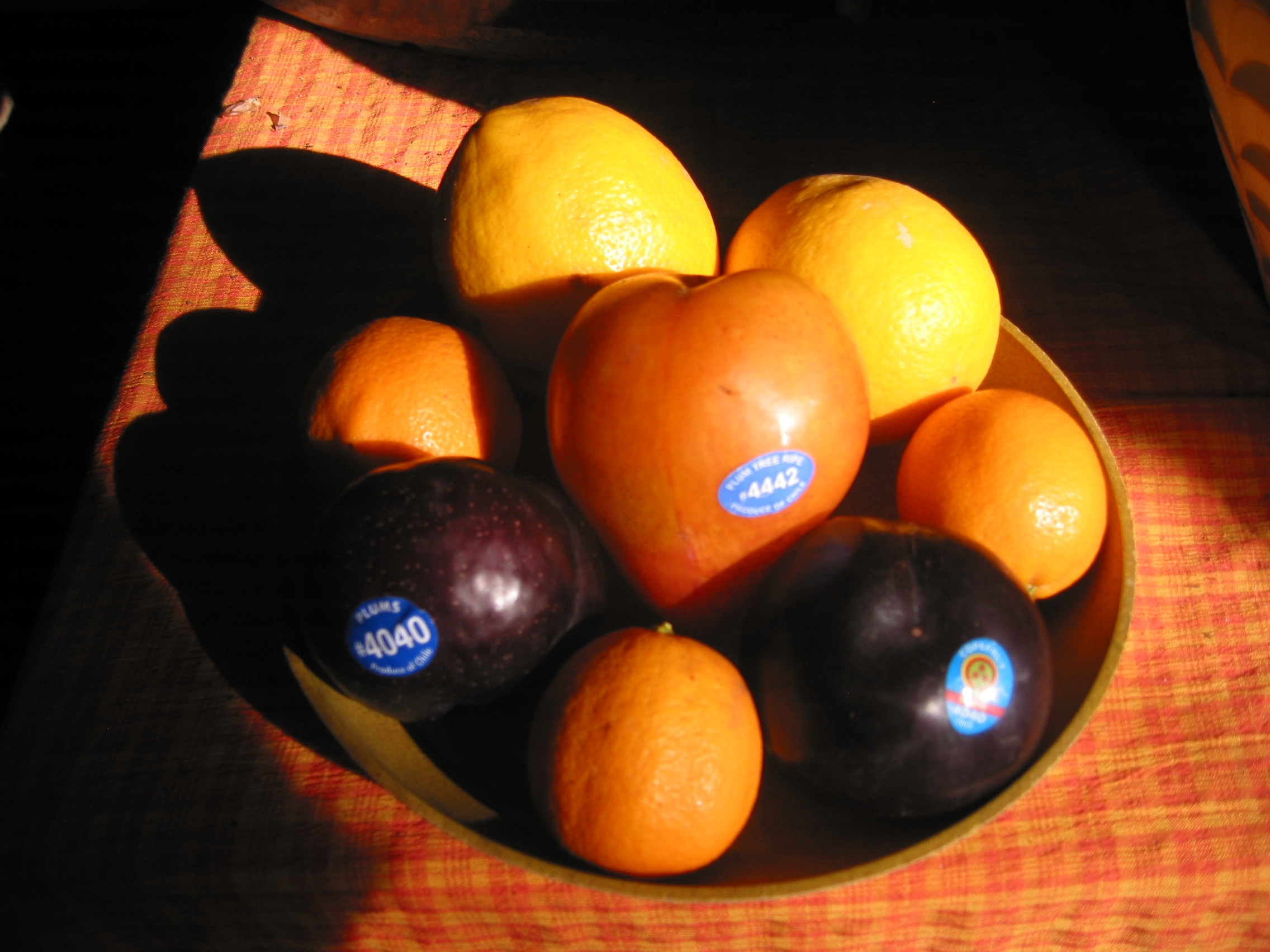
Nearly every plum you buy is a complex interspecific hybrid between Japanese, Chinese, and sometimes American species. Luther Burbank spent more time on plum hybrids than any other plants, estimating that he reviewed 7.5 million seedlings. Many varieties that he introduced in the 1890's remain favorites today, including Santa Rosa, Satsuma, and Wickson. Shown above are some commercial plums grown in Chile, along with some Meyer lemons -- which are also probably hybrids, most likely between a true lemon and a mandarin.
Fruit Trees
But does the term heirloom apply to fruit trees? And what does it mean, anyway? The folks at the Slow Food movement (www.slowfoodusa.org) have developed an Ark of Taste: lists of plant varieties that they believe should be grown, sought out, and appreciated, including what they call heirloom fruit varieties. Some they believe are on the brink of extinction, at risk of being displaced forever by newer commercial varieties. Others have just been around for a long time and have special merit for flavor and history.A few examples suited to California: Sebastopol's Gravenstein apple, the Blenheim apricot, Meyer lemon, Mission olive, important peaches such as Fay Elberta, Rio Oso Gem, and Sun Crest, and plums including Elephant Heart, Laroda, and Mariposa (which was bred in Winters in 1943).
Since many of these are hybrids, clearly this definition of 'heirloom' is based on longevity. Meyer lemon was introduced from China in 1907 by USDA scientist Frank Meyer, and is probably a hybrid between a true lemon and a mandarin. Elberta peaches were from the prodigious breeding efforts of Luther Burbank, who also introduced many of the plums that we know today, as well as the blight-resistant Burbank potato, Shasta daisies, and many other garden treasures. Sometimes a variation occurs naturally, gets noticed by a grower, and is propagated clonally. More often, fruit tree varieties have been intentionally created in hybridization programs.
Roses
Rose growers use the term heirloom to refer to any rose variety that was in existence before 1867. That is the year that the first Hybrid Tea rose was introduced. This cross between Hybrid Perpetual roses and the sensational new Tea roses that had been brought to England from China revolutionized the rose industry, creating the class that has dominated the nursery and florist trade ever since. So all those old Hybrid Perpetuals, Bourbons, and other types that you would have found in any early 19th century garden? Those are the heirloom roses.Vegetables
Vegetable growers tend to use stricter definitions of heirloom. Some say it only includes varieties introduced before 1951, when hybrid varieties from inbred lines were introduced. This seems a little arbitrary. Burpee Hybrid tomato was introduced by W. Atlee Burpee Co. in 1945. Hybrid corn was invented in 1879 and grain hybrids from inbred lines were introduced in the early 1900's. But it wasn't until the 1950's that hybrid varieties became common in the seed catalogues for home gardeners.More commonly people use the term to apply to old "open-pollinated" varieties. Let's say you get seed of a good tomato from a friend. You like it because it grows big, produces lots of fruit, and the fruit is very tasty. Or unusually large, or a different color, or striped. So you save the seed of the best producing plants and you grow that the next year. Since tomatoes are self-pollinating, all you have to do is cover the flower to make sure no stray bee brings pollen from another type of tomato.
Each year you save seed only from the plants that have those desirable characteristics, and grow that seed the next year. You haven't crossed selected parents to create your seeds, as is done with hybrids. Your seedlings are not exactly the same, but they are close enough to be considered homozygous. Within a few generations the traits are stable and the variety is established. That's how old varieties such as Brandywine, Mortgage Lifter, Mr Stripey, etc., have been preserved and passed on for generations.
Sometimes people want to know if the seeds or seedlings are "genetically modified." While traditional hybridizing could be considered a form of genetic modification, usually the term refers to new plants created by gene splicing: inserting a gene, as with CalGene's FlavrSavr¨ tomato introduced in 1991. No seeds or seedlings available to home gardeners are created this way.
A labor of love?
Most people have no idea how long it takes to develop a new hybrid. George Ball Jr., owner of Burpee Seed Co. and Heronswood nursery, wrote in his blog Heronswood Voice: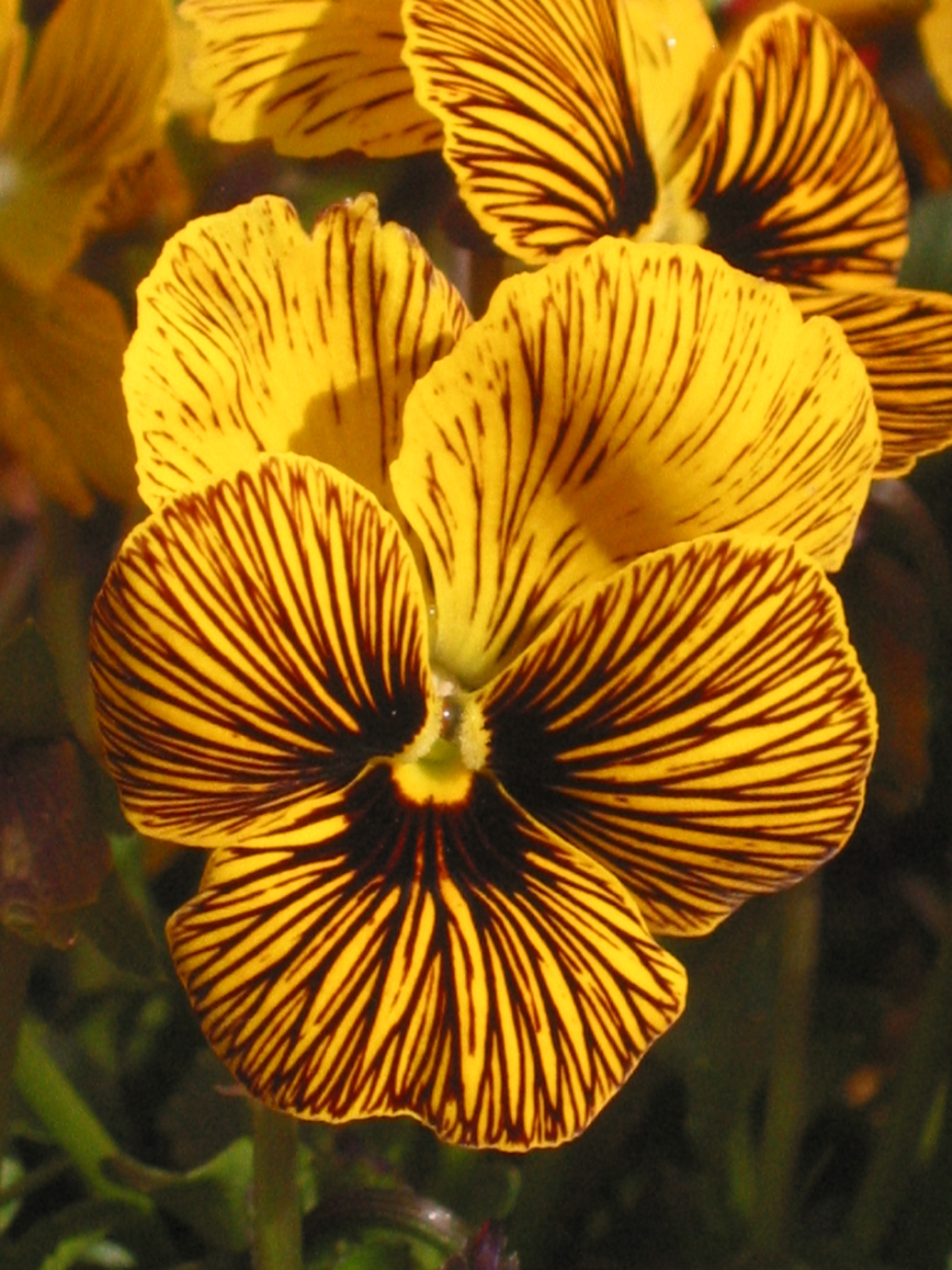
Bred and introduced by Floranova of the United Kingdom, the Angel (TM) violas are hybrids between pansies (Viola wittrockiana) and violas (Viola cornuta). Flowers are smaller than pansies, but hold themselves up better in the rain; larger than violas, with the abundant bloom of that species. Shown here is uniquely striped Angel (TM) 'Tiger Eyes'. Floranova also has operations in Costa Rica.
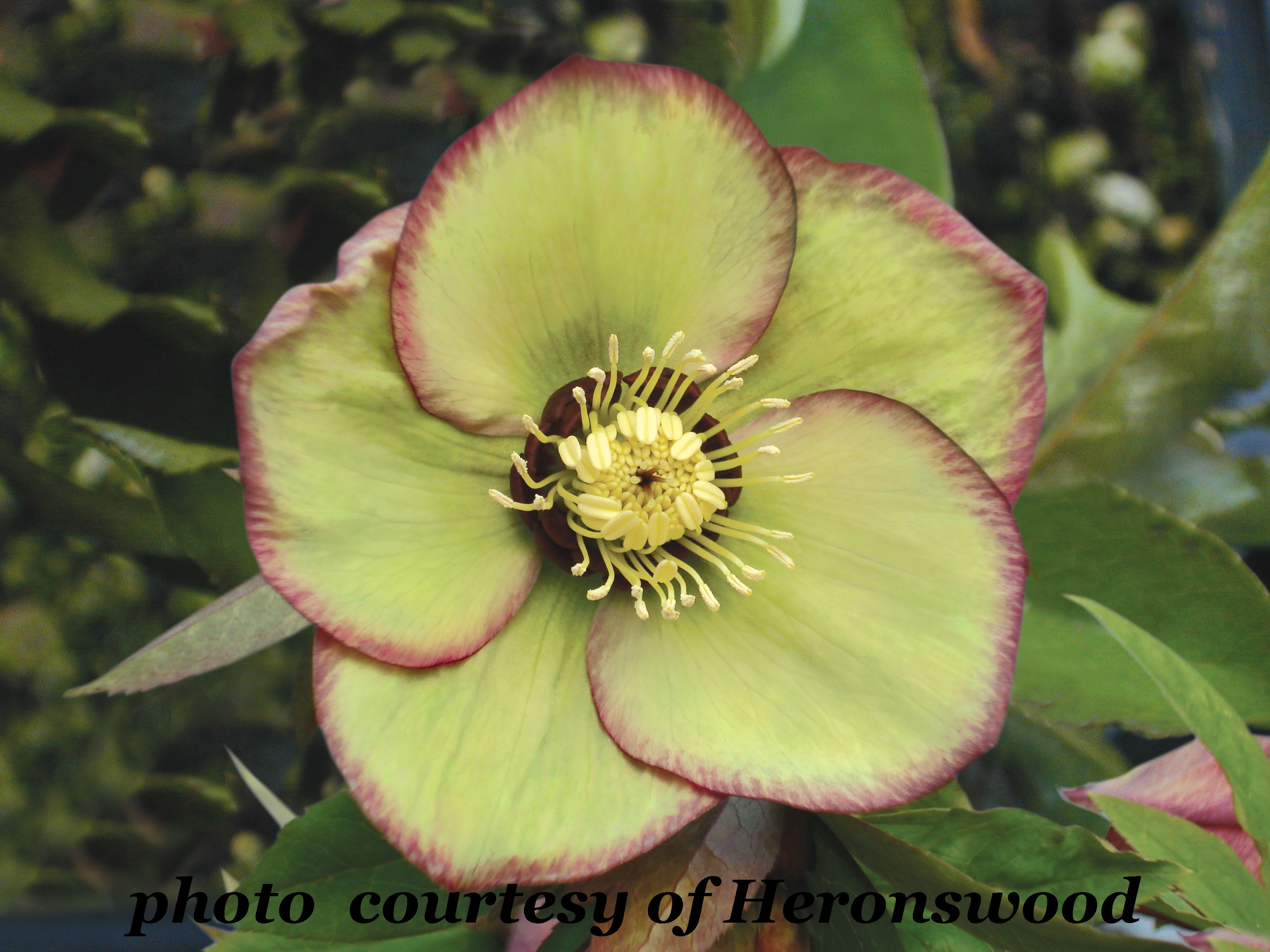
Helleborus orientalis, the Lenten Rose, is an easy-to-grow perennial that will bloom in full shade, in winter. For many years only seedlings in a limited range of colors were available, and the difficulty of propagation made the plants expensive. Heronswood Nursery began a breeding program, selecting for a wider range of colors and for two-toned flowers. After 13 years, the first hybrids came on the market. Shown here is 'Phoenix', an ivory white flower with a distinct pink edge. Photos courtesy of Heronswood Nursery.
Dr. Carl Whitcomb grew 26,000 Lagerstroemia seedlings before he found the wine red foliage he was looking for in the fourth generation. The fifth generation yielded mildew resistance and fragrance, and true red flowers emerged in seedlings of the sixth generation. Some crape myrtle seedlings will flower in the first year, but most take 2 - 6 years. After seven years he had narrowed the seedlings down to a few, including the bright red Dynamite¨ that has become so popular. By 1999, 14 years after embarking on his quest for mildew-resistant crape myrtles with vivid colors, Dr. Whitcomb had grown over 160,000 seedlings. His patent on Dynamite¨ and several other varieties provides some income, but clearly this is a labor of love.
Breeders take a variety of steps to speed up the process.
One of my first jobs as a teenager was tying up cantaloupes. The breeder was growing them in a greenhouse for faster growth, hand-pollinating them, and my job was to fashion slings from his wife's old pantyhose to suspend the fruit from trellises in order to save space. Cantaloupe vines are itchy and greenhouses are hot. I don't recommend this job.
A fruit tree seedling may take 3 - 5 years to produce fruit, but if the seedling wood is budded or grafted onto a mature tree it will fruit sooner.
Breeders of annual flowers and vegetables maintain growing facilities in the northern and southern hemispheres to double their growing seasons. "They 'grow out' selections every six instead of twelve months-and spend a lot of time flying back and forth to Peru, Chile, South Africa, Southeast Asia, Australia and New Zealand," says Ball.
So in the world of fruit trees, an heirloom variety is simply one that has stood the test of time. I don't recommend getting too dogmatic when it comes to tomatoes. I always suggest planting some hybrids such as Early Girl and Celebrity for reliable production and flavor, and some heirlooms for variety. Most of the heirloom tomatoes are regionally adapted to the east coast or Midwest: Brandywine, the famous Amish heirloom, barely produces in the Sacramento Valley heat (my plant produced four fruit last year). California gardeners need to start developing our own seed strains. Then if we wait fifty years or so, we can call them heirlooms.
Written for the Davis Enterprise, February 26, 2009
Thursday, January 28, 2010
Starting summer vegetables from seed!
- Garden centers will have lots of seedlings of tomatoes, peppers, and eggplant at the proper planting time. But there may be unusual varieties you wish to grow. Starting seeds indoors can be a fun project. You may wish to save a little money, or make sure that your seedlings are organically grown.But the indoor environment is not ideal for vegetable plants.
o Low light and lack of air movement cause plants to "stretch" and become leggy. There is the risk of attack by seedling diseases.
o If you start your seeds too far ahead of outdoor-planting weather, they become very tall and undergo transplant shock when you finally move them out.
Given these limitations, the following guidelines will help you succeed:
When to plant
o Start tomato seeds 6 to 8 weeks ahead of your outdoor planting time. We plant outside in late April or May here. Tomato seedlings sprout in about a week and grow very quickly.o Start pepper and eggplant seeds 10 to 12 weeks ahead of your outdoor planting time. We plant them outside in May here. These seeds sprout in 1 to 2 weeks and grow rather slowly.
Planting by the calendar? Tomatoes grow faster, but can be planted out earlier. Peppers and eggplant grow slower, and require warmer soil outdoors. So February is the ideal month to start all of them here. Just be aware that you will hold your pepper and eggplant seedlings a few weeks longer than your tomatoes before putting them in the ground. March is ok; April is too late from seed.
Thursday, January 21, 2010
It's bareroot season!
The Bareroot Season: the gardening year begins
I had the only European white birch tree in my neighborhood, and I hauled it home on the bus. When I was a teenager I got to choose a tree for my yard. My friends and I rode the bus downtown to Walter Andersen Nursery, the largest nursery in San Diego. January!
Bareroot season! There were bins of roses, fruit trees, and shade trees heeled into shavings. Deciduous trees aren't common landscape items along the coast of Southern California. Palms, Norfolk pines, and eucalyptus predominate. But the pictures of soft green foliage and clean, papery white bark enchanted me. I looked for the biggest tree I could buy with my gardening allowance and found a ten-foot tall birch.
The nurseryman yanked it out of the shavings, wrapped the roots, and rang up my purchase. Then he stunned me by whacking the top of the tree off. More on that later. The bus driver looked askance as we boarded, then decided to charge me an extra fare (25 cents) for the tree. Planted in the middle of my meadow (the former lawn, which I no longer mowed), my Betula pendula grew five feet a year, flourishing in the midst of all the subtropicals I had planted, looking about as out of place (and about as white) as the tourists at our local beaches.
Californians may be startled to learn that nursery plants in much of the rest of the country are grown in dirt, in fields, whence they are dug up and wrapped in burlap and wire for sale. Here most of our nursery plants start their lives in greenhouses and are then move into pots in specially formulated potting soils, sitting on clean beds of gravel. But deciduous fruit trees, many shade trees, and nearly all roses are still field grown.
The arrival of bareroot trees and shrubs in January marks the beginning of the planting season. Nowadays many nurseries pot the roses and fruit trees as soon as they arrive. But some still stow them in shavings or sand to sell for a few brief weeks before warm weather breaks the dormancy.
The sandy river-bottom soils on the east side of California's Central Valley are perfect for production of deciduous trees and shrubs. Growers plant the rootstocks a few inches apart, then graft or bud on the desirable fruit or shade varieties in spring. In a season or two, the tree is ready for harvest. As soon as the trees are dormant, specialized machines dig them up, sans soil (hence "bare root"), and teams of fieldworkers sort, stack, and bundle them. Within weeks millions of trees are being shipped all over the country and overseas for orchards and home gardens.
There are just a few major growers of bareroot fruit and shade trees in California. All produce large quantities of commercial varieties of stone fruits, pome fruits (apples and pears), and nut varieties for orchards, and each has found a special market niche. Based on figures from five growers, 8 - 10 million trees are grown and shipped annually. Take that, global warming! Some grow only for commercial orchards, but two split their product lines between orchards and home gardens. These are venerable businesses. The youngest, Sierra Gold Nurseries, is 58 years old; Fowler Nursery in Newcastle will be 100 years old in 2012!
Dave Wilson Nursery (1938) in Hickman (east of Modesto) sells specialty fruit trees, working to broaden the ripening periods and expand the fruit palette. Their collaboration with Zaiger Genetics has led to "150 or so" varieties, says former sales manager Ed Laivo (now retired): white and miniature peaches and nectarines, unique hybrids such as apriums and pluots (apricot/plum hybrids), a new nectarine/plum hybrid, and more. The name notwithstanding, Zaiger Genetics uses conventional hybridizing techniques (not genetic engineering), hand-pollinating and back-crossing and rigorously evaluating tens of thousands of seedlings.
What's new on the horizon? How about the peacotum? (peach - apricot - plum, rhymes with bottom.) Crosses between peach, apricot, and plum, Zaiger and Dave Wilson have test varieties "maybe to introduce in 2010, we'll see," says Laivo, adding that the flavor is "out of this world." Laivo is well-known in nursery and gardening circles for his tireless promotion of backyard orchard techniques, whereby home gardeners plant trees close together, prune severely to reduce fruit production, and do major pruning in summer for size control.
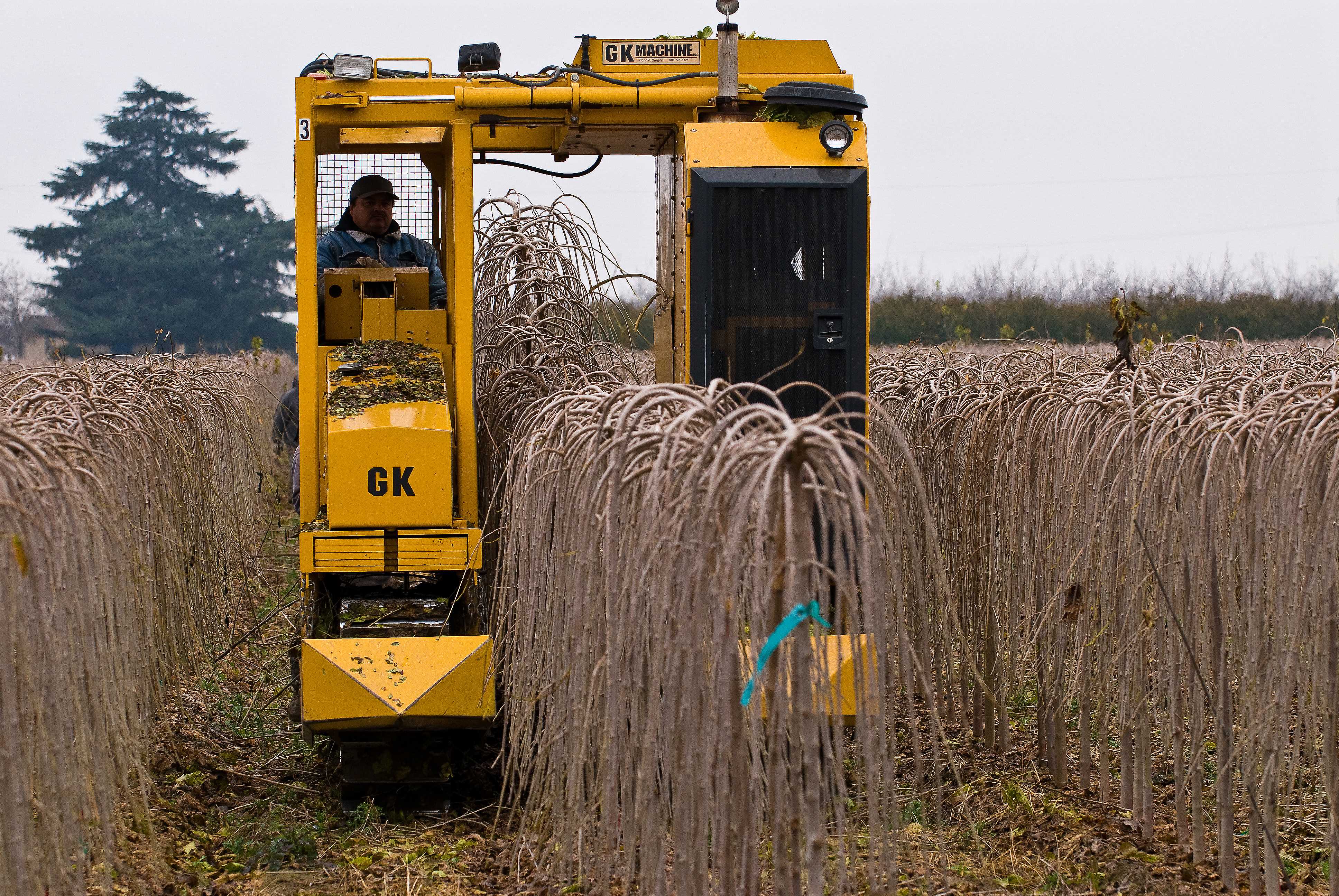
Field workers at L.E. Cooke Co. digging weeping mulberry trees. Photo courtesy of L.E.Cooke Co./Ron Ludekens.
L.E. Cooke Co. (1944) in Visalia grows fruit varieties as well as shade trees and ornamentals. A few years ago they pioneered a new training technique in field production of fruit trees: young trees are cut back once as they grow, leading to lower branching and easier access to the fruit. These EZ-Pick® trees have changed the look of what you buy: instead of an unbranched "whip" you can now get a shrubby, multi-branched plant. L.E. Cooke also grows many weeping trees: cascading varieties are grafted high up onto a rootstock to create unique garden specimens.
What is the advantage of bareroot?
What you get in the bareroot season is the biggest root system at the lowest price. The roots are so big, they have to be pruned to fit in containers. Properly planted and watered, a bareroot tree establishes faster than a container-grown tree. This is when nurseries have the largest selection of fruit tree and rose varieties.Should I prune it?
No. The nurseryman I bought my birch tree from was old school; in the past bareroot trees were topped to "bring the tops and roots in balance." Research has found that the young trees establish better if the top is left unpruned at first. The more leaves you have, the faster the roots will grow. Pruning to train the tree can begin in the first winter after planting.What do I do with this tree until I can plant it?
Keep it moist! The roots should be kept in moist shavings, potting soil, or compost. Water them daily, and sprinkle the top as well. Plant ASAP!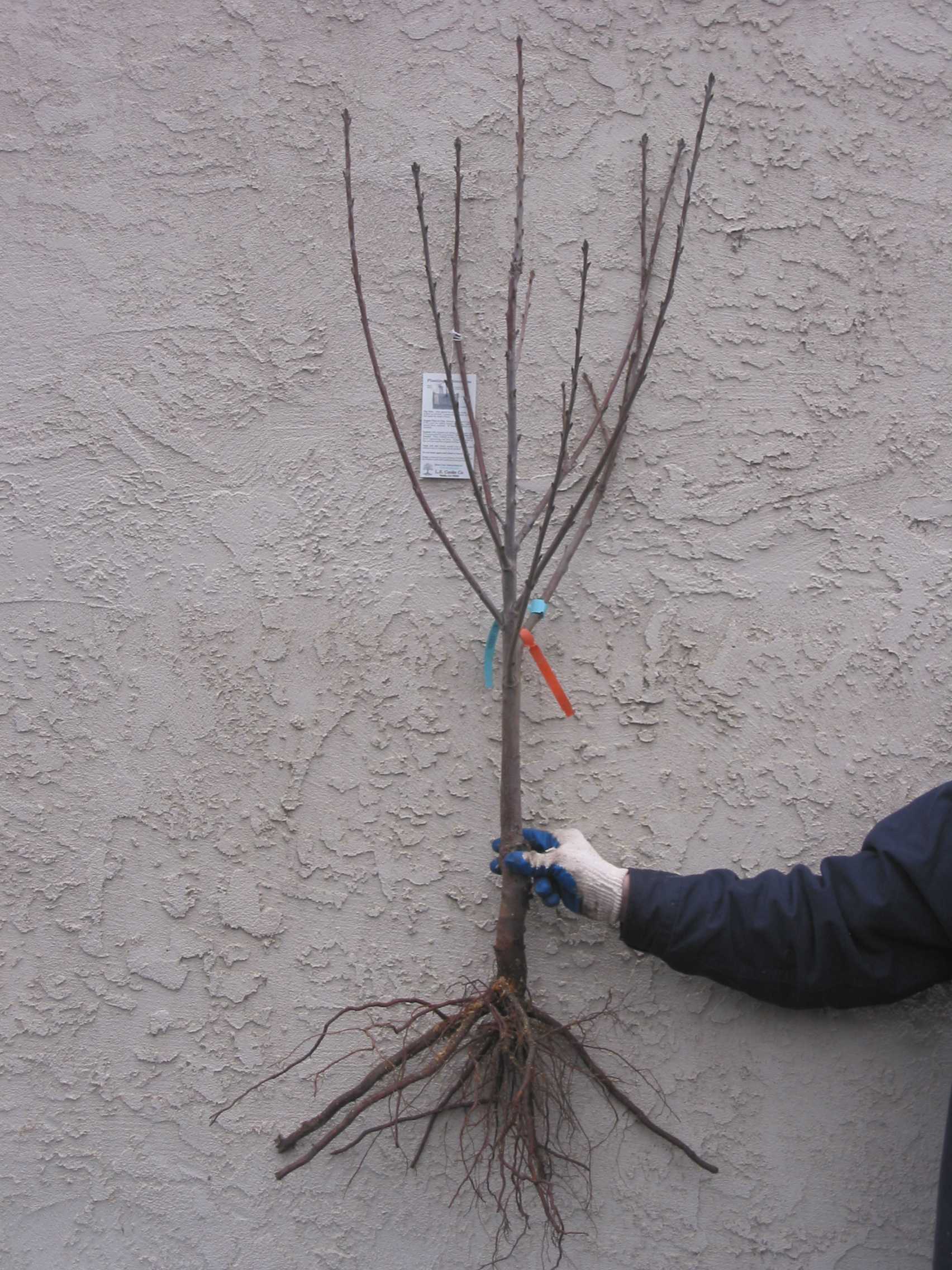
Pruning out the central leader during field production leads to a low-branched tree, which makes it easier for the homeowner to control the size and pick the fruit.
How do I plant this thing?!
Dig a hole wide and deep enough to accommodate the roots without bending them, typically 3' wide by 18" deep. The graft union should be out of the ground a couple of inches. You can add fertilizer to the backfill, but don't add compost.Backfill, firm the soil, then soak the tree thoroughly. Tug it up a little if it settles. You don't want the graft buried, and you don't want the tree in a low spot. It should be "crowned up" an inch or so.
Make a basin for watering by pulling excess soil to form a ring around the tree. Water thoroughly again.
When it is dry, paint the trunk with an interior white latex paint, up to the first branches to prevent sunburn on the bark.
My watering advice for this area: give the tree one gallon of water every day until it leafs out and starts to grow. You don't need to water on rainy or foggy days. Then gradually water less often and more deeply. By May - June you should be able to have it on your regular watering cycle. The crucial watering time is March to early April, when we first get dry and warm. Don't let those fine root hairs dry out! A north wind in March kills lots of young bareroot trees.
What to choose?
The bins of bareroot trees can be a little overwhelming. There may be a dozen or more types of peaches, for example. Scores of roses. Lilacs, wisteria, flowering cherries, flowering plums, crabapples; shade trees. Nearby you may find artichokes, asparagus, rhubarb, strawberries, and even horseradish.What's easy to grow?
Pomegranates, persimmons, and figs. Just plant, water, and wait. No pruning needed. All are tolerant of drought, but are not particularly susceptible to rot so they can be in a garden or even in or near a lawn. Cherries are very easy except for sensitivity to rot. No pruning or spraying needed.But don't shy away from the other fruit varieties. Home orchard care is not difficult: some seasonal pruning and possibly some spraying. Organic options are available for the occasional pest problems. We are fortunate to live in an area where you can grow all the major types of stone fruits (apricots, peaches and nectarines, plums, pluots), the pome fruits (apples et al.), Mediterranean and Asian fruits, and more.
Factors in selecting a variety include flavor and ripening period, ease of size control, pest problems, chilling hours, and cross-pollination requirements, if any.
What about citrus?
Citrus trees may be available now, but not bare root as they are evergreen. It is an ok time to plant them, but warmer weather is optimal. Look for best selection of citrus in spring and summer. For more information: Dave Wilson Nursery L. E. Cooke Co. For a ripening chart, showing how to get fruit from your back yard year round: click hereJargon: what's all this stuff on the label?
Semi-dwarf
I am getting away from this term as it is misleading. Some rootstocks make a tree grow more slowly. But they don't (usually) keep the tree much smaller than a regular rootstock. You determine the size of the tree by how you train and prune it. Exceptions: there are some extremely dwarfing rootstocks for apples that keep the plant miniature, small enough to grow in a tub or barrel. "Genetic dwarf" (miniature) varieties are available for peaches and nectarines, and there is a dwarf almond.Rootstock
There are specific rootstocks for certain situations: nematode-infested soils, poor drainage. Mostly these are for commercial plantings. You may want to ask locally if you have a need for special rootstocks. If you ask me, the answer will be 'no'. If drainage is an issue, elevate your planting. If you want a smaller tree, prune it.Pollenizers and pollinators?
"Pollenizer required." A few fruit varieties are self-sterile, either completely (Bing cherry) or partially (many apples). So they require the presence, within bee-flying distance, of another type which blooms at the same time. Not another tree of the same variety, but another variety. It can be in your neighbor's yard, or even a couple of doors away.Apricots, peaches, nectarines, etc., are mostly self-fruitful.
Plums and pluots are complicated, so check before you buy, but there are some self-fruitful plums.
Some pears and apples are partially self-fruitful, and others will produce fruit without a pollenizer in our area but require one elsewhere.
The bee is the pollinator.
Chilling hours?
Deciduous fruit trees need a certain number of hours between 32 - 45F to break dormancy and develop their flowers properly. Too low chilling, the flowers don't open right. Low-chill varieties planted in cold areas may break dormancy too early, and try to flower while frost could still occur and damage the blooms. For more information on chilling hours, check out the UC Cooperative Extension Fruit and Nut Research and Information Center Website: http://fruitsandnuts.ucdavis.eduwritten for the Davis Enterprise January 29, 2009
Wednesday, January 13, 2010
Choosing a Fruit Tree
- a self-fruitful cherry (May),
- an apricot and an early peach (June),
- a mid-season white nectarine (July),
- a late-season pluot (with a pollenizer) and/or a late peach (August),
- an Asian pear (September),
- a pomegranate (October),
- and a persimmon.
That would give fruit from late May through November! Citrus trees would round out the year, fruiting through the winter.How patient are you?
If you're planting a fruit tree for your kids, you might want some fruit before they leave home! Peaches, nectarines, and plums all fruit on year-old wood, so you will actually get some fruit in the second growing season (thin off most of it so the tree can put its energy into growth). Spur-fruiting types such as apples, pears, apricots, and cherries take 3 - 4 years to produce fruiting wood.top of page
What is easy to grow?
This includes how much pruning or spraying will be needed, which have special pest or disease considerations, and which fruit blemishes or damages easily (making them more vulnerable to extreme weather and pests).Apples and pears, for example, are really kind of a hassle here. The fruit is sure to get codling moth, the 'worm' in your apple, and managing that pest requires a combination of trapping, spraying, and picking up the spoiled fruit on the ground. (For more information, see our 'Pest Notes' at www.redwoodbarn.com).
Larger-fruited stone fruits are considered the most desirable fruits. The flavor of a summer peach just off the tree is incomparable! But these must be pruned heavily or the branches will collapse from the weight of the fruit. This especially includes peaches, nectarines, plums, and pluots. It's important to keep a dense canopy so that the fruit isn't damaged in 100+ degree weather. Peaches and nectarines also require spraying to prevent peach leaf curl. These winter chores aren't very difficult, but must be done each year, and summer pruning techniques can be used to manage the tree size.
Persimmons, pomegranates, figs, and citrus, on the other hand, require no pruning or spraying at all. They can be pruned for size control, but it isn't necessary.
Which trees look nice in the landscape?
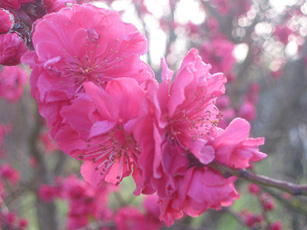
This can be an important consideration, as your fruit trees can be part of your landscape. Some have very showy flowers: 'Red Baron' and 'Fantastic Elberta' peaches, 'Garden Prince' almond (also a naturally small tree), and others. Cherries are a mass of white blossoms in early spring, with a narrow upright habit suitable to side yards or corners.
Some have all-season beauty: persimmons have vivid chartreuse new growth in spring, attractive shiny leaves in summer, golden fall color, and the winter fruit is showy even if you don't eat it (don't worry, the birds will!). Apricots and pie cherries have graceful spreading growth habits. And citrus trees have fragrant spring flowers, nice evergreen foliage, and colorful fruit all winter.
You really can 'enjoy nature's bounty!' and 'have luscious fruit from your back yard!' A little planning can just make it easier and more satisfying.
Choosing a fruit tree
Selling the virtues of back yard fruit production is nothing new. "Step outside and pick an orange right off your own tree!" Citrus Heights, Orange County, Orangevale--these California place names reflect the sales techniques of early housing developers beckoning snow-bound easterners to California. A customer who moved here from Syracuse, New York, to retire had only two landscape requirements: an orange tree, and a palm tree. Such is the lure of California.
California's development history is intertwined with fruit trees. Since the Spanish padres brought seeds of the Spanish sweet orange (a seeded juice orange with thin skin, similar to our modern Valencia) and a thick-skinned lemon-like fruit, the earliest settlements by Europeans have taken advantage of the ideal fruit-growing regions of the state. The first citrus farm was planted in 1841 in Los Angeles, and William Wolfskill's oranges were selling in San Francisco during the Gold Rush for a dollar apiece.
Northern California growers quickly discovered that our climate was ideal for commercial production of stone fruits (apricots, cherries, plums, peaches and nectarines), and that these could be shipped back east for high profits because of the early harvest season here. All of these are readily grown as backyard trees. Apples are generally grown where autumn nights are cooler, and pears thrive in the Delta. In recent years Mediterranean and Asian fruits have become increasingly popular, and for good reason: persimmons, figs, and pomegranates are probably the easiest, lowest-maintenance backyard fruit trees.
So how do you choose a fruit tree? It's a very individual decision. The desirability of some fruits may outweigh the maintenance issues of the trees. Here's a checklist of considerations.
What do you have room for?
This is less important than you might think, based on newer spacing and training techniques. Many methods have been promoted over the years to enable home gardeners to get fruit production in small yards. Miniature trees, multiple grafts, dwarfing rootstocks, close spacing, espaliered trees, and summer pruning all enable you to get more trees in your yard, and more fruit per square foot. Of these techniques, the close spacing and summer pruning are the easiest ways to get high yield from outstanding varieties.Ignore old-fashioned spacing and pruning recommendations designed for orchard production. Your goals are smaller trees, better quality fruit, and a longer harvest season, and YOU are in control of the size and production of the trees. You can plant trees very close together, prune each one severely to reduce the size of the tree and the quantity of the fruit, and choose varieties that ripen over a long period. With the right combination of stone fruits, Mediterranean fruits, and citrus, you could get fruit from your backyard every month of the year!
| top of page |
What do you like? What would you actually use?
A fully-grown tree trained in the traditional 'orchard' style can produce hundreds of fruit! Soft-fruited types don't store well, and that is a LOT of fruit to eat or process in a few days.or pick up off the ground. It can be a considerable mess. Reducing total fruit production may be a major goal of pruning peaches, nectarines, plums, pluots, and (to a lesser degree) apricots and figs. These are all ripe for only a few days. So training them as small trees or shrubs, and pruning severely, enables you to plant several varieties and extend your harvest. On the other hand, cherries are so popular with birds that you don't have to worry about the fruit being a mess. 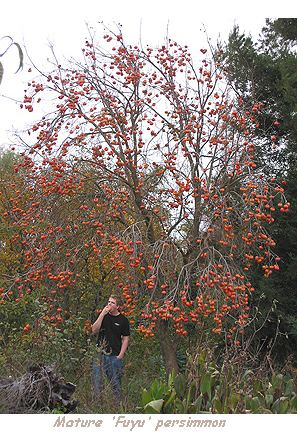
What ripening period is important to you?
My own experience is that earlier-producing varieties of any particular fruit get heavier use in our household. The peach that ripens in June is prized; by late July you've eaten a lot of peaches. Early varieties are also less damaged by extreme heat. But the 'all-purpose' varieties tend to be mid- to late-season, and may have higher sugar content. Consider firmer textured varieties for mid and late season, as they will be more useful for pies, freezing, and canning. Or buy a good fruit dryer--nearly all fruit can be dried, including some that would surprise you (dried Asian pear slices are like candy). Consider a mix of 'styles' and fruit types so you have something different each period during the season. An excellent combination, if you have room, is
Written for the Davis Enterprise, January 27, 2005
Subscribe to:
Posts (Atom)
