Monday, June 21, 2010

Let Nature Run Its Course


Letting nature run its course is a valid strategy for pest and disease management in the garden!


Reaching for broad-spectrum insecticides and fungicides is rarely necessary and often does more harm than good.
For example, there have been a lot of fungus problems on leaves of shrubs and trees during this wet spring, especially on roses.
Fungus disease symptoms show up when the pathogen, the host, and the environment interact to cause the disease to inoculate, establish, and spread. We are fortunate to live in a climate which is usually unfavorable to the continued spread of fungus. A couple of days of dry north wind can stop most diseases in their tracks. You can prune an infected plant to open it upÓ and allow better air movement; water early in the day to allow leaves to dry off, and make sure you have the plant in the right sun exposure. Roses in the shade, watered with sprinklers, and allowed to get overgrown are going to get a lot more disease problems than those planted in the sun, pruned properly, and watered at ground level.

As for aphids, there is outright warfare going on in your garden, though you'd practically need a magnifying glass to see it. Why poison the plants when beneficial insects are riding in like cavalry to the rescue?
Life as an aphid is actually pretty rough. When you get an infestation, it seems they have come out of nowhere. Indeed, a female aphid produces 50 or more babies a day, and each baby is a pregnant female. They NEED this massive reproductive capability because so many beneficial insects find them delectable: aphids are soft, succulent, and stuck in place.
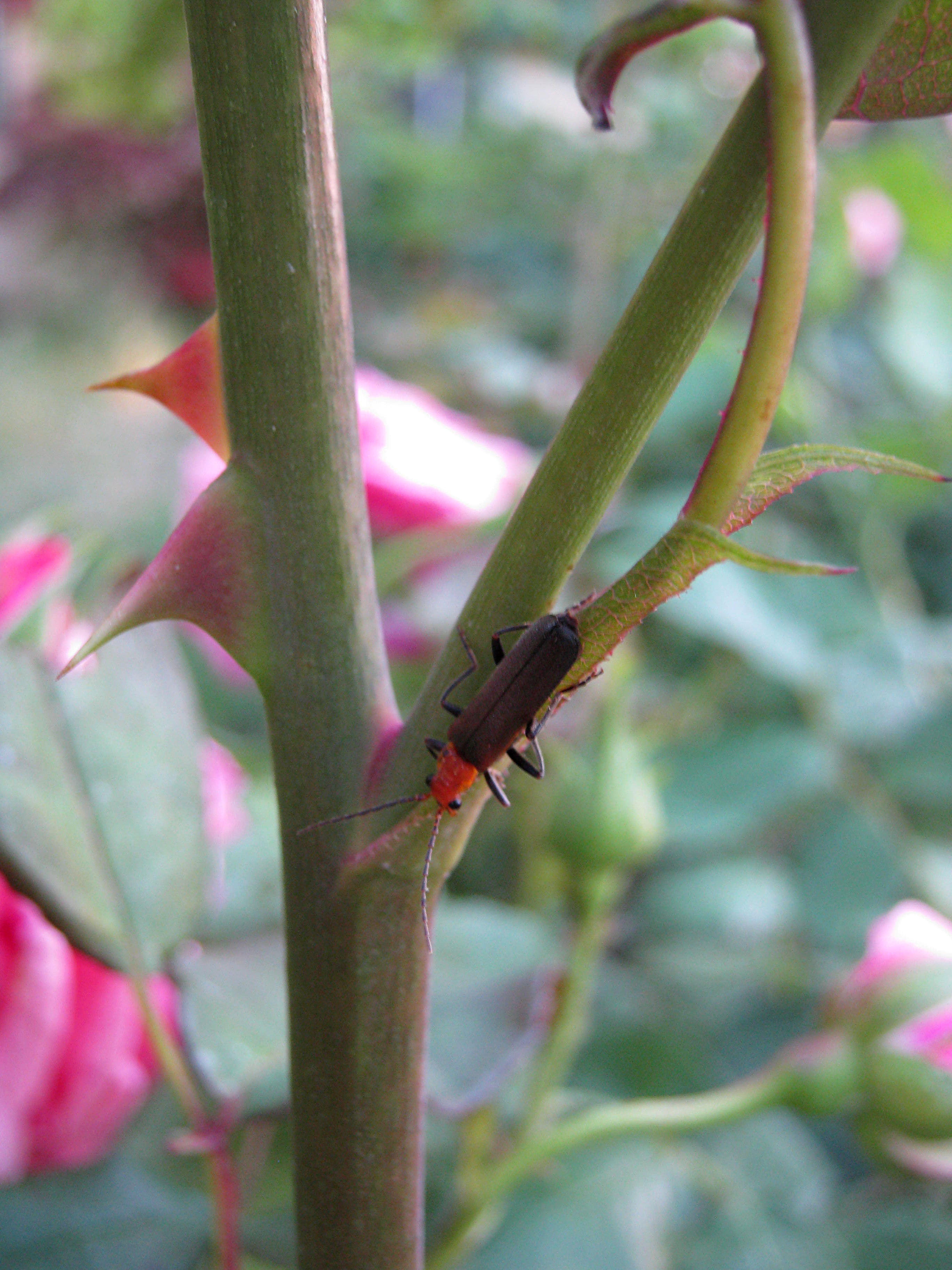
Three beneficial insects that you can see readily are ladybird beetles (ladybugs), lacewings, and leatherwing beetles (aka soldier beetles). The larvae of the first two resemble little dragons, inching along on rose buds and plum leaves as they eat aphids. Ladybird beetles and leatherwing beetles fly around, roving rapidly over leaves and flowers.

The aphids that we see in summer are often naturally controlled by parasitoid wasps and by the larva of small flies.

Note: the terms parasite and parasitoid are similar. The difference is that a parasite usually doesn't kill the host, it just lives on it and takes nutrients from it (think tapeworms and mistletoe). A parasitoid lives on or in the host and ultimately kills it. The adult usually lives free of the host.

If you look closely at any population of aphids you are likely to see some that are tan, listless, and bloated. If so, you need take no further action: tiny parasitoid wasps (usually aptly named Aphidius species) have laid their eggs in some of the aphids. The larvae are feeding on the aphid from inside, getting ready to pupate and emerge and further decimate the population. Those that have emerged leave behind aphid carcasses with neat holes cut in them. After a slight lag, the population of wasps will catch up with the aphids. It is rare to see the adult wasps, and they can't sting you. These little wasps are everywhere; I rarely see a population of summer aphids that isn't being controlled by them.

You may also find very small worm-like larvae near the aphids. These are the progeny of tiny flies called aphid midges (Aphidoletesspecies). Each midge has strong jaws and eats several aphids before pupating. Apparently they like to hunt: they often kill many more aphids than they eat. The problem is, the adult
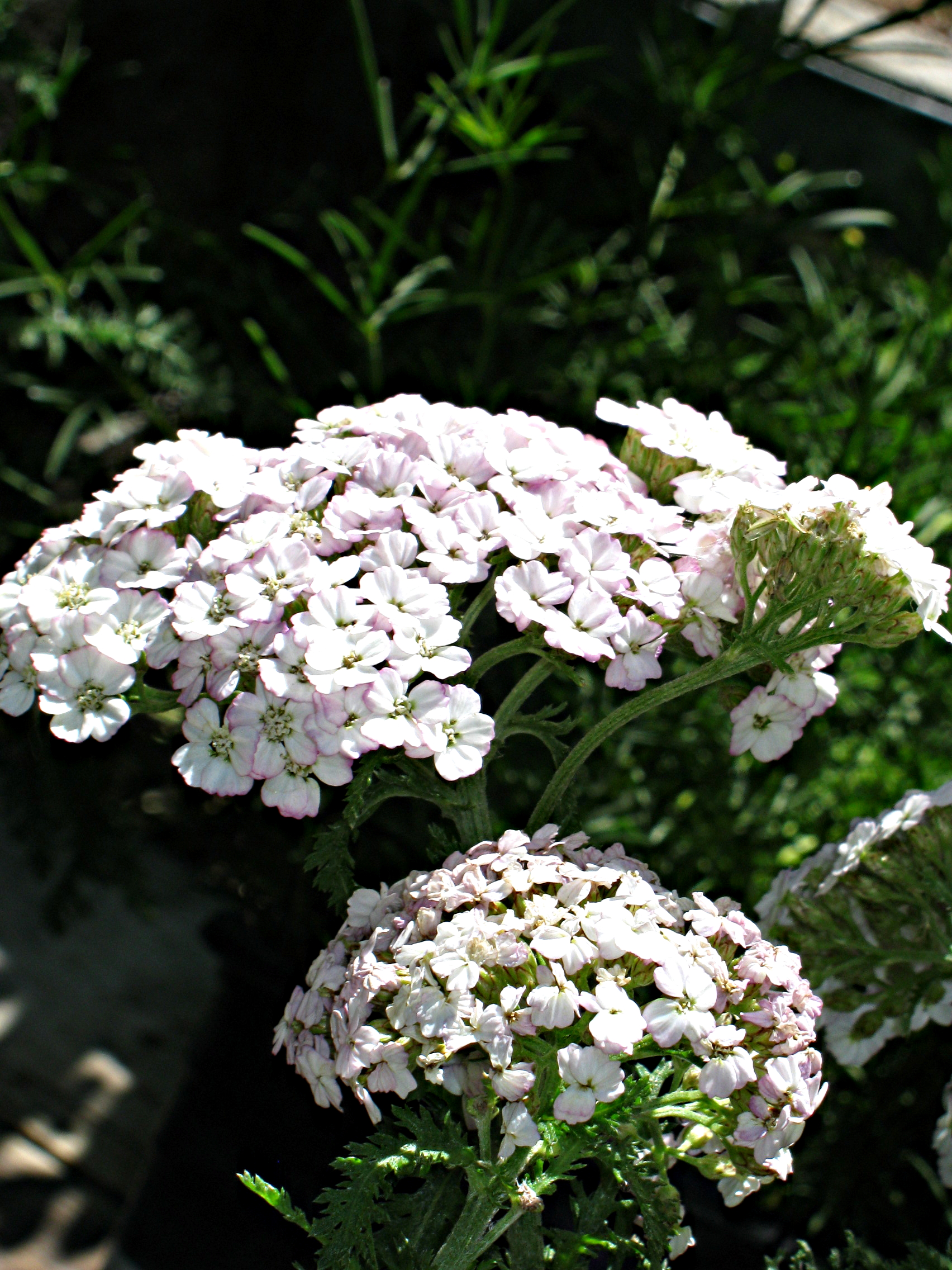

Achillea 'Apple Blossom'
You can plant flowers to attract and keep beneficial insects in the garden. Plants that have small flowers in clusters provide nectar and pollen for small insects. Members of the carrot and daisy families are especially good. Shown here is Achillea Spring Blossom, one of many garden hybrids of Yarrow. Yarrow has fern-like foliage, summer-long clusters of flowers, and is very easy to grow in sun or light shade.

These beneficial insects don't just eat pests. The adults need food and water too. Small areas such as shallow stones or abalone shells where sprinkler water can puddle can provide moisture. Honeydew from the tiny flowers of annuals such as Sweet alyssum draw and feed many beneficials. Any flowering plants in the carrot family (Umbelliferae), including cilantro, fennel, parsley, and Queen Anne's lace will help attract them. Members of the daisy family provide pollen, which many feed on. One of the best is yarrow (Achilleaspecies and hybrids), an easy perennial with showy clusters of tiny flowers, known to attract many types of beneficial insects. Yarrow spreads readily and is very long-lived, tolerating full sun or light shade and some drought.

You can plant flowers and create habitat for natural enemies. Or you can apply poisons with unintended consequences. The choice seems simple to me!

Click on any picture for a larger view!
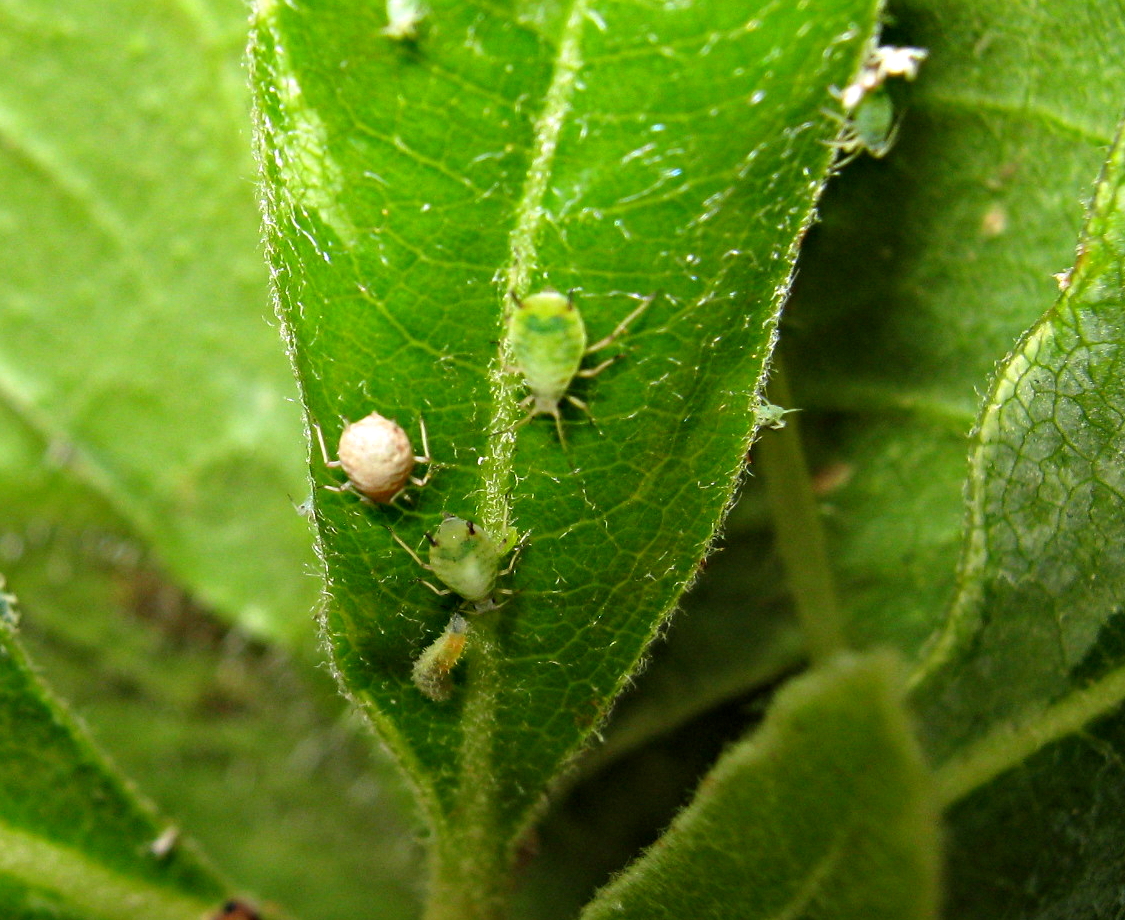
Aphids under attack!
Aphids are common in early summer on landscape shrubs. Shown here on a leaf of Pittosporum tobira, the aphid on the left has been mummified and has larva of a small wasp (Aphidius species) inside it. The one to the right is healthy -- for now. The aphid at the bottom of the photo is about to meet its demise at the hands (or jaws) of an aphid midge larva (undetermined, but probablyAphidoletes species).


Some beneficials


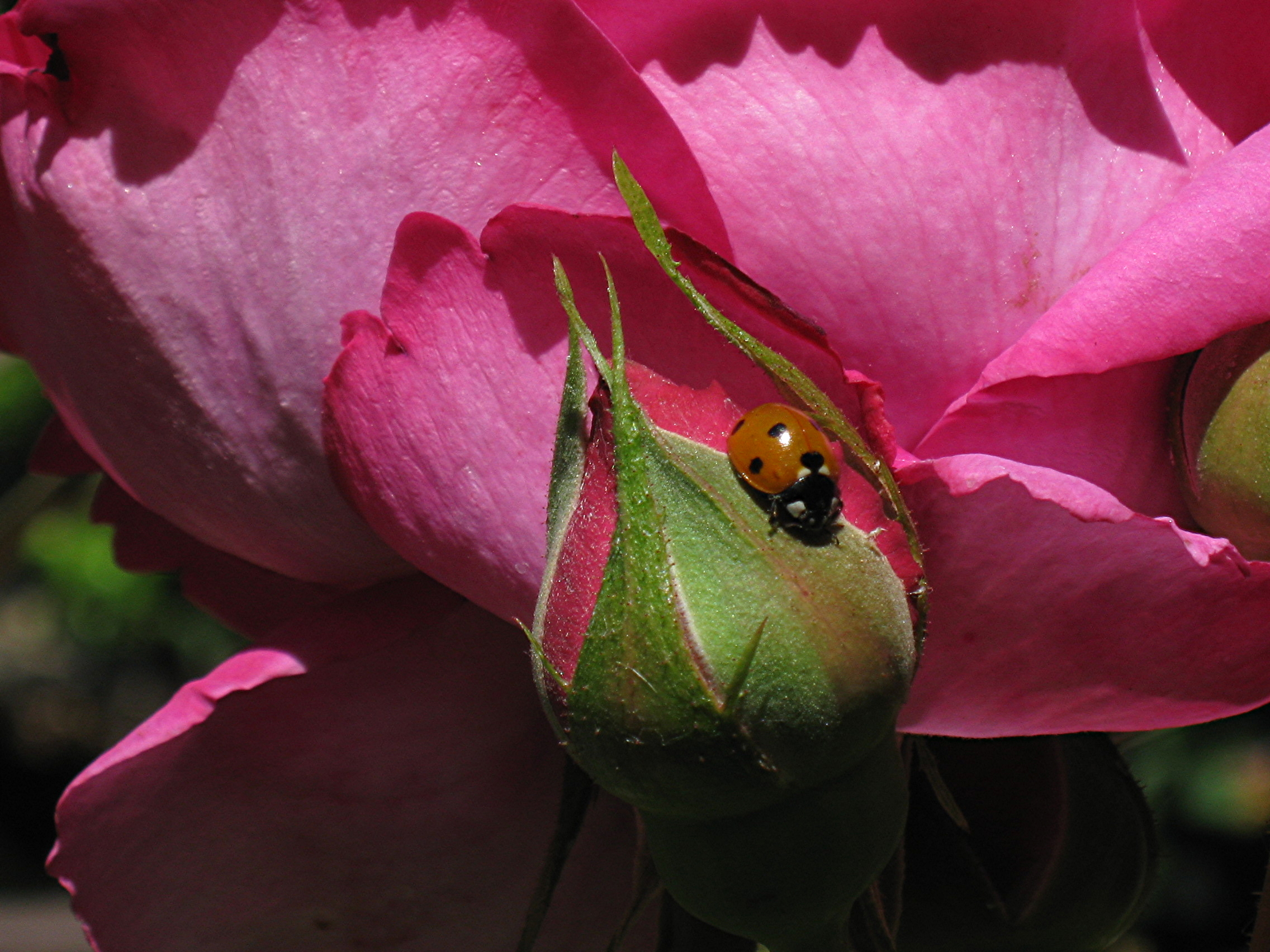
Ladybird beetle on a rose bud
The common ladybird beetle is an effective aphid eater. "Ladybug" is the commonly used name, but they are actually beetles, not bugs. Learn to recognize the larvae, which look like little black and orange dragons. Plants with accessible pollen and sources of moisture can help keep ladybird beetles in the garden.


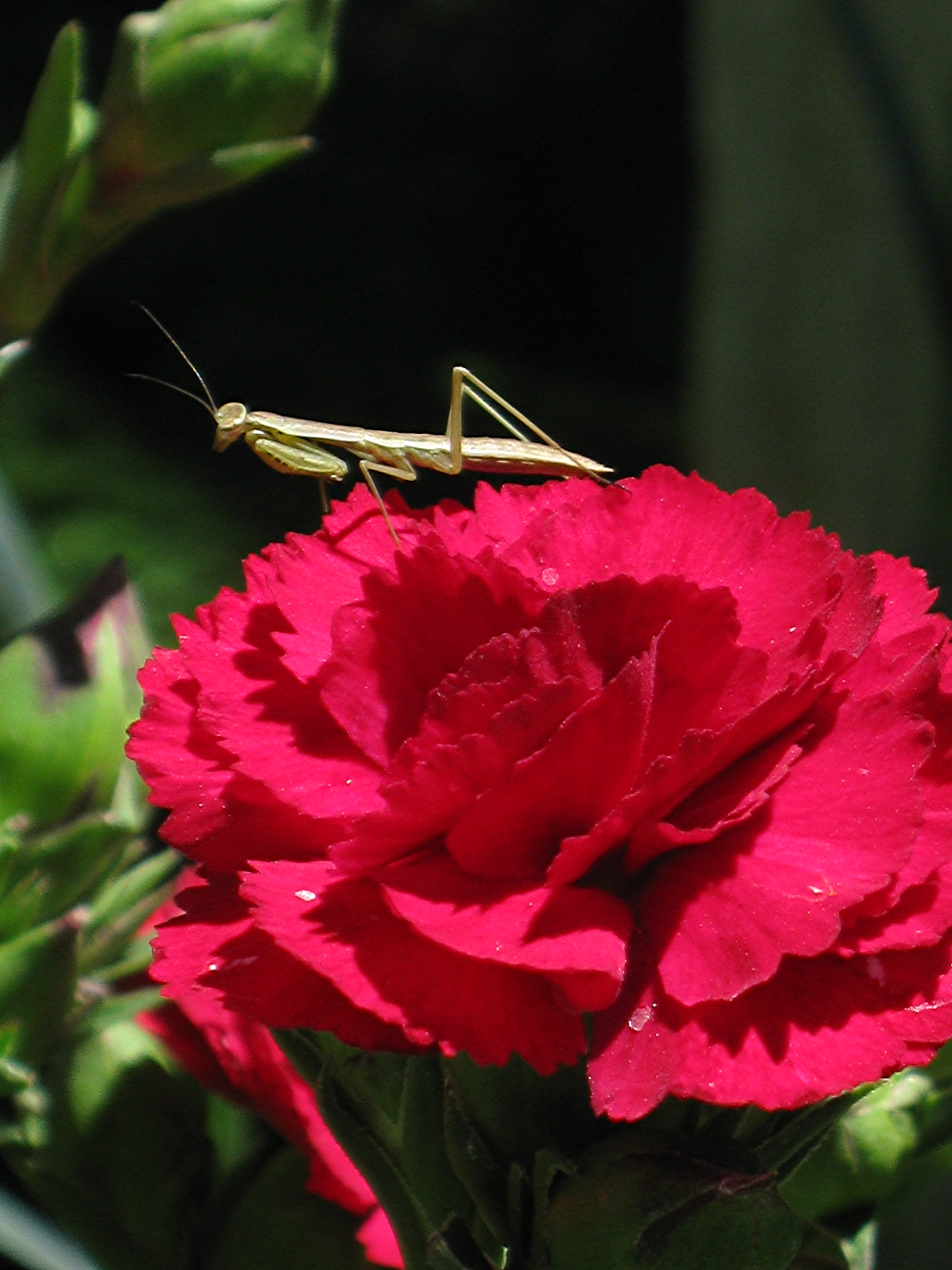
Young praying mantid on a Dianthus
One of the best-known beneficial insects is actually one of the least effective for pest management. Praying mantids are general feeders, so they eat pests and other beneficials (including each other) alike. However, they are fun to watch in the garden and are part of a healthy yard. Shown here is a young mantid on a carnation flower in early June; by now it has probably doubled in size.


Leatherwing (soldier) beetle

Tuesday, June 15, 2010

Canada bans Weed'n'Feed lawn products!

Health Canada's Pest Management Regulatory Agency (PMRA), which regulates pesticides in that country, has announced the end of registration and legal sale of fertilizer/pesticide combination products in Canada, effective at the end of 2010:

"The PMRA, in conjunction with Canadian Food Inspection Agency, is taking action to uncouple the fertilizer-pesticide combination products intended for lawn and turf uses. A date of last sale of 31 December 2012 for fertilizer-pesticide combination products for lawn and turf uses has been set in order to allow for replacement products to be made available where needed."

The most common combination is fertilizer with a broad-leaf weed killer, usually 2,4-D and other similar herbicides.
"Turf fertilizers will continue to be available for broadcast application when needed. Pesticide-only products will also continue to be available for lawn care use to homeowners and commercial applicators for either spot treatments of localized weed patches or for use as broadcast applications to severely infested turf areas when warranted."


Friday, May 28, 2010

We get questions....garden problems in May!


    An odd year?!?

    So many questions! Weird weather, the usual spring pest problems, and much more. So today we have a grab bag of odds and ends.

    What's up with this weather?


    2010: a strong El Niño year!
    NASA climate scientists inform us that January through April were warm worldwide. But there are regional anomalies, and we are in one of them (weather isn't climate).

    Below average temperatures every month of 2010. April and May had high temperatures below average by as much as 10 - 15 degrees. If we complete May without breaking 90 degrees, it will be the first time since 1971. Pleasant as that may be for gardeners, the weekly rain and cool temperatures have played havoc with plants and crops.

    My peppers aren't growing!

    Summer vegetables are off to a sluggish start. Soil temperature should be 60 degrees for tomatoes, and it barely reached that mid-May. Soil temperature of 70 degrees is best for peppers and eggplant, and it is still only in the low 60's! Transplants are sulking: growth is slow, nutrient deficiencies are showing up, and pests are eating the seedlings faster than the plants are growing.

    An overview of early-season vegetable problems:


    Virus or weather?
    Too soon to tell.
    o Holes in leaves = earwigs (small holes), snails and slugs (large holes). Organic baits are available.
    o Leaf edges burnt = windy weather drying the leaves of seedlings that were just out of the greenhouse. They'll grow out of it.
    o Leaves crinkled = cold soil, probably. Some virus diseases cause crinkled leaves on tomatoes and peppers. If it is on random plants, suspect virus; replace the plant. If it is on most plants, suspect weather; they'll grow out of it.
    o Leaves curling = overwatering. Cool weather reduces the need for irrigation.
    o Leaves purple = phosphorus deficiency. Cold soil inhibits uptake of this nutrient. They will outgrow it when soil warms up.
    o New leaves yellow = pH problem. Apply sulfur or fertilizer containing micronutrients. Overwatering can mimic this due to root damage.
    o Older leaves yellow = lack of nitrogen. Organic fertilizers release more slowly in cold soil.
    o Plants not growing = cold soil.

    The leaves of my roses are ugly!

    Weekly rain and high humidity have caused more disease problems than usual. The only thing keeping it from being even worse has been cool temperatures. Many diseases simply cause cosmetic damage, and we can wait for dry weather to stop the cycle of infection. The major rose diseases are: o Black spot: spots on the upper leaf. Prevalent during warm, damp weather.
    o Downy mildew: spots on the upper leaf, eventual leaf drop. Prevalent during cool, damp weather.
    o Powdery mildew: white poweder on leaves, new shoots, buds. Hasn't shown up much yet; prefers warmer, drier conditions.
    o Rust: orange spots on the underside of the leaf. Requires leaves be damp for 2 - 4 hours; heavy spores spread by splashing water via wind, rain, and sprinklers.

    Disease management is a matter of making the environment less fungus-friendly. Wider-spaced plants in full sun rarely get severe infections. Trim out infected portions and throw them away, prune to open up the bushes and keep them from contacting each other. You can prune hard if rust is severe. Water at ground level.

    I am dubious about the effectiveness of fungicides for home gardeners. You have to spray at least weekly, get thorough leaf coverage (top and bottom), and they aren't effective after the plant is infected. Some are very toxic: anything with Warning or Danger on the label is best avoided by home gardeners. Sulfur and copper sprays are safer, but work only as a protective barrier. The good news is roses outgrow most diseases here when we get lower humidity.
For more, plus pictures, click here

    Written for the Davis Enterprise, May 27, 2010


Friday, May 21, 2010

Bayer Advanced Fruit, Citrus, & Vegetable Insect Control -- a good idea?!?

“I’ve heard there is a new systemic insecticide for vegetables and fruit trees.”
Yes, indeed: Bayer CropScience has introduced Bayer Advanced™ Fruit, Citrus & Vegetable Insect Control, which you pour on the ground around edible crops. It goes up into the plant and kills insects that are feeding on the plant.
My god, what a terrible idea!
“Keeping your plants protected from listed damaging insects has never been easier.”
Just because you can do something, doesn’t mean you should!

The active ingredient imidacloprid (Merit) is a widely used neo-nicotinoid systemic insecticide. We recommend it for control of some pests on ornamentals, in situations where you and bees won’t be exposed to it, and it is useful on houseplants. It is the active ingredient in a popular flea control product on pets. It is heavily used on some agricultural crops in California, including head and leaf lettuces and citrus, as well as on turf and ornamentals.

I understand the basic principle of toxicology: the dose makes the poison. How toxic a material is depends on how much you ingest. There are doses that are considered safe for humans. Neonicotinoids are especially toxic to insects and much less so to humans. But the regulatory agencies base their safe dosage on assumptions about our current intake of the product by other sources. You are ingesting imidacloprid regularly when you eat conventional produce, walk across commercially-maintained turf, pet a cat that has been treated with Advantage®, etc.

Ok, so you put this insecticide on the ground, it is taken up by the roots, goes up into the plant and kills anything that sucks or chews on the plant. Then it breaks down steadily in the plant over time. Apparently Bayer and various regulatory agencies believe that it’s ok for you to eat whatever the plant produces because it has diminished to less harmful levels in the plant.

This all assumes you follow the label instructions for the rate per square foot, that you only apply it once a year, and that you wait the specified interval before harvest. Why, one wonders, is it a 21 day waiting period for lettuce, but a 45 day waiting period for Swiss chard?

You can download the 10-page label from bayeradvanced.com. Read about imidacloprid at the cooperative-extension maintained site http://extoxnet.orst.edu/

Here’s what anybody selling, buying, or using this product needs to know:
• You must carefully follow the rate of application per square foot of garden space.
The product is in the plant, including the part you consume. If it provides “Season-Long Protection!” then it is in the plant all season. Including when you harvest.
• It is important to check the interval before harvest for a particular crop, which ranges from 14 to 45 days after application.
You cannot use this product more than once a year. In California we have two full vegetable growing seasons.
• Imidacloprid is very toxic to bees of all kinds. Bees are exposed to it through pollen.
• You should not apply it when trees are blooming or bees are foraging nearby. It can be taken up by the roots of nearby flowering plants. Your garden needs to be entirely separated from plants that bees might visit. Sub-lethal doses to bees have unknown effects. It is one possible factor being reviewed in Colony Collapse Disorder, but has neither been ruled in or out as a cause.
• It is very toxic to earthworms.

I am concerned that the manufacturer and the regulatory agencies have not considered California’s unique gardening climate.

I don’t know if the baseline for acceptable “average” intake from other approved uses has been updated since the mid-1990’s (that is the only data I could find online). There have been many new approved uses of imidacloprid in the last decade, including urgency permits for new pests. Imidacloprid is the pesticide of choice for many of the new pests that arrive in California, so I would guess that we are consuming more and more of it.

I personally would not use it or sell it for edible crops, and urge nursery professionals, Master Gardeners, and landscape gardeners to discourage its use.

Tuesday, May 11, 2010

Fungus weather!

Rain every week is leading to many disease problems. Here is a chart that reviews some of the common diseases we've been seeing at the nursery recently. I have been removing specific fungicide recommendations from my articles, as availability of specific products has changed. In most cases fungicides aren't necessary, application is impractical, and oftentimes labeled products really don't work.
Good news: hot, dry weather stops the spread of most diseases. And one thing we can count on in the Sacramento Valley is that we will eventually get hot, dry weather!

Tuesday, April 27, 2010

Real Gardeners Plant Biennials

I once heard that the gardening terms most misunderstood by beginning gardeners are annual and perennial. So let's review: an annual is a plant which grows, blooms, and dies within one growing season. Or, as the cynics put it, "a plant which should have bloomed before it died." A perennial is a plant which grows and blooms year after year.

Perennials may be herbaceous (soft), dying to the ground but resprouting. Or sometimes we call flowering shrubs such as lavenders perennials, and they are classed as woody perennials. Terms in horticulture often derive from how we use the plant, so there can be overlap between categories such as shrub and perennial.

So an annual flower blooms right away. Perennials bloom year after year. But what are biennials? These are plants which grow one season, bloom the second, and then die. They require patience and planning. They require replanting, although many reseed (some prolifically!). Hence they are plants for devoted gardeners.

So why do we grow them?

The long period of growth while the plant prepares to bloom allows it to store energy and develop large, complex flower structures (the structure that holds a number of flowers is called the inflorescence). In some cases they develop a large root to store water and energy, helping to support rapid elongation of a flower spike. When they finally bloom, biennials do it in a BIG way.

The common characteristics of biennials are:
o late season growth at ground level;
o continued growth in spring;
o late spring and summer bloom, often with very large, showy flowers on tall spikes;
o significant seed production;
o seedlings emerging again in late summer and fall.

This cycle has unique adaptive features. The low growth habit during the initial phase allows the plant to survive frequent mowing or grazing. The later bloom season means there is little competition from winter and spring grasses. Production of large amounts of seed has obvious advantages - for the plant.

Unfortunately, one of the most noxious weeds in California has found this biennial growth cycle very adaptive. Yellow starthistle sprouts in fall, forming a tight clump (rosette) of foliage at ground level. The plant forms a tap root with winter rains, which can grow deeper than the competing roots of nearby weeds and grasses. Leaves on the rosette grow steadily through the winter and spring, with the plant nestled at the base of tall grasses. Then, as the grasses dry off, get grazed, or get mowed to prevent fire hazard, the starthistle rapidly sends up bright yellow thistle flowers and goes to seed.
Starthistle is very prickly and irritating, is toxic to horses, and now is estimated to have spread to over 15 million acres in California (up from 8 million in the mid-1980's, according to the Weed Research and Information Center at UC Davis). A field of starthistle is basically impenetrable on foot or horseback. On the plus side, the flowers are pretty and bees like it.

Many biennials require a cold period (vernalization) before they initiate flower buds. So they are planted in fall for blooms the following spring or summer. As with starthistle, during the initial season they develop a rosette (a tight complex of buds and leaves at ground level, densely packed along a short stem). Once they've had their period of chilling, longer days initiate flower development. The flower structure (inflorescence) elongates and produces dozens, sometimes hundreds, of flowers. Those flowers may set prodigious quantities of seed. Let's just say that your patience is rewarded.

Warren Roberts, retired Superintendent of the U.C. Davis Arboretum, credits an unusual biennial for sparking his interest in plants. He remembers the Tower-of-jewels in a neighbor's yard from early childhood. Echium wildpretii (native name tajinaste rojo) certainly follows the biennial pattern. In the first season you get a mound of silvery foliage, resembling Cousin Itt from the Addams Family. Then in late spring the plant begins to stretch upward, and upward, and upward, ultimately to 7 to 8 feet or more! It was just such a flower spike poking above the neighbor's fence that attracted young Warren's attention, intriguing him with its Dr. Seuss-like qualities and launching his long career in horticulture.

All along the Tower-of-jewels flower spike are hundreds of small, showy flowers in a vivid hue of pinkish-purple. Hummingbirds and bees love all members of the genus Echium. After the long season of bloom thousands of seeds are produced. Even with a low germination rate, you are pretty likely to have seedlings. Tower-of-Jewels is native to Tenerife, one of the Canary Islands, which is a mild-winter area. We sometimes get frost damage on young Echium plants here, but they pull through and bloom.

Biennials we grow for their flowers include some very old garden favorites.
o Canterbury bells (Campanula medium) are planted in partial shade, producing lavender or white cup-and-saucer flowers in late spring. The big, fleshy plants flop over easily. Stake or cage them!
o Dollar plant (Lunaria annua) can grow in full sun to considerable shade. The pretty purple flowers are followed by thin, papery seed capsules that are shaped like coins. The seed capsules are often dried for flower arrangements. I have this plant re-seeding around my property, but not to the point of being invasive. As I was photographing it at night (for better contrast) I discovered that the flowers have a sweet scent in the evening.
o Evening primrose (Oenothera species) is best known for the pink-flowered Mexican species that is used as a ground cover. But the genus has many biennial species. Mostly adapted to desert areas, their flowers open in the evening for moth pollination. Some are quite invasive reseeders. My mother planted O. biennis in her cactus garden in San Diego, and then spent many years digging out seedlings.
o Foxgloves (Digitalis species) and Hollyhocks (Alcea rosea) are probably the best-known biennials. Foxgloves can grow in considerable shade, as well as sun. Although there are now annual varieties of foxglove such as 'Foxy' which bloom the first year from seed, most are biennial or short-lived perennials. Hollyhocks love sun but can tolerate some shade. Both bloom in late spring and well into the summer, with flowers continuing to open along the spikes for many weeks. If you aren't too fastidious about your garden, and don't mind the spent bloom spikes falling over into the border, both will reseed freely.
o Sweet William (Dianthus barbatus) is perhaps one of the most fragrant biennials, possibly one of the most fragrant garden flowers ever. The genus Dianthus includes carnations and pinks, and the scent of Sweet William is similar but even more pungent. Largely superceded by modern Dianthus cultivars, Sweet William is still grown by old-fashioned, patient gardeners like me. It comes in dwarf (6 inch) and tall (12 inch) forms. Hard to find in garden centers, the seed is easy to save and plant from year to year.

There are many edible plants whose biennial habit we exploit, growing for part of the lifecycle and consuming the root or tight rosette that the plant was developing for its flowers. Beets and carrots develop roots in fall and winter, which we eat before the plant has a chance to flower. Cabbage and Brussels sprouts, celery, lettuce, and parsley form heads which, if not harvested, would bolt and flower the next spring (if that happens, leave the blossoms; they attract beneficial insects). If you plant parsley, expect it to flower and go to seed in the second year, and then die. So gardeners generally replant it each year to have a steady supply.

In addition to Yellow starthistle, another invasive biennial is worth noting. Dames Rocket (Hesperis matronalis) is an attractive plant that was introduced by the pilgrims in the 1600's (I guess that would make it simultaneously an heirloom and an invasive!). Each plant sets very large quantities of seed. It is often included in "wildflower" seed mixes, and has spread to nearly every state. It resembles Money plant (above) which is not considered invasive and would be a better choice for gardeners.

Plant biennials for future enjoyment! These old garden favorites have many advantages that reward your patience.


Written for the Davis Enterprise, April 22, 2010

Tuesday, April 20, 2010

Target Corp closing all of its garden centers

From Grower Talks:
Target Closes Garden Centers
| Chris Beytes
>> Published Date: 3/15/2010

http://www.ballpublishing.com/GrowerTalks/ViewArticle.aspx?articleID=17661&highlight=target+garden+center


Take a good look at this Target garden center in Merritt Island, Florida, as it’s the last you may see: The big-box retailer announced in March that it’s closing its remaining garden centers in Florida, California, Arizona and Nevada and getting out of garden centers altogether, effective late September. The move affects more than 260 stores.


Why? “Several reasons,” answers Target spokesperson Jana O’Leary. “First is that the garden centers don’t provide significant value to our guests. Also, it’s no longer a profitable business for us.”

When asked if they would continue to sell garden hardgoods inside the store, such as potting soil and fertilizer, Jana replied that they’d continue to do that this season, but she couldn’t confirm if they’d continue inside L&G sales beyond 2010. 

She also couldn’t confirm whether or not they’d continue to sell poinsettias and other holiday crops inside the stores. However, GrowerTalks has heard that they have committed to growers for poinsettias for 2010. Until September, they will continue to operate “business as usual throughout the entire spring and summer seasons,” she says.


You can’t talk about Target without talking to Ken Altman of Altman Plants, headquartered in southern California. He estimates they provide 85% of the plants to Target’s garden centers—so it’s a major blow to his business. Still, Ken seemed to be taking the loss of a major customer philosophically.

“You know, you never want to take a hit like this,” he says, “but we’ve had a really, really great relationship with Target since the mid ’80s. They’re a great company. They’ve been great partners. They’ve worked with us on programs and they’ve always been open to our creativity. Even something like this, they gave us eight-nine months notice to adjust.”


Ken says his focus now is finding other ways to use his production capacity, to save as many jobs as possible for his employees. GT