Friday, October 5, 2012
Pistache for posterity
I was raised that you don’t mention a lady’s age. But she volunteered it, and I think at a certain point that old rule doesn’t apply.
I’ve known her for a long time. She isn’t getting around as well as she used to, so her sister drove her in. Her sister lives in Texas, but comes out to visit and help out now and then. She’s 91.
The old walnut tree in their front yard died, so it had to be taken out.
“We weren’t going to replace it,” said the sister. “At our age, we’d never see it grow. But,” she paused.
“You should plant trees no matter what your age,” I replied.
“Yes, you should,” she agreed firmly. “Plus, our doctor lives across the street, and he said he wanted us to plant a tree.”
“You do what your doctor tells you,” said the older sister with a smile.
So, doctor’s orders, she bought the largest tree we had and arranged for a young man to come out and plant it.
The city had planted one Chinese pistache already in their front yard a while back when the Modesto ash came out. That one is a female tree, doesn’t color up so well. “The females do have pretty berries,” I said. “And the songbirds enjoy them, even if they are a bit of a mess.” But they especially wanted the fall color.
The reason we sell the grafted Keith Davey Chinese pistache is for that reliable fall color and the fact that it doesn’t have the berries. Most people prefer that; they want to know they’ll get that familiar bright red color. And while the pistache berries aren’t squishy, there sure can be a lot of them. Pistacia chinensis is dioecious, having separate male and female trees. With nursery stock grown from seed, you have a 50-50 chance. And the fall color ranges from yellow to orange to purplish to red.
I’m partial to all of them. I live along the freeway, where CalTrans has planted mixed seedlings. And Chinese pistache is fecund enough that more seedlings have augmented that stand. I bought a tray of seedlings from a grower years ago, culled out those that lacked good fall color, and planted half a dozen of the best on my property. I have some male and some female. Lots of winter songbirds enjoy the female trees. But I understand why homeowners want to know what they’re getting. For reliable fall color, plant Keith Davey.
Chinese pistache is one of our most common landscape trees. It can tolerate drought (many of the trees on or adjacent to my property get zero summer irrigation). It can also tolerate reasonable lawn watering. No pests and few diseases. A small percentage of trees in some parts of town die from a vascular disease that looks and spreads like verticillium wilt. The pathogen hasn’t been confirmed, but if you do lose one I suggest avoiding trees that are known to be susceptible to that when you replace it. But thousands of them grow without incident around the Sacramento Valley.
The growth rate is what we call moderate. Watered deeply, fertilized a bit when young, they grow two to three feet a year up and out. In ten years you have a nice medium tree with equal spread to height. In a couple of decades, you have a good-sized tree. Eventually they can get quite large. Roots are deep. A little gawky when young, they barely require pruning once established.
This is the tree that has the most reliable, consistent fall color in our area, beginning in late October and continuing through November. When they turn color varies with watering regimen, exposure to cold, soil nutrition, and other factors. Unirrigated trees, such as those along the highways, turn color first. And even with the right genetic material, some trees don’t give good color some years. A tree in a sheltered courtyard may disappoint you, and some years are better than others. Nature is fickle.
But if you want fall color, this species is your best choice here. And in the right year, the right place, the right tree, the results are spectacular.
I like their attitude. Yep, they can grow that. And you can too.
Saturday, August 4, 2012
Rethinking Lawns
Lower Water Lawn Options
written for the Davis Enterprise, July 26 2012
As Davis faces water rate increases, garden professionals get lots of questions about ways to conserve water in new and existing landscapes. Previous columns have discussed low-water options for shrubs, ground covers, and trees in the landscape. The biggest water-user of all is the lawn. But that presents a conundrum, because the lawn is part of the yard we really use. Someone moving to a new house was asking about options and noted, “I have a big conflict about water usage. But we have two small kids who play on grass. Tough to play on cacti beds!”
Let’s not disparage lawns too much. That water use does provide natural air conditioning, heat reduction, and reduces dust. A normal lawn watered optimally requires about a thousand gallons of water a week per thousand square feet. But it takes that water and pumps it back up into the air around your yard, providing evaporative cooling. Grass is much cooler to walk on and work around than are bark, decomposed granite, concrete, and other non-plant surfaces. In California we use our yards as extensions of our living areas, and there is no question that a lawn is a more comfortable place to be than a drier landscape. Dogs and kids like to play on them.
As noted in my October column: "Form follows function," Louis Sullivan said. Let your landscape form follow the actual use patterns of your family. Lawns are for kids and dogs, and are usually unneeded in front. Put lawn where you will use it, not just where you'll look at it. Reducing your total lawn area is a simple way to save water.
You can probably reduce your total water usage on your existing lawn. Lawns don’t need daily water. A rule of thumb for traditional lawns is one inch of water, two times a week. Measure to see how long your sprinkler takes to put out an inch of water. I find most people aren’t watering long enough, but are watering way too often.
You could get a “smart timer.” Once the realm of commercial turf areas such as golf courses, these have become less expensive and may be appropriate for those of you with large lawns.
These amazing lawn sprinkler timers communicate with local weather data sites to determine the rate of watering needed, and adjust accordingly. When weather is cooler than average, they reduce the output. You can do the same thing, of course, but it takes some awareness of actual water use rates. The IPM web site maintained by UC Davis has links to weather stations all over the state, providing ET data (ET = evapotranspiration, the rate at which plants use water. It is measured in inches, just as rainfall is. Lawns use up to two inches of water a week in our hot, dry climate).
Go to http://ipm.ucdavis.edu/WEATHER/index.html and find the local weather station. Add up the ET rates and provide the water use calculated for the previous week.
Or you can be intuitive: if it’s cooler than average for the time of year, cut how long your sprinklers run a bit. We tend to fluctuate between short intervals of high temperatures, and periods when the delta breeze prevails and cools us off.
Keep an eye on your lawn. If it is looking duller green than usual, it is probably water stressed. Poke a trowel into the soil and assess the moisture. Water rates we give are optimal. Perhaps we can all learn to accept a little turf stress as long as the overall appearance is good enough.
If that all seems too complicated, the smart timers may be worth the investment. Local irrigation supply companies can give you more details, and a landscape contractor can install one for you.
Second option is to change your type of grass. All grasses are not equal in their water use. Until the advent of tall and dwarf fescues, most lawns were blends of bluegrass and perennial ryegrass. Those are the highest water users, and tend to be more susceptible to diseases. If you’re in an older neighborhood, it is possible you still have a blue/rye blend.
The newer, coarser-bladed fescues (tall and dwarf) can get by with as little as 20% less water than those older grasses. They are deeper-rooted, so they can go longer intervals between waterings.
If you have an older lawn, simply converting your lawn to a tall or dwarf fescue would enable you to cut your water use immediately. But they have a less refined look and require taller mowing height (preferably about 3 inches height in summer). If you are in a neighborhood built from the early 1990’s on, your lawn is probably already one of these blends of “dwarf tall fescue.” Yes, I know it’s an oxymoron: “dwarf fescues” are the lower, slower-growing strains of tall fescue.
Fescue is an important group of grasses. Most lawn blends that are labeled for shade contain another type: the fine fescues. The two most common are creeping red fescue and chewings fescues. They happen to tolerate more shade than other grasses, including the dwarf and tall fescue cousins. But we should all be using these more, as they are tolerant of even less water. Data I have seen show fine fescues can use up to 20% less water than the dwarf/tall fescues. They grow in full sun just as well as in shade, and make a very attractive lawn. As with other fescues, it is very important to mow them high (the grass, not you). Fescues have a high growing point. If you cut them too short, especially in hot weather, a lot of the individual plants will die out and the lawn may thin out. Mow at three inches if possible.
So converting your existing lawn to fine fescue can enable you to use 20 to 40% less water overall. If you don’t mind the appearance of grasses of differing texture, you can just over-seed your lawn and let the fine fescues fill in around your present grass mix. Otherwise, you can kill your lawn with chemicals or black plastic first. Fall is an excellent time to do the seeding, and it’s a pretty simple operation.
1. Mow your lawn as short as possible.
2. Rent a dethatcher and run it over the lawn. This machine rips out old, dead stems and leaves, exposing bare soil between the remaining healthy grass plants.
3. Apply a starter fertilizer.
4. Seed the fine fescue grass at 1 lb. seed per 100 square feet.
5. Top-dress the lawn with a fine layer of bagged compost.
6. Water daily, one or two times each day, until the grass germinates and grows to an inch or two of height.
7. Gradually reduce watering. Once you’ve mowed once or twice, you can revert to your regular watering schedule.
Timing this whole project just before a rainstorm in October or early November virtually guarantees success.
A final option is to consider a meadow. These fine fescues make very attractive groundcovers when left unmowed. On my rural property I have a large area where I seeded chewings fescue, hard fescue (a pasture grass), and creeping red fescue. I water as little as every two weeks in the summer. We allow it to grow long for an informal look. Once a year, in the spring, my strapping son rents a high-wheel mower from JB’s Power Equipment and mows the whole thing to prevent flowering and to manage any weeds that might be trying to poke through the grass.
It’s a great area for throwing balls for our dogs, and kids of all ages love to lie on the soft green grass. It’s very active with wildlife: last year when he mowed it praying mantids were scattering in all directions. Swallows fly above the field each evening. Unmowed grasses are important harboring sites for beneficial insects.
The UC Davis Arboretum is establishing a large area of California native grass in a meadow at the edge of the lawn area near the oak grove on the west end. They’re using Blue grama (Bouteloua gracilis). Other options include native strains of Festuca californica and Festuca rubra (there are those fescues again). These are available as small plant starters through Suncrest Nurseries, a wholesale grower in the Bay Area. And many larger ornamental and native grasses can be used for informal meadows. The key is to plant a mowable, walkable, lower-growing species where you’d be walking on it, and then plant some of the taller ornamental grasses on the edges.
We need to rethink lawns. Not necessarily get rid of them, but put them where we use them. Create the effect we want with lower-water grasses. And develop a new culture: less clipped, less formal, more appropriate, more sustainable, and less expensive.
You can find previous columns about low-water plant choices in the Enterprise archives. Look for the October and November 2011, and January 2012 columns. They are also available at http://redwoodbarn.com.
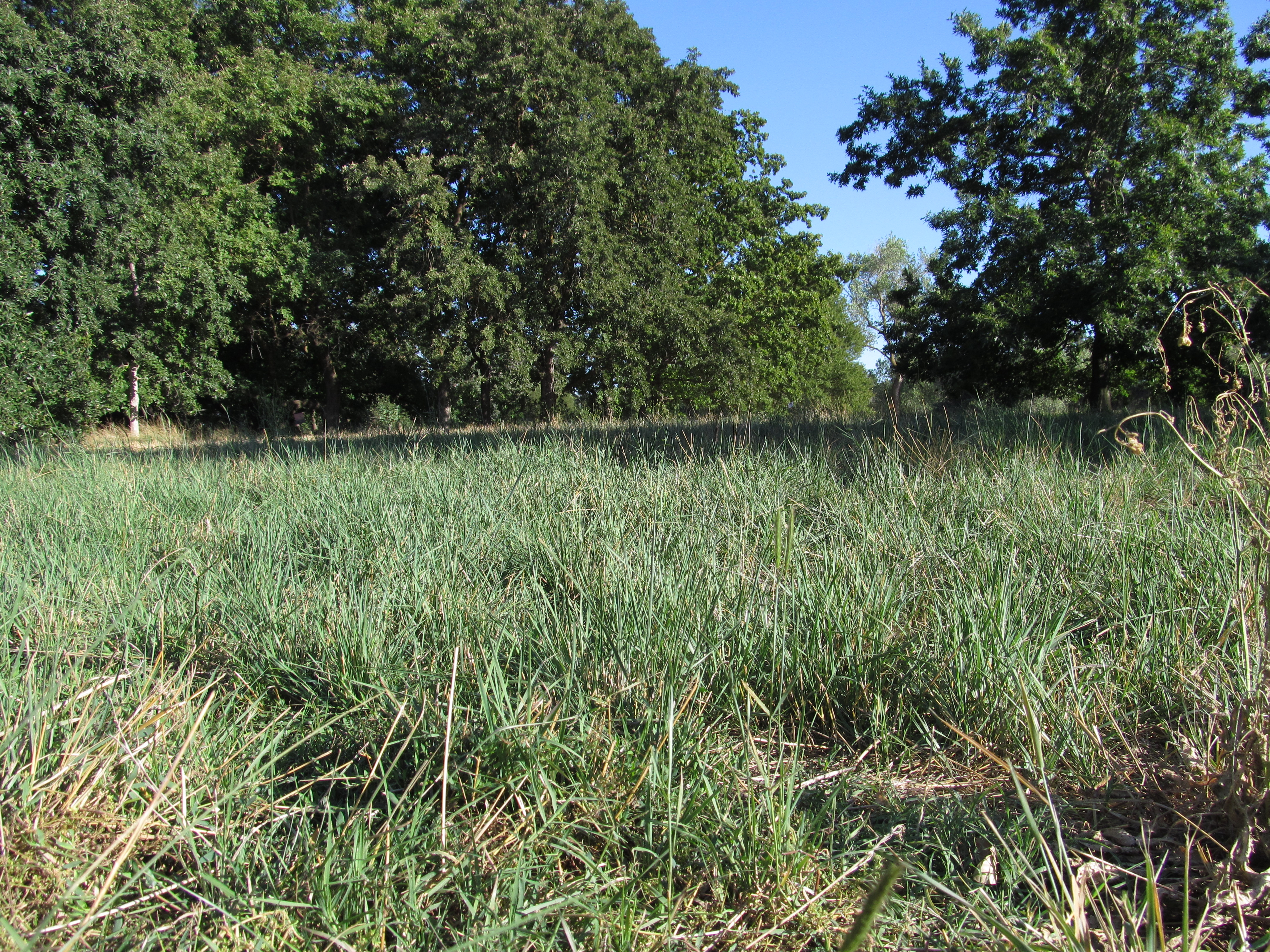
A work in progress: the UC Davis Arboretum is converting a large part of the lawn at the west end to native grasses. Please don’t walk on it while it’s establishing! This species should be able to grow and look good with much less frequent watering than traditional turf.
Our meadow of fine fescues. This area was seeded with chewings, hard, and creeping red fescues. The first two form clumps, the latter spreads. The effect is informal, great for playing with dogs and kids.
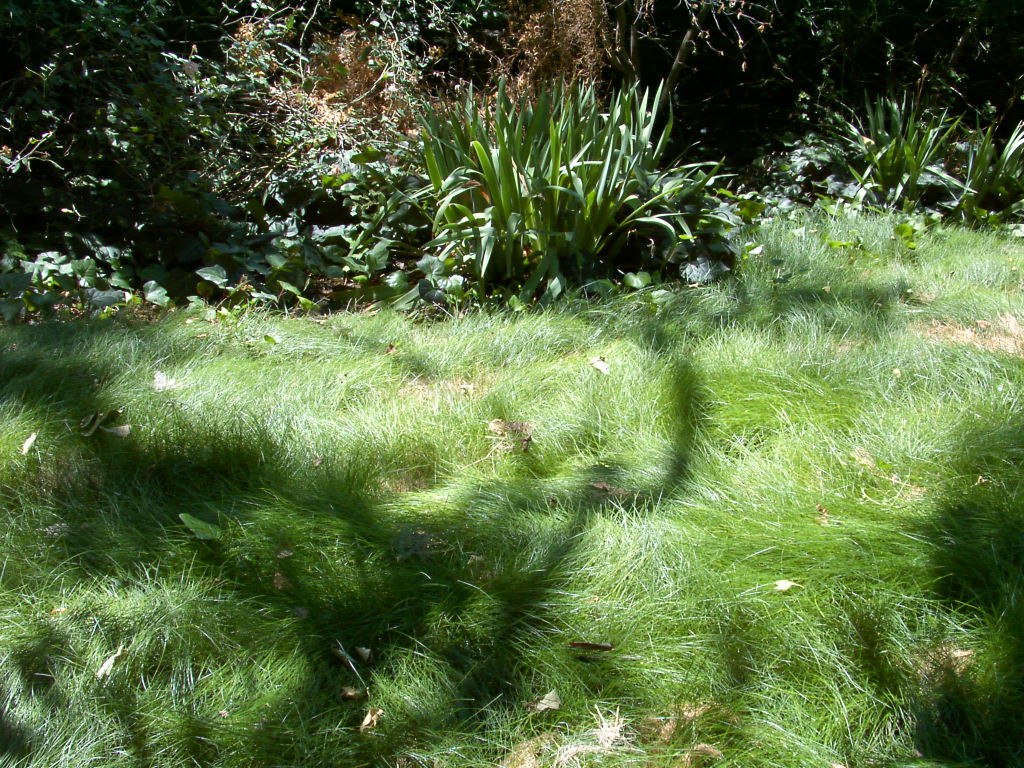
Here creeping red fescue has been seeded pure in a shaded area and allowed to grow without mowing, making a soft ground cover. Creeping red fescue is more tolerant of shade than most other lawn grasses.
The leaf blades of the fine fescues. The individual blades are rounder and much narrower than other grass species. You may already have these grasses in your lawn, as they are often added to seed blends for their shade tolerance.
Many ornamental grasses can be planted, preferably in groups or masses, on the edges of lawn areas to continue the visual effect. Most are much more drought tolerant than traditional turf species. Here is a specimen of Nassella tenuissima (formerly Stipa tenuissima), a fine-leaved ornamental grass.
c 2012 Redwood Barn Nursery
Saturday, July 7, 2012
Garden Questions in Early Summer!
Recently the USDA Plant Hardiness Zones were changed to reflect the warmer winters that have been observed in many parts of the country. No changes were made to California zones, because winter temperatures have not warmed in most parts of our state. The major changes have been observed in the southeastern U.S.
Western gardeners generally use Sunset Zones, not USDA zones. USDA zones only reflect winter low temperatures. Sunset Zones, created by the publishers of the Sunset Western Garden Book years ago, are much more detailed, showing the differences caused by local geography. Davis is in Sunset Zone 14: a hot interior climate with strong coastal influence (the delta breeze that we all appreciate so much on summer evenings). Woodland is in Sunset Zone 8: less coastal influence. For winter hardiness purposes, both are in USDA Zone 9.
So a recent comment in a gardening article in the Sacramento Bee got me curious. From the June 12 edition, in an article titled Gardening's Busy Season Starts With Understanding Climate, an author from the Bay Area is quoted, "Our weather is changing. I've lived in Alameda my whole life, and it's not the same climate I grew up with - it's hotter. We have to adapt. It's one more challenge for gardeners."
Well, the statistics don't actually show that for many parts of California, and particularly not for coastal areas such as Alameda. 30-year temperature data compiled by the National Climate Data Center shows average temperatures have dropped in California's coastal cities and areas such as Davis and Sacramento that have strong coastal influence, while temperatures have increased slightly in interior cities such as Fresno and Redding that don't have the delta breeze. Reasons? Perhaps the Pacific Decadal Oscillation, of which we are in a cool phase.
Bottom line: California gardeners needn't worry about reports of gardening zones changing. Your old books are still valid. Question from another plant pro: Thrips on roses. What is your experience and what would you recommend to a homeowner to manage the situation? They used the Bayer 3 in 1 product 10 days ago.
Thrips are tiny insects that feed on the tips of the rose buds before they open, causing the petals to distort and the flowers to open imperfectly. Pull back the petals and you will see fast-moving very skinny insects less than a quarter-inch long inside the bloom. Thrips in our area show up on flowers as the nearby grasses dry off in late spring and they move into our gardens looking for food; they are worse on light-colored roses than dark ones.
Spraying with anything is likely to delay the population increase of the natural predators. It isn't the answer the gardener wants, but it's the honest one. We all need to stop selling and using the combination products due to their environmental harm and unintended consequences.
Bayer 3 in 1 is a combination insecticide, miticide, and fungicide. The insecticide part is taken up into the plant and poisons the insect after it feeds. Since it has to feed first, and the feeding is what causes the damage, you still get the damage. It is one of the very worst combinations a gardener can apply with respect to harming bees. Combine tau-fluvalinate with tebucanazole and imidacloprid? Toxicity of the first ingredient to bees increases something like 1000-fold when combined with SBI fungicides such as tebucanazole. And the imidacloprid itself is known to be harmful to bees. So we have a gardener unnecessarily applying a miticide and a fungicide to a plant on which the only identified pest is an insect, and doing significant harm to bees and other beneficial insects with a product that will only marginally manage the thrips (if at all).
Neem sprays might help, since they could smother existing thrips and repel any new ones. Vigorous washing of the plant might help, and will reduce aphids and mites in any case. Ace hardware stores sell a hose-end pressure washer that is great for managing pests on garden plants. More to the point, thrips season will pass. Beneficial insects populations will catch up with the thrips, hot weather will reduce the reproductive rate of the pest, and your roses will be back to normal again.
Bottom line: there is no conventional pesticide, labeled for thrips or not, that gives good control on roses. The damage is done to the blossom before the pesticide takes effect, even if it works. Thrips populations develop resistance to pesticides very quickly. Some products have very adverse effects on beneficial insects. I know garden center professionals want to sell a solution to a problem, but often I find myself explaining that we don't have one. These problems tend to be seasonal and of short duration. A dwarf Butterfly bush? Wowzer!
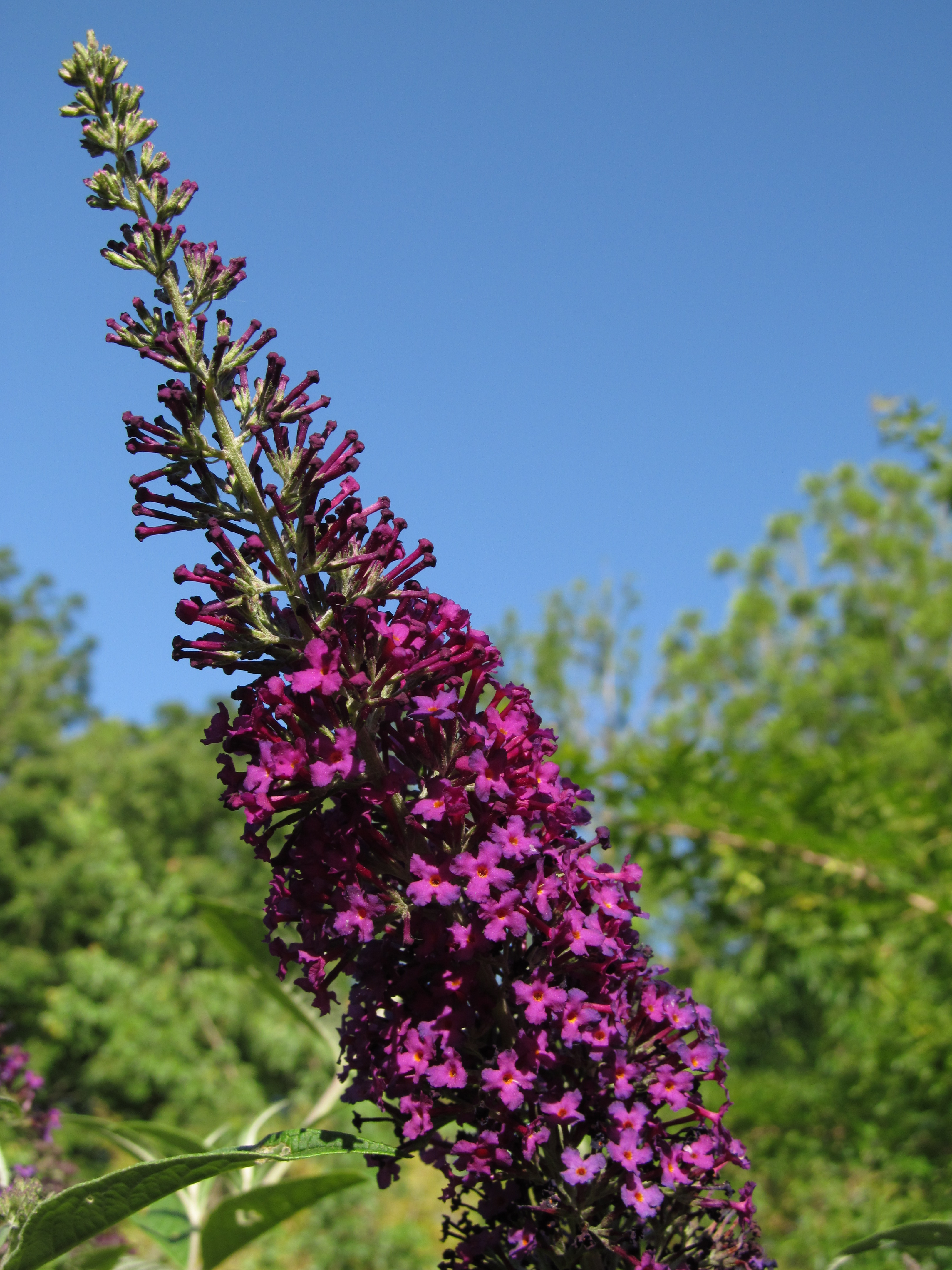
We appreciate your enthusiasm. Yes, breeders have achieved short, compact-growing Buddleias. Commonly called Butterfly bush, Buddleias have been long-time garden favorites for their long season of bloom, fragrance, attraction to hummingbirds as well as butterflies, and tolerance of heat and drought. But even the most compact types got to 5 to 6 feet tall, and the older ones were even taller and rangier.
Enter the Buzz Buddleias, and the Flutterbye Petite Buddleias. Little three-foot mounds of color, blooming non-stop from May through summer. Available in purple, lavender, pink, and white, these can be kept in containers or planted in the front of the border. Mix them with lavender, rosemary, rockrose, or other sun-loving low shrubs and perennials. My clematis came up and bloomed real nicely, and now it's set those seed things. How can I get it to bloom again? Do I have to cut those off?
That plant won't bloom again this season. Each clematis variety blooms for a few weeks. But there are varieties available for bloom at different times spring through mid-summer. The seedheads are interesting and sort of attractive; removing them is tedious, unnecessary, and won't yield any further bloom.
Clematis have a reputation for being fussy. They're not, really; they just like their roots in rich, loose soil that is shaded a bit, and they need regular watering. The tops are fine in full sun or partial shade. Once established, they can be very long-lived and carefree.
Most types put on vigorous growth in just a few weeks in the spring, then bloom, and then rest for the remainder of the season. So the key is to keep the root system healthy and vigorous to build up the plant for the next growing season. Fertilizing in late summer with an organic plant food will help make a more robust plant the following year.
I bought some moss ground cover and planted it in the shade, and it isn't doing well. Looks like it's dying. Is it not getting enough water?
Wrong plant, wrong place. Or if you prefer: misleading common name. Irish moss and Scottish moss (varieties of Sagina subulata) are actually not mosses at all. They are in the carnation family and prefer full sun and slightly dry conditions. For a soft green look in moist shade, try Baby's tears (Helxine soleirolii). My tree in my lawn has never grown as well as the others. Should I feed it? Why do you recommend keeping grass clear away from trees?
Grass roots compete significantly with tree roots! Trees planted with grass growing up to their trunks grow as much as 30% more slowly than those with the grass cleared. Feeding trees in the lawn is very difficult because grass roots are very efficient at 'stealing' nitrogen. You end up feeding the grass, not the tree. Clear the grass from an area at least 3 to 4 foot diameter around each tree. Then you can fertilize a young tree, using an organic source of nitrogen in spring and/or fall. Established trees need no feeding unless they show specific deficiency symptoms.
Trees in grass are also vulnerable to damage from power equipment such as mowers and especially weed trimmers. Repeated damage harms the water and food conducting part of the tree (the cambium) and stunts it, and creates an avenue for disease to enter. Finally, grass or mulch up against the stem of any plant traps moisture, inviting crown rot fungus. Trees and grass don't mix!
For further reading:
To check out the new hardiness zone map, visit http://planthardiness.ars.usda.gov/PHZMWeb/ Want to see the differences from 1990 to 2006? For an interactive map, visit: http://www.arborday.org/media/mapchanges.cfm Article about climate data: http://www.sacbee.com/2012/06/16/4557398/gardenings-busy-season-starts.html#storylink=cpy For more on pesticide interactions: http://www.extension.org/pages/61004/miticide-and-fungicide-interactions